.svg)
.svg)
UAE Dirham Inflation: Causes, Impact, and Smart Investment Approaches
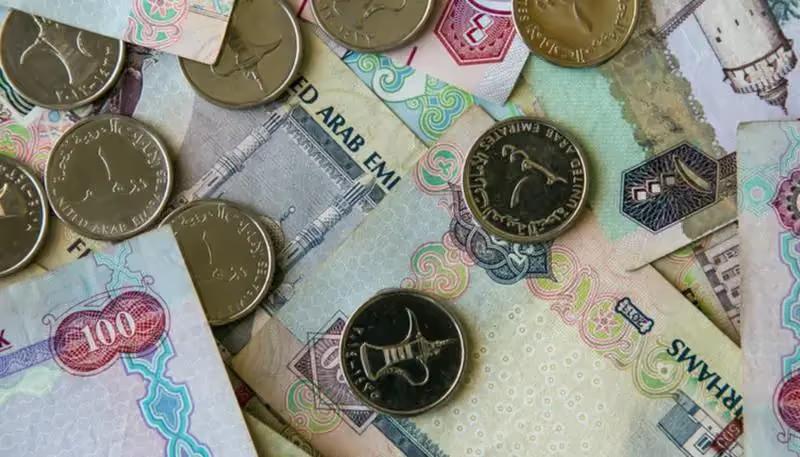
If you are living in Dubai in your first years as a migrant, you have probably asked yourself this question: why are costs so high? Why does everything feel so expensive? A city that appears advanced in terms of infrastructure, economic stability, and financial security does not seem, at first glance, to show signs of severe inflation. Especially if you have moved to the UAE from countries such as Iran, Afghanistan, or Pakistan, your understanding of inflation is likely connected to currency crises and daily price jumps. Many migrants arrive in Dubai believing they are leaving inflation behind.
But the reality is that Dubai is also dealing with inflation—not the kind you may have experienced before, and not in the way you might define it in your mind.
The truth is that the cost of living in the UAE, from rent to education and services, has been gradually rising in recent years. The nature of inflation in the UAE is different from countries facing financial instability. You do not witness daily price surges, yet even gradual and controlled increases can affect your purchasing power and investment decisions over the long term.
The UAE is a trade- and investment-driven economy. Therefore, if you intend to build a career or make long-term investments here, you need a clear understanding of how inflation works and how it can influence your financial planning. You must understand how inflation may impact your long-term investments and overall financial life. In this article, we explore exactly that.
Inflation exists in every economy, and the UAE is no exception. Although the dirham is pegged to the US dollar and the country enjoys considerable currency stability, this does not mean inflation is absent. In recent years, many residents of the UAE, particularly migrants, have experienced a gradual increase in living costs. These increases may not be sudden or shocking, but over time they influence household budgets and financial planning. This type of rising cost environment has made it more difficult for many migrants to build meaningful savings throughout the year.
Inflation in the UAE is primarily reflected in the gradual rise of prices in areas such as housing, education, services, and imported goods. This type of inflation differs from currency crises or financial instability seen in some other countries. However, even moderate inflation, if not factored into investment calculations, can reduce real returns over the long term.
For migrants who arrive with around $100,000 in capital and intend to build their financial future in the UAE, understanding how inflation works and how it affects investment decisions is essential. This article aims to clearly examine what drives inflation in the UAE, how it impacts purchasing power and investment returns, and what approaches can help manage capital more effectively in such an environment.
What Drives Inflation in the UAE?
Inflation in the UAE is largely the result of the country’s economic structure and its deep connection to the global economy, rather than financial instability or monetary crises like those seen in some neighboring countries in the Middle East. To better understand this, we must examine the main factors influencing price levels and why inflation occurs in the UAE and Dubai.
Dirham Peg to the US Dollar and the Transmission of US Monetary Policy
The UAE economy is closely linked to the United States. This connection is both a strength and, at times, a limitation. The peg to the US dollar provides currency stability and reduces sharp volatility, but it also ties the UAE to US monetary policy. The Central Bank of the UAE explains that its Base Rate is aligned with the Federal Reserve’s Interest on Reserve Balances rate. This transmits US interest-rate changes into UAE financial conditions; it does not mean that UAE inflation automatically matches US inflation.
At the same time, a significant portion of consumer goods in the UAE are imported from neighboring countries and global markets. When global prices rise, those increases gradually appear in the domestic market as well. This is one of the main sources of what can be described as imported inflation in the UAE.
The Real Estate Market and Rising Rent
If you have recently moved to Dubai, renting is likely one of your first living arrangements. It is important to understand that inflation can affect rental prices over time and directly influence your financial stability.
One of the most tangible drivers of rising living costs in the UAE is the real estate market. In cities such as Dubai and Abu Dhabi, population growth, the arrival of international companies, and increasing investment demand have placed upward pressure on both property purchase prices and rental rates.
Higher rent directly impacts the monthly budgets of migrants. Even if official inflation indicators remain relatively moderate, rising housing costs can intensify the feeling that everything is becoming more expensive. The CBUAE’s September 2025 Quarterly Economic Review discusses persistent housing and services price pressures alongside easing costs in other categories.
Population Growth and Rising Demand in Services
The UAE continues to be a major destination for skilled professionals and foreign investors. Transparent financial regulations and a favorable tax environment make the country increasingly attractive. As population and economic activity expand, demand grows in sectors such as education, healthcare, retail, and tourism.
When demand grows faster than supply, gradual price increases are natural.
Dependence on the Global Economy and Supply Chains
Although the UAE is a major exporter of oil and fossil fuels, it remains deeply integrated into global trade. Fluctuations in commodity prices, higher transportation costs, or disruptions in global supply chains can indirectly influence domestic prices.
For this reason, inflation in the UAE should be understood as part of global economic cycles rather than a purely domestic issue.
How Does Inflation Affect Investors in the UAE?
Inflation in the UAE may not be severe or resemble the experience you associate with inflation, but even moderate inflation rates influence long-term financial decisions. For a migrant entering the country with around $100,000 in capital or even slightly more or less, ignoring inflation can reduce real investment returns over time.
Gradual Erosion of Purchasing Power
The most direct effect of inflation is the gradual erosion of purchasing power. If part of your capital is held in cash without generating returns, its real value declines over time. In a hypothetical example, an annual inflation rate of 3–4% can significantly reduce real capital value over five to ten years; this is an illustration, not a forecast for the UAE. Assets intended to help offset inflation should be assessed alongside risk, liquidity needs, and the need for accessible emergency cash.
For this reason, keeping large amounts of cash long-term without an investment plan may appear conservative, but in reality it can be costly. On the other hand, a suitable asset mix may help manage inflation risk, but no portfolio is guaranteed to preserve purchasing power or generate gains.
The Impact of Interest Rates on Financing Costs
Because interest rates in the UAE generally move in line with US monetary policy, increases in interest rates can raise mortgage costs or the cost of financing a business. This directly affects decisions regarding property purchases or business expansion.
For example, a Federal Reserve policy-rate change can affect UAE borrowing conditions through the dirham peg. A change in Federal Reserve leadership alone does not automatically change rates, and the effect on a borrower depends on the loan’s terms.
As a result, inflation and interest rate movements can change investment costs and must be considered in financial planning.
Nominal Returns vs. Real Returns
In an inflationary environment, focusing solely on nominal returns can be misleading. In a hypothetical example, if an investment generates a 6% return while inflation is 4%, subtracting inflation gives an approximate real return of 2%. The exact calculation is (1.06 / 1.04) − 1, or approximately 1.92%, before fees and any applicable taxes.
Therefore, investors should always evaluate returns after adjusting for inflation to gain a clearer picture of actual wealth growth.
In a high-inflation economy, for example, a bank deposit can lose purchasing power when its after-fee and after-tax interest rate is lower than inflation. The outcome depends on the deposit rate, inflation rate, currency, and period rather than the country name alone.
The Growing Importance of Diversification
Inflation does not affect all asset classes equally. Some assets, such as real estate or equities, may perform well during certain inflationary periods, but they can also lose value. Fixed-rate instruments face purchasing-power risk, and bond prices can fall when interest rates rise; see Investor.gov’s explanation of bond risks.
Stagflation describes an economy facing inflation alongside weak growth; individual asset classes do not themselves experience stagflation. Therefore, the allocation strategy during inflation must be aligned with the level and nature of inflation.
For a $100,000 portfolio, concentrating entirely on a single asset class can be risky. Diversification may help manage concentration risk, but it cannot guarantee stable returns or protection against inflation. An appropriate mix should reflect your goals, time horizon, and personal investment strategy.
