.svg)
.svg)
The Economic Impact of U.S.–Iran Conflict on Middle East Markets
Introduction: The Economic Significance of U.S.–Iran Tensions
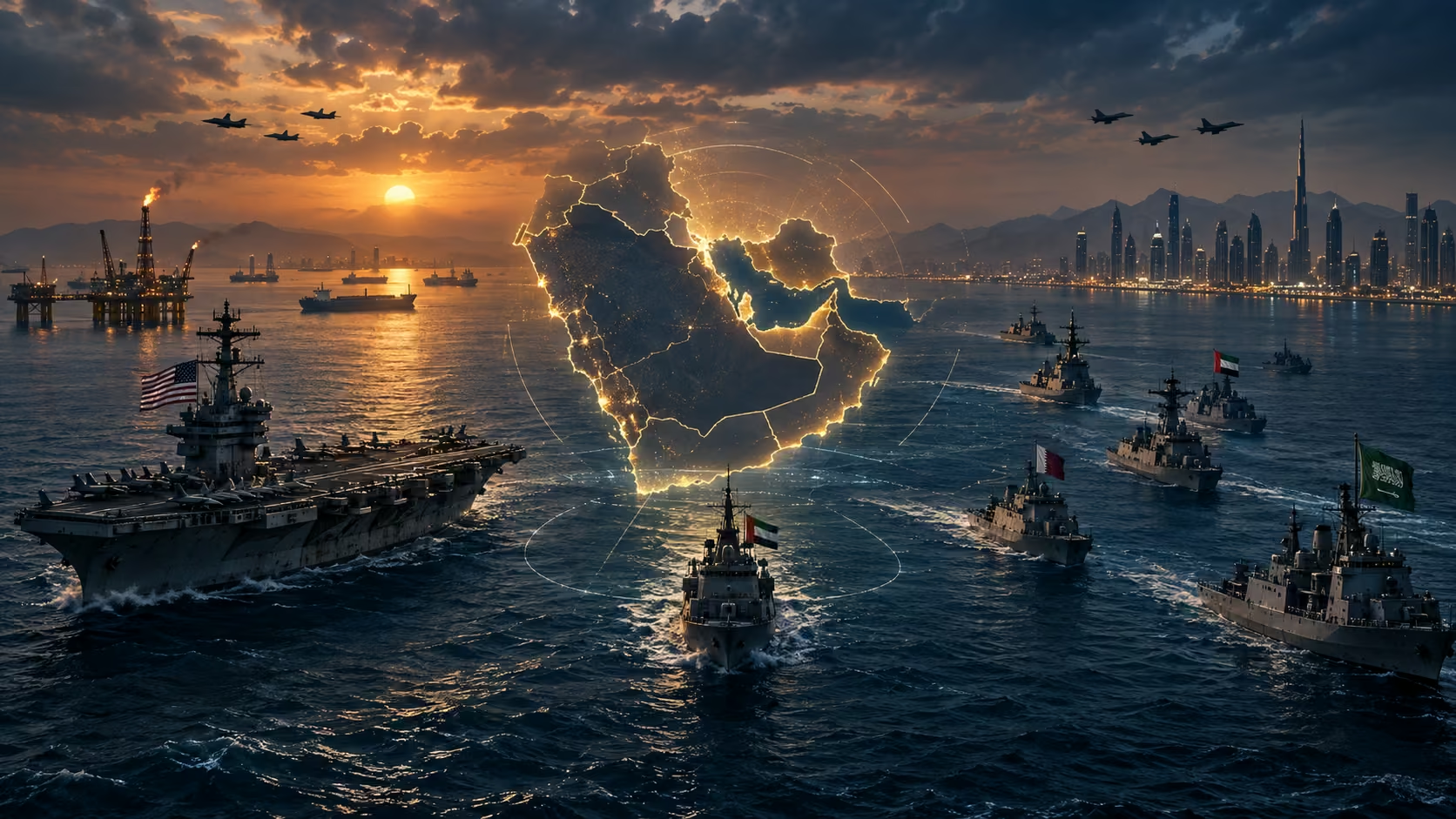
As of March 11, 2026, more than ten days had passed since the conflict between Iran and the United States escalated into open military confrontation. For years, economic and political tensions between the two countries had been building, shaped by sanctions, diplomatic disputes, and regional rivalries. With the return of President Trump to power, these tensions intensified and eventually turned into a direct conflict.
A large-scale war between two major geopolitical actors may appear unlikely in the modern world. However, in the Middle East, such scenarios are never entirely distant. The region has long been a focal point of geopolitical competition, energy resources, and strategic interests. As a result, conflicts that begin between two nations often extend beyond their borders and affect the broader regional environment.
Today, the consequences of this conflict are already visible across several parts of the Middle East. The tensions and instability associated with the war have begun to influence economic expectations, investor confidence, and regional financial markets. Countries across the Persian Gulf—including Iran, the United Arab Emirates, and Qatar—are closely connected through trade, energy markets, and financial flows. As a result, economic developments in one part of the region can quickly influence the broader Middle Eastern economy.
In this article, we examine the economic consequences of the ongoing conflict between Iran and the United States, with a particular focus on the Middle East. The analysis will explore how geopolitical instability may influence energy markets, regional economies, and international investment flows.
Finally, we will also discuss the potential risks and opportunities for investors during such periods of uncertainty. Although wars are never desirable, financial markets often react in complex ways to geopolitical events. In some cases, periods of instability may create investment opportunities that did not previously exist. Understanding both the risks and the emerging opportunities is therefore essential for investors navigating uncertain economic conditions.
The Strategic Importance of the Strait of Hormuz
In this section of the article, we focus on one of the most important strategic chokepoints in the global energy system: the Strait of Hormuz. This narrow waterway connects the Persian Gulf to the Gulf of Oman and ultimately to international waters. Despite its relatively small geographic size, it plays a critical role in global energy trade. A significant portion of the oil exported from the Persian Gulf passes through this route, making it one of the most vital oil transit corridors in the world.
According to the U.S. Energy Information Administration (EIA), roughly 20% of the world’s total petroleum consumption passes through the Strait of Hormuz. On average, about 20–21 million barrels of oil per day move through this narrow waterway, including crude oil and petroleum products exported from major producers such as Saudi Arabia, Iraq, the United Arab Emirates, Kuwait, and Iran. Because of this concentration of global energy flows, the strait is widely considered the most important oil transit chokepoint in the world.
A few months ago, when tensions between Iran and Israel escalated into a brief twelve-day conflict, one of the main concerns among analysts and global markets was the possibility that the Strait of Hormuz could be closed. Such a scenario was widely viewed as a major risk for global energy markets, with the potential to trigger a sharp surge in oil prices and disrupt global supply chains.
Today, in the context of heightened tensions between Iran and the United States, these concerns have once again returned to the forefront. Any disruption to shipping routes in this area would immediately affect the global energy market, as alternative routes for transporting such a large volume of oil are limited.
Within a short period of time, oil prices in global markets have already surpassed $100 per barrel, reflecting growing uncertainty and risk premiums in energy markets. Rising oil prices not only affect the cost of fuel but can also contribute to broader economic consequences, including higher inflation, increased transportation costs, and pressure on global supply chains.
For this reason, the Strait of Hormuz is not merely a geographic passage. It is one of the most critical energy chokepoints of the global economy. Any disruption to its security or functionality can have consequences that extend far beyond the Middle East, influencing financial markets, global trade, and economic stability across the world.
Oil Price Shock and Its Impact on the Middle East Economy
One of the first and most immediate economic consequences of geopolitical conflict in the Middle East is volatility in global oil prices. Because the region accounts for a significant share of global oil production and exports, any disruption in stability can quickly translate into higher energy prices in international markets.
In the current conflict environment, rising geopolitical risk has already pushed oil prices above $100 per barrel. Such increases are not unusual during periods of regional instability. Energy markets tend to price in risk premiums whenever supply routes, production facilities, or transportation infrastructure are perceived to be under threat.
For oil-exporting countries in the Middle East, higher oil prices may initially appear beneficial. Nations such as Saudi Arabia, the United Arab Emirates, Kuwait, and Qatar rely heavily on energy exports as a primary source of government revenue. When oil prices rise, these countries often experience stronger fiscal balances, higher export income, and increased foreign currency reserves.
However, the economic picture is more complex than it may appear at first glance. Prolonged geopolitical instability can also create uncertainty that discourages foreign investment and slows broader economic activity. For economies like the United Arab Emirates, which have worked extensively to diversify beyond oil through sectors such as tourism, finance, logistics, and technology, regional instability may negatively affect investor confidence and business sentiment.
Higher oil prices can also contribute to global inflation. When energy costs rise, transportation, manufacturing, and logistics expenses increase as well. This inflationary pressure can slow economic growth in many parts of the world and ultimately reduce global demand for energy over time.
As a result, while oil-exporting economies in the Middle East may experience short-term financial gains during periods of elevated energy prices, the long-term economic effects of conflict are often far more uncertain. Stability remains a key factor for sustained investment, economic diversification, and long-term regional growth.
Impact on Financial Markets and Investment Flows
Geopolitical conflicts rarely affect all asset classes in the same way. When uncertainty increases, capital tends to move across markets as investors reassess risk, liquidity, and long-term stability. Recent market data during the current geopolitical tensions show that major asset classes—including gold, oil, cryptocurrencies, and regional real estate—have reacted in very different ways.
Gold Market
Gold initially behaved as a traditional safe-haven asset during the early phase of the crisis, but its price movement has not been entirely linear. On January 26, 2026, gold reached a record high of approximately $5,110.50 per ounce, with spot prices trading around $5,077.22 on the same day. However, the market soon experienced sharp volatility.
According to market data, gold briefly recovered to around $5,120.71 on March 4, 2026, after falling more than 4% the previous day. Two days later, on March 6, 2026, gold climbed again to approximately $5,149.14 per ounce, although the metal still recorded a 2.4% weekly decline due to pressure from a stronger U.S. dollar and expectations of higher interest rates. By March 9, 2026, gold prices had slipped again to roughly $5,091.62, marking another 1.5% daily drop.
These movements illustrate that while gold remains an important defensive asset during geopolitical crises, its price can still be influenced by macroeconomic forces such as currency strength and monetary policy expectations.
Oil Market
Oil markets have reacted far more directly to the geopolitical escalation. Because the Middle East remains central to global energy supply, even the possibility of disruptions to oil exports can trigger immediate price spikes.
On March 8, 2026, Brent crude oil briefly surged to approximately $119.50 per barrel, while U.S. West Texas Intermediate (WTI) reached about $119.48 per barrel. Later the same day, prices partially retraced, with Brent falling to around $99.90 and WTI declining to roughly $95.40. The following day, on March 9, 2026, Brent was reported trading near $107.97, while WTI was around $106.22.
This pattern shows how geopolitical risk premiums quickly enter energy markets. In practical terms, the crisis pushed oil from sub-$100 levels to peaks near $120, before volatility returned as markets reassessed the likelihood of actual supply disruptions.
Cryptocurrency Market
Cryptocurrencies have behaved very differently from traditional safe-haven assets during this period. Rather than rising alongside geopolitical risk, Bitcoin experienced significant downward pressure in the initial phase of market stress.
On January 31, 2026, Bitcoin was trading at approximately $78,719. However, by February 5, 2026, the price had dropped sharply to around $63,295, representing one of the largest single-day declines in the crypto market since late 2022.
This rapid decline highlights an important point for investors: despite the narrative that Bitcoin functions as “digital gold,” the data from this crisis suggests that it has behaved more like a high-volatility risk asset rather than a traditional safe-haven investment. When global risk sentiment deteriorates, crypto markets often experience significant selling pressure before any recovery occurs.
UAE Real Estate Market
Unlike commodities or cryptocurrencies, the real estate market in the United Arab Emirates operates on longer investment cycles. Before the recent escalation in geopolitical tensions, the UAE property market—particularly in Dubai—had already been experiencing strong growth.
Market data indicate that Dubai property prices increased by approximately 60% between 2022 and early 2025. In the fourth quarter of 2025, residential property prices in Dubai were still growing at roughly 13% year-over-year, while Abu Dhabi recorded an even stronger 32% annual increase in certain segments.
Additional data show that the average residential price in Dubai reached about AED 1,689 per square foot in December 2025, representing an annual increase of nearly 19.8%. In Abu Dhabi, the latest reported average for Q3 2025 stood at approximately AED 1,005 per square foot, reflecting roughly 9% annual growth.
These numbers suggest that the UAE real estate market entered the current geopolitical environment from a position of strength. However, property markets are highly dependent on investor confidence and capital flows. If geopolitical tensions were to intensify or persist for a prolonged period, the primary risk would likely be a slowdown in new investment activity rather than an immediate collapse in property values.
Practical Implications for Investors
Taken together, the data across these asset classes highlight how different markets respond to geopolitical crises. Oil has benefited most directly from rising geopolitical risk, experiencing sharp price spikes driven by supply concerns. Gold has retained its role as a defensive asset but has shown significant volatility due to macroeconomic factors. Cryptocurrencies, particularly Bitcoin, have behaved more like risk assets during the initial phase of the crisis. Meanwhile, UAE real estate remains supported by strong structural demand but is more sensitive to long-term investor confidence than short-term geopolitical shocks.
For investors navigating such an environment, the key lesson is that crises do not produce a single “winning” asset. Instead, capital typically redistributes across different markets depending on risk tolerance, liquidity needs, and investment time horizons.
Investment Strategies During Geopolitical Conflict
Periods of geopolitical conflict tend to reshape financial markets in asymmetric ways. Some assets benefit directly from supply shocks, others attract capital because they are perceived as safe havens, and some experience selling pressure as investors reduce risk exposure. The current crisis in the Middle East provides a clear example of this divergence across asset classes.
Gold: Defensive Asset with Volatility
Gold once again attracted safe-haven demand as geopolitical tensions escalated, but its price movement has been far from linear. At the beginning of 2026, gold surged to a record level of roughly $5,110 per ounce on January 26, reflecting strong defensive demand from both institutional investors and central banks.
However, the rally quickly became more volatile. By early March, prices fluctuated between roughly $5,090 and $5,150 per ounce, with sharp daily movements driven by shifts in the U.S. dollar and expectations regarding global interest rates. In other words, gold maintained its defensive role, but macroeconomic forces prevented a sustained one-directional rally.
For investors, this behavior reinforces an important point: gold continues to function primarily as portfolio protection, not necessarily as a short-term speculative trade. Its main value lies in preserving capital during systemic shocks rather than generating rapid returns.
Oil: The Asset Most Directly Linked to the Conflict
Among major asset classes, oil has responded most dramatically to the conflict. Concerns about potential supply disruptions in the Middle East—particularly around the Strait of Hormuz—pushed energy markets sharply higher.
Brent crude surged to approximately $119.5 per barrel on March 8, while U.S. WTI briefly traded around $119.4 per barrel. These levels represented a significant spike compared with the sub-$100 levels seen earlier in the year. Within hours, however, prices partially retraced as markets reassessed the probability of actual supply disruptions.
This pattern highlights the nature of oil markets during geopolitical crises: prices can rise quickly when supply fears increase, but they can also reverse rapidly if those fears fade. As a result, energy markets tend to offer short-term tactical opportunities rather than stable long-term defensive positions.
Bitcoin and Cryptocurrencies: Risk Asset Behavior
The behavior of cryptocurrencies during the crisis offers a useful contrast to gold. Despite the popular narrative that Bitcoin functions as “digital gold,” market data suggest that it behaved more like a risk asset during the first phase of the conflict.
Bitcoin traded near $78,700 at the end of January 2026, but within a week it dropped to roughly $63,300, representing a decline of nearly 20%. This sharp sell-off occurred as global investors reduced exposure to volatile assets amid rising geopolitical uncertainty.
While the market later recovered part of the decline and Bitcoin returned to levels above $70,000, the initial reaction clearly showed that crypto markets remain highly sensitive to shifts in risk appetite. In practice, this means that cryptocurrencies can experience significant drawdowns during periods of geopolitical stress before recovering once broader market sentiment stabilizes.
UAE Real Estate: Structural Strength with Confidence Risk
Unlike commodities or digital assets, real estate markets react more slowly to geopolitical events. The UAE property market entered the current crisis from a position of considerable strength.
Between 2022 and early 2025, residential property prices in Dubai increased by roughly 60%, reflecting strong population growth, international capital inflows, and a robust economic environment. By late 2025, average residential prices in Dubai had reached approximately AED 1,689 per square foot, representing nearly 20% annual growth. Abu Dhabi also experienced solid price appreciation, with residential prices increasing roughly 9% year-on-year.
However, real estate markets are highly sensitive to investor confidence. If geopolitical tensions persist or escalate, the most immediate impact is unlikely to be a sharp fall in property prices. Instead, the first signs of stress usually appear in transaction volumes, delayed purchases, and slower inflows of foreign capital.
For long-term investors, this distinction is important. Structural drivers such as migration, infrastructure investment, and economic diversification continue to support UAE property markets. Yet short-term uncertainty may temporarily reduce investment momentum.
The Role of the U.S. Dollar and Liquidity
Another notable development during the crisis has been the renewed strength of the U.S. dollar. In periods of global uncertainty, international capital frequently flows toward dollar-denominated assets because of the currency’s role in global trade and financial markets.
At the same time, government bond markets have shown mixed performance. Rising inflation expectations and concerns about government borrowing have limited the traditional safe-haven rally that bonds often experience during crises.
As a result, many investors have responded by increasing liquidity and short-term dollar exposure, allowing them to remain flexible while markets reassess geopolitical risks.
Practical Allocation Logic for Investors
Taken together, the data from the current crisis suggest a diversified approach rather than a single “safe” investment.
Gold remains useful as a defensive allocation that protects purchasing power during systemic shocks. Oil and energy assets can benefit from geopolitical supply risks but are highly volatile and best approached tactically. Cryptocurrencies continue to behave as high-risk assets that can fall sharply when market sentiment deteriorates. Meanwhile, UAE real estate remains supported by strong structural fundamentals but depends heavily on long-term investor confidence.
For investors navigating such environments, the most effective strategy is often to divide capital into three functional categories: defensive capital, opportunity capital, and long-term strategic investments. Defensive capital focuses on stability and liquidity, opportunity capital seeks tactical gains in volatile markets such as energy, and long-term investments target structural growth sectors such as real estate or infrastructure.
In times of geopolitical uncertainty, this balance between protection, flexibility, and long-term positioning often proves more effective than concentrating capital in any single asset class.
Conclusion: Navigating Uncertainty in Middle East Markets
The recent escalation of tensions between Iran and the United States has once again highlighted how deeply geopolitical events can influence global financial markets. The Middle East remains one of the most strategically important regions in the global economy, particularly because of its central role in energy production and international trade routes.
As the analysis in this article has shown, the economic impact of such conflicts does not affect all assets equally. Energy markets reacted most directly, with oil prices rising sharply due to concerns about potential supply disruptions. Gold continued to play its traditional role as a defensive asset, although its price movements remained influenced by broader macroeconomic forces such as currency strength and interest rate expectations.
Other asset classes demonstrated different behavior. Cryptocurrencies showed significant volatility and behaved more like risk assets than traditional safe havens during the early phase of the crisis. Meanwhile, the real estate market in the United Arab Emirates entered this period of uncertainty from a position of structural strength, supported by strong demand and capital inflows in recent years.
For investors, the key lesson from this environment is the importance of balance and diversification. Periods of geopolitical instability rarely produce a single winning asset. Instead, they tend to reshape capital flows across markets, rewarding investors who maintain disciplined portfolios and manage risk effectively.
In uncertain times, the most resilient strategy is not to react impulsively to headlines, but to focus on long-term fundamentals, diversification, and careful capital allocation.