.svg)
.svg)
Why Oman Matters in the Middle East’s New Logistics Order
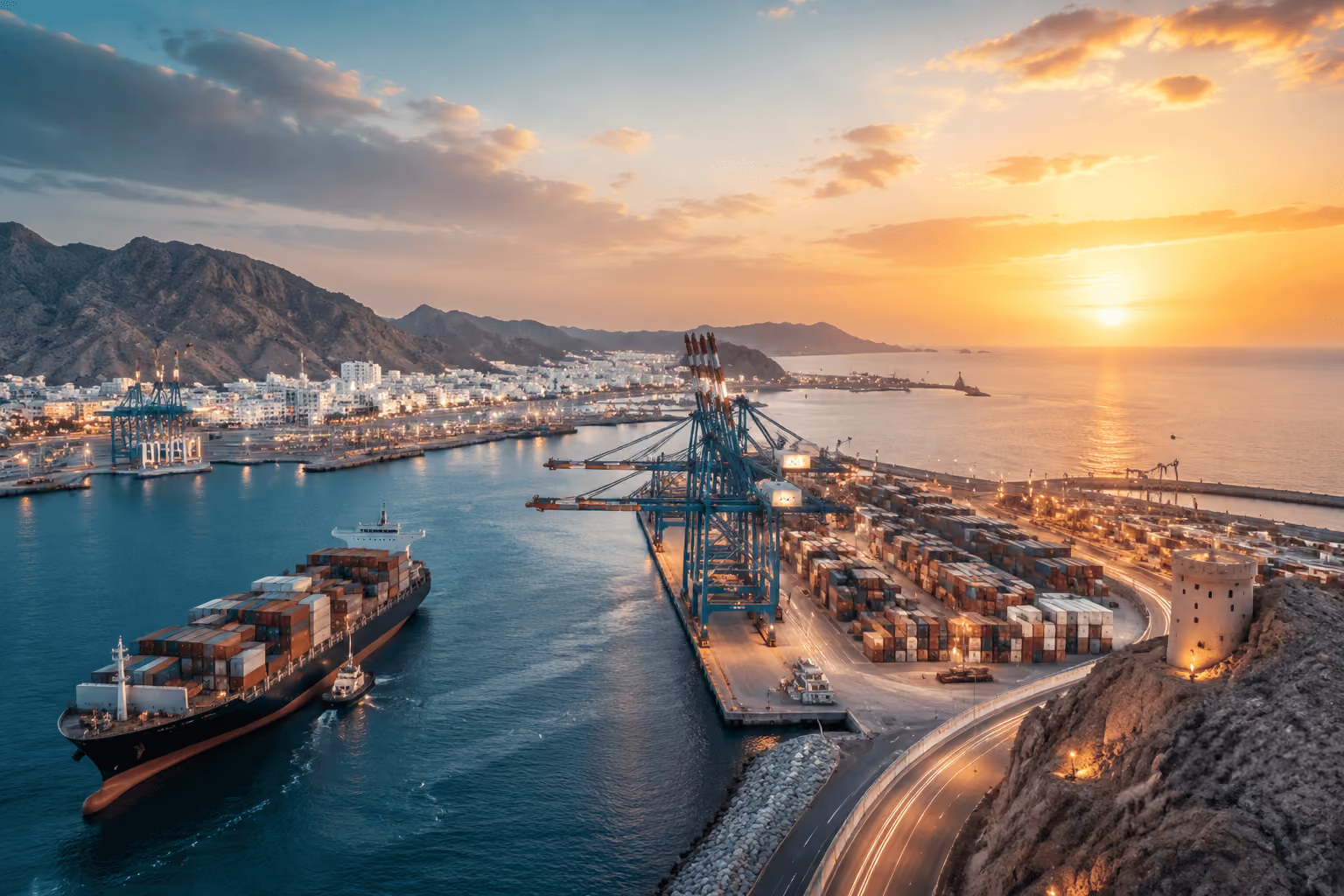
If one of the Middle East’s most important maritime routes were disrupted tomorrow, where would regional trade go?
Until just a few years ago, the answer to this question was of little importance. Companies were primarily looking for the shortest, fastest, and most cost-effective routes. But today, the equation has changed. Route security, access to alternative ports, and the level of dependence on maritime chokepoints have become just as important as transportation costs.
The Strait of Hormuz, the Bab el-Mandeb Strait, and the Suez Canal remain among the most important arteries of global trade, and any disruption to these routes can affect insurance costs, shipping times, and even the routes taken by vessels. As a result, shipping companies and cargo owners are redesigning their supply chains to avoid relying on a single route or port.
This shift is shaping a new logistics order in the Middle East—one in which Oman, thanks to its geographical position, direct access to the Arabian Sea and Indian Ocean, and diverse network of ports, could play a distinctive role.
But why Oman? And how can Salalah, Sohar, and Duqm transform the country from simply a maritime route into a critical node in the future trade network of the Middle East?
Why Is the Middle East’s Logistics Map Changing?
The Middle East’s trade map has always depended on a few key routes, but in recent years, it has become clear that this dependence can turn into a serious vulnerability. When a large share of trade passes through chokepoints such as the Strait of Hormuz, the Bab el-Mandeb Strait, and the Suez Canal, any disruption along one of these routes can have consequences far beyond a simple delay.
The increase in security risks in the Red Sea and around the Bab el-Mandeb Strait is a clear example of this shift. Vessel diversions, longer sailing distances, rising insurance costs, and extended delivery times have demonstrated that low transportation costs alone cannot make a route a reliable option.
As a result, major shipping companies and cargo owners are moving toward a different approach: diversifying supply routes and creating alternative options. Instead of relying on a single port or route as the backbone of a supply chain, a network of ports, roads, railways, and distribution centers is being developed so that, in the event of a disruption, trade flows can continue through an alternative route.
This shift is not limited to responding to current crises. Competition to control and develop new trade corridors, connect Asia with Europe, and expand multimodal transportation networks is also reshaping the position of countries on the region’s logistics map.
Under these circumstances, geography has once again become a strategic asset. A country that can access the major markets of the Gulf while also connecting to international routes without being fully dependent on a single maritime chokepoint has more opportunities to attract trade.
This is where Oman’s advantage goes beyond a simple geographical feature. The country is located along the Arabian Sea and has access to open waters through its southern and eastern ports, while at the same time remaining close to the Gulf markets and the commercial network of the Arabian Peninsula.
However, geography only becomes a logistics advantage when infrastructure is capable of capitalizing on it. In recent years, Oman has moved beyond relying on a single port and has developed a network of ports with different but complementary roles. This structure could be one of the key factors distinguishing Oman from the traditional logistics model in the region.
How Is Oman Turning Geography into a Logistics Advantage?
Oman’s advantage is not simply that it has several major ports. More importantly, these ports can play different roles within a multi-route supply chain. Rather than concentrating all of its logistics capacity in a single location, Oman is building a network in which Salalah, Sohar, and Duqm each serve a distinct purpose.
This distinction becomes particularly important when the goal is to reduce dependence on a single route. If one port focuses primarily on container handling and international trade, another can connect to the Gulf’s land-based network, while a third can support heavy industries, energy projects, and large-scale developments. The result is a system that creates multiple entry and exit points for trade rather than relying on a single gateway.
Salalah: Oman’s Gateway to East-West Trade
In southern Oman, the Port of Salalah is located near one of the major shipping routes connecting Asia, Africa, and Europe. This strategic location has allowed it to play a role that extends beyond simply serving Oman’s domestic import and export needs.
One of Salalah’s most important capabilities is transshipment. Under this model, the cargo does not necessarily have Salalah as its final destination. A large vessel can unload its cargo at the port, after which the goods can be transferred onto smaller vessels and shipped to markets in East Africa, the Arabian Peninsula, or other regional destinations.
This model allows Salalah to generate revenue from its position along international trade routes rather than depending primarily on the size of Oman’s domestic market. The port can function as a distribution point, where cargo flows in from major international routes and is then divided among several different markets.
Of course, Salalah is not completely insulated from regional risks. Ships seeking to reach Europe via the Red Sea and the Suez Canal still have to pass through the Bab el-Mandeb Strait. However, as shipping companies reroute vessels around the Cape of Good Hope or adjust their services between India, East Africa, and Arab markets, Salalah’s location could become increasingly important—from bunkering and maritime services to route adjustments and cargo redistribution.
In the north of the country, however, a different logic is at work. While Salalah is more closely connected to east-west maritime trade, Sohar can serve as a bridge between Oman and the economic network of the Gulf.
Sohar: Where the Sea Connects to the Gulf’s Land-Based Network
The Port of Sohar is located in northern Oman, close to the markets of the UAE and the region’s industrial centers. A free zone and a range of metal, petrochemical, and logistics industries have developed around the port. As a result, Sohar is not simply a location for loading and unloading containers; it is part of a broader industrial and commercial ecosystem.
Cargo can enter Sohar, be stored in warehouses or processed at industrial facilities, and then be transported to regional markets by road or, in the future, by rail. This connection between the port, industry, and land transportation is what increases Sohar’s logistics value.
The Hafeet Rail project, the rail connection under construction between Sohar and the UAE network, is also important in this context. In April 2026, Hafeet Rail reported that the project had reached 40% completion. If this connection becomes operational, some of the cargo entering Oman by sea could reach the UAE through the rail network instead of continuing by truck, and from there gain access to the wider land transportation network of the Gulf countries.
This shift is economically significant. A port that only handles cargo primarily earns revenue from port services. But a port that handles, stores, processes, and then distributes cargo by road or rail participates in multiple stages of the value chain.
For this reason, Sohar could become one of the most important points connecting Oman to the region’s new logistics order. However, if Oman is to become more than just a transit route and attract major industrial and energy projects as well, another port takes on greater importance.
Duqm: Oman’s Industrial and Energy Arm
If Salalah can be seen as Oman’s gateway to maritime trade and Sohar as a bridge between Oman and the Gulf’s land-based network, Duqm plays more of a long-term industrial and logistics hub role.
Located on the Arabian Sea and outside the direct route of the Strait of Hormuz, Duqm has been developed from the outset with a different approach from the region’s older ports. The port, a special economic zone, heavy industries, a refinery, energy storage facilities, an airport, and ship repair and maintenance infrastructure are all being developed as part of a large integrated complex.
One of Duqm’s most important advantages is the vast amount of space available for large-scale projects. This allows Oman to attract industries that require extensive land, deep-water berths, and direct access to the sea—from refining and petrochemicals to energy storage, ship repair, equipment manufacturing, and clean-energy projects.
For example, heavy equipment required for an energy project can enter through the Port of Duqm, be processed or assembled within the economic zone, and then be shipped to other regional markets. Under this model, the port is not merely a point of entry for goods; part of the production process and value creation is brought into Oman.
For this reason, Duqm is not expected to replace ports such as Jebel Ali or even Salalah in the short term. Its role is different: to create a large-scale base for industries that could generate new flows of trade, energy, and transportation into Oman in the future.
This becomes even more significant when the energy transition is added to the equation. Oman is developing green hydrogen projects in Duqm and Salalah, including projects designed to produce hydrogen derivatives such as green ammonia for export. As a result, Omani ports may not simply handle oil and containers in the coming years; they could also become part of the infrastructure supporting the next generation of energy trade.
However, a modern logistics network is not limited to ports. Even the best port only creates real value when it can move cargo quickly and efficiently to its next destination. This is why the future of Oman’s logistics sector is closely tied to connectivity between maritime, road, rail, and air transportation.
From Port to Destination: Why Multimodal Connectivity Matters
One of the major changes in modern logistics is the shift from a “port-to-port” model toward multimodal transportation. Under this model, cargo can arrive by ship, be processed or stored at a logistics center, and then reach its final destination by rail, truck, or aircraft.
Oman is moving in the same direction.
The connection between Sohar and the UAE’s rail network could become one of the most important pieces of this puzzle. If this network is eventually integrated more extensively with the GCC’s land-based corridors, Oman could evolve from being simply a maritime destination into a point connecting maritime and land transportation.
Air freight is another component of this network. In May 2026, Asyad announced the operational readiness of the Muscat Airport Free Zone after completing Phase One infrastructure. Its integrated logistics focus could increase Oman’s capacity to handle time-sensitive cargo, ranging from pharmaceuticals and electronic components to e-commerce shipments.
Under such a structure, Oman’s advantage would no longer be limited to the number of ports or the depth of its berths. Its core advantage would be the ability to create a network in which maritime, road, rail, and air transportation are interconnected.
And this is exactly what the Middle East’s new logistics order requires: not a single large port, but a network capable of remaining resilient in the face of disruptions.
Asyad: When Logistics Goes Beyond the Port
Building a port, railway, or free zone on its own cannot turn a country into a logistics hub. What gives these infrastructure assets real value is the coordination between them and their connection to larger trade networks. This is where the role of the Asyad Group becomes important in Oman’s logistics strategy.
Oman has brought a significant portion of its logistics assets and services under the broader umbrella of the Asyad Group, coordinating everything from ports and free zones to shipping, land transportation, and supply chain services. Such a structure can allow customers to access different stages of cargo transportation as part of a more integrated supply chain, rather than having to manage each stage separately.
The importance of this model becomes even greater as Asyad looks beyond Oman’s borders. In June 2026, Asyad announced the acquisition of a controlling stake in key logistics platforms in Uzbekistan. The group said the transaction creates direct connectivity between Omani ports and Central Asian trade corridors linking the Middle East with China, Europe, and neighboring markets.
This shift carries an important message: Oman does not want to be merely a place where cargo is loaded and unloaded. The broader goal is to become part of the management of international trade corridors.
Under this model, the port is no longer simply the starting point of the supply chain. Cargo can enter through an Omani port, be processed and stored in free zones or logistics centers, then move through the land network to Gulf markets or connect through other routes to Central Asia and larger markets.
This is where Oman’s geographical advantage becomes a commercial advantage. Geography alone does not generate revenue. But when it is combined with ports, warehouses, industry, land transportation, customs services, and international networks, it can create a logistics value chain.
Another Advantage in Oman’s Logistics Map
Infrastructure is not the only factor determining the choice of a trade route. In a region where geopolitical risks can directly affect trade, stability and predictability also matter greatly.
Oman’s foreign policy emphasizes dialogue, balanced relations, and positive neutrality. The Omani Foreign Ministry describes dialogue and maintaining relations with regional partners as core principles. This approach can provide a relative advantage for a country seeking to position itself as a trade hub connecting multiple regions.
Of course, this advantage does not mean that Oman is immune to regional risks. No port in the Middle East operates entirely independently of the security developments around it. However, for companies looking to diversify their trade routes, having a relatively independent option with direct access to open waters can carry significant strategic value.
Ultimately, the key question is no longer simply whether Oman has suitable ports. The more important question is whether these infrastructure assets can operate quickly, affordably, reliably, and with sufficient connectivity for international companies to genuinely choose Oman as a major trade route.
The answer depends not only on Oman’s opportunities but also on the limitations that the country still faces.
Oman’s Challenges in Becoming a Regional Logistics Hub
Despite all the advantages Oman offers within the Middle East’s emerging logistics order, becoming a major regional trade hub will not be a straightforward process. Having modern ports and a favorable geographical position is only the first part of the equation, because international companies choose logistics routes based on a wide range of factors.
One of the most significant challenges is intense competition from powerful regional players. The UAE, with major ports such as Jebel Ali and Khalifa Port, has spent years establishing itself as one of the world’s leading trade and logistics centers. Saudi Arabia is also seeking to expand its role in regional trade through extensive investments in ports, industrial zones, and transportation corridors.
Under these circumstances, Oman cannot compete with these rivals by relying solely on its geographical position. Geography only becomes an economic advantage when it is supported by fast services, competitive costs, extensive shipping connections, efficient customs procedures, digital infrastructure, and strong land connectivity.
Another challenge is completing Oman’s domestic and regional transportation network. Some rail projects and land connections still require further development, and Oman’s long-term success will depend on ensuring that its ports are not merely entry and exit points for cargo but are connected to a broader network of production, distribution, and consumption centers.
At the same time, Oman’s domestic market is smaller than those of some of its neighboring countries. Therefore, Oman’s success will depend more on attracting international trade, re-exports, port-related industries, and value-added logistics services rather than relying primarily on domestic consumption.
In reality, the true value of logistics for Oman will emerge when cargo does not simply pass through the country but also generates economic activity within it. Warehousing, packaging, ship repair and maintenance, cargo processing, distribution centers, digital customs services, and energy-related industries can transfer a larger share of the value chain into Oman’s economy.
For this reason, the future of Oman’s logistics sector will not depend solely on the number of vessels entering its ports; it will depend on how much economic value is created within Oman.
If Oman can manage these challenges, the combination of its diverse ports, new transportation connections, and geopolitical position could turn the country into one of the important options in the future trade network of the Middle East.
But ultimately, what exactly will Oman’s role be in this emerging order? Is the country seeking to replace major hubs such as the UAE, or is it pursuing a different path?
Conclusion: Oman’s Future in the Middle East’s New Logistics Order
Oman’s role in the Middle East’s new logistics order should not be defined by a race to build the “largest port in the region.” Oman’s path to success is likely to be different. Rather than concentrating its logistics capacity in a single location, the country is seeking to build a flexible, multi-hub logistics network.
Within this network, each component has a distinct role. Salalah serves as a gateway to east-west maritime routes and an important transshipment hub. Sohar can act as a link between Oman’s maritime trade and the Gulf’s land-based network. Duqm, with its focus on heavy industries, energy, and future projects, can serve as a long-term industrial and logistics base. Alongside these ports, the development of air transportation and fast logistics services in Muscat adds another layer to the supply chain.
This model offers an important advantage: if one trade route is disrupted, the entire system does not depend on a single point. In a world where supply chain security has become a major priority for international companies, having alternative options can become a significant economic advantage.
Therefore, Oman’s future importance lies not only in its geographical position, but also in its ability to transform that position into a functioning network of trade, industry, and transportation.
Oman is unlikely to replace major hubs such as the UAE in the short term. However, it can establish a different role within the new architecture of regional trade—one focused on route security, logistics diversification, port-related industries, and connectivity between Asia, Africa, the Gulf, and Europe.
Ultimately, the new logistics order in the Middle East is no longer simply about finding the fastest or cheapest route. The future belongs to networks that can remain secure, diversified, and reliable. And in this transformation, Oman, thanks to the combination of its geography, infrastructure, and development strategy, is one of the countries that could capture a significant share of this emerging opportunity.