.svg)
.svg)
Qatar and U.S. LNG: How the Hormuz Crisis Changed Supply Security
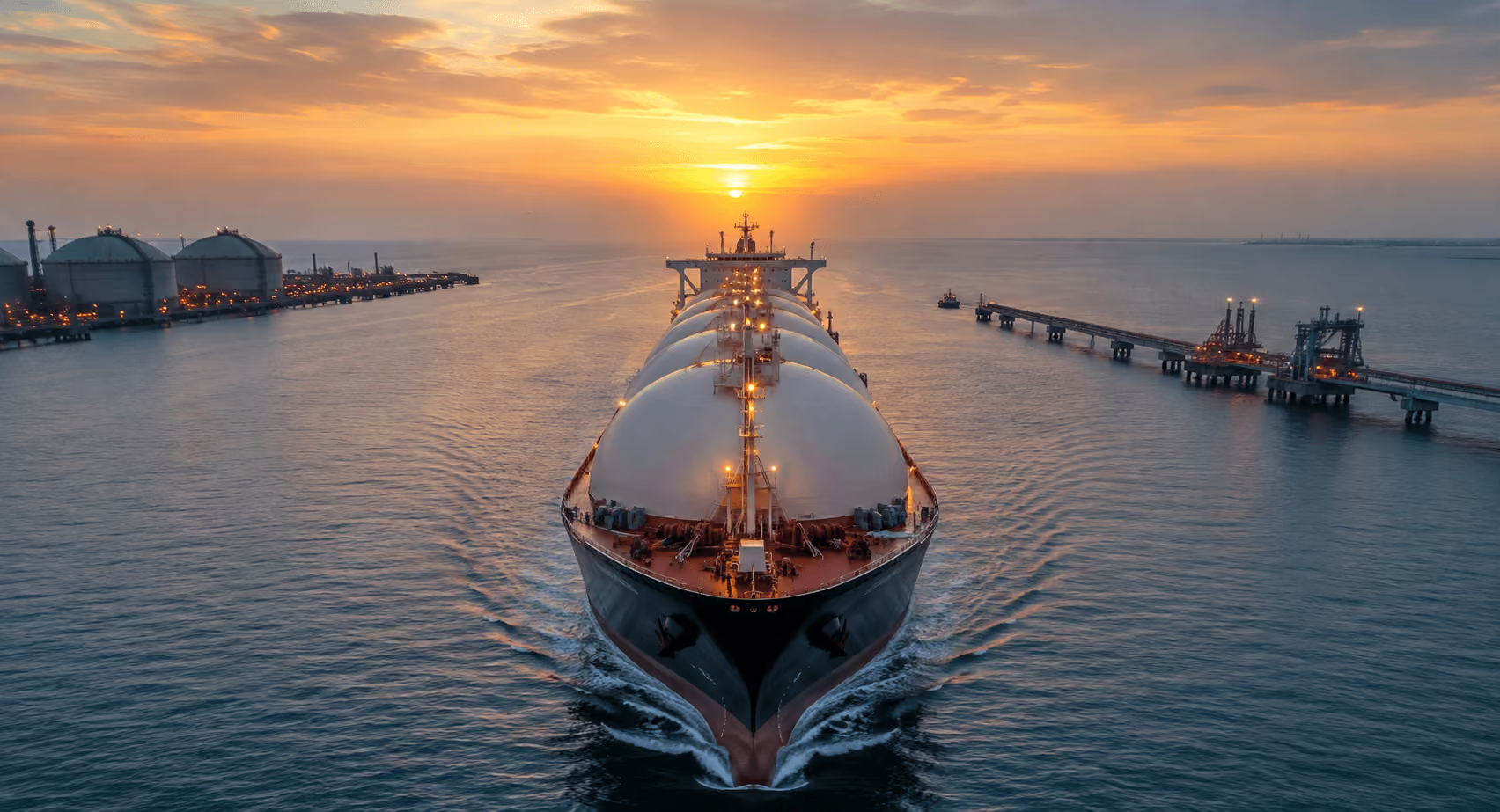
If one of the world’s largest LNG exporters turns to the United States for spot cargoes during a supply disruption, the important question is not whether Qatar has enough natural gas. It is whether that gas can reach customers reliably.
That distinction became unusually important in 2026. Disruptions linked to the Strait of Hormuz and damage to Qatar’s LNG infrastructure interrupted normal deliveries, forcing buyers and suppliers to search for alternative cargoes and routes.
On July 30, 2026, Reuters reported, citing four trade and industry sources, that QatarEnergy had bought 33 spot LNG cargoes from the United States during 2026 for customers in South Korea, Taiwan, Bangladesh, India, and Japan. Reuters calculated the cargoes were worth around $1 billion; Kpler data showed 28 had been delivered and five were still en route at the time of the report. QatarEnergy did not respond to Reuters’ requests for comment on the purchases.
The significance goes beyond 33 cargoes. The episode illustrates how geopolitical disruption can change the value of flexibility in the LNG market. A supplier may have large reserves and low production costs, but buyers also care about whether cargoes can move through the required shipping route when a crisis occurs.
That creates an opening for U.S. LNG. American export terminals do not depend on the Strait of Hormuz, and the United States entered 2026 as the world’s largest LNG exporter. The question is whether emergency demand for U.S. cargoes remains temporary or influences longer-term buyer behavior and contracting decisions.
Why Did Qatar Have to Buy LNG From the U.S.?
Qatar’s problem was not a shortage of natural gas reserves. It was a combination of disrupted export routes and damaged production infrastructure.
Historically, Qatar has been one of the largest LNG suppliers in the world. The QatarEnergy LNG overview describes a large expansion program designed to raise national LNG production capacity from 77 million tonnes per annum to 142 million tonnes per annum by the end of 2030.
But most Qatari LNG exports normally leave the Persian Gulf through the Strait of Hormuz. The U.S. Energy Information Administration (EIA) estimated that about one-fifth of global LNG trade passed through Hormuz in 2024, primarily from Qatar, and that 83% of the LNG moving through the strait went to Asian markets.
During the 2026 conflict, shipping through the strait was severely disrupted. Reuters reported that QatarEnergy declared force majeure on LNG shipments after Iran closed the waterway to shipping. Damage to two of Qatar’s liquefaction trains also reduced export capacity.
Under those conditions, QatarEnergy had two broad options: accept deeper disruption to customer deliveries or source replacement LNG from the international market. According to Reuters’ July 30 report, it bought 33 U.S. spot cargoes, compared with only four U.S. spot cargoes the previous year.
The purchase therefore should not be read as evidence that Qatar lacks gas. It demonstrates that supply reliability depends on transport routes, operational capacity, and access to flexible replacement cargoes as well as reserves.
India provides a clear example of the customer-side impact. On August 13, 2026, Reuters reported that Petronet LNG CEO A.K. Singh said there was still no definite schedule for receiving Qatari LNG in September. Force majeure had affected 56 of Petronet’s contracted Qatari cargoes, and Indian companies were sourcing replacement LNG from the United States, Oman, Nigeria, and Angola.
This is the central market lesson from the crisis: a long-term contract can secure volume and pricing terms, but physical delivery still depends on infrastructure and shipping access.
Why Could the Qatar Crisis Benefit U.S. LNG?
The United States has an important geographic advantage during a Hormuz disruption. U.S. LNG export terminals are located outside the Persian Gulf, so cargoes can reach Europe or Asia without passing through the strait.
The U.S. also entered the crisis with significant and expanding export capacity. In February 2026, the EIA said the United States was the world’s largest LNG exporter, ahead of Australia and Qatar. In April, the agency forecast U.S. LNG exports would average 17.0 billion cubic feet per day in 2026 and said disruptions through Hormuz were increasing demand for cargoes sourced outside the strait.
Company results show how this environment has coincided with strong U.S. LNG activity. On August 6, 2026, Reuters reported that Cheniere Energy exported 184 LNG cargoes during the second quarter, up 19.4% from a year earlier. Cheniere also raised its 2026 adjusted EBITDA forecast to $7.9 billion–$8.4 billion and said U.S. LNG deliveries to Asia reached a quarterly record of 11 million metric tons.
Venture Global has also benefited from strong demand and flexible sales. On August 11, 2026, Reuters reported that the company raised its 2026 adjusted EBITDA forecast to $8.7 billion–$9.1 billion. Management also said geopolitical conditions were increasing buyer interest in shorter-duration LNG contracts.
These results do not prove that the Hormuz crisis alone caused higher U.S. LNG earnings. Production growth, pricing, contract terms, plant utilization, and other market conditions also matter. But the crisis has increased the strategic value of export capacity that can serve buyers without depending on Hormuz.
For buyers, the value proposition is therefore not simply “American LNG is better.” It is that LNG sourced from a different geography can reduce dependence on one supplier region and one maritime chokepoint.
Can the U.S. Replace Qatar in the Global LNG Market?
A complete replacement of Qatar by the United States is neither necessary nor the most plausible interpretation of the current market.
Qatar remains a major LNG producer with large reserves, established infrastructure, a substantial shipping fleet, long-term customer relationships, and a major expansion program. Those structural advantages do not disappear because of one period of disruption.
The United States also has its own constraints. Export terminals require feedgas, liquefaction capacity, shipping availability, and commercial agreements. U.S. cargoes can also face longer voyages to some Asian destinations and may have different pricing structures from Qatari long-term contracts.
What can change is market share at the margin and the way buyers build their supply portfolios. A utility or importer does not have to abandon Qatar to reduce route risk. It can keep long-term Qatari volumes while adding U.S., Omani, Nigerian, Angolan, or other supply sources.
That distinction matters. The commercial opportunity for U.S. LNG is not limited to replacing every lost Qatari cargo. It can also come from becoming a larger complementary source within a diversified procurement strategy.
If buyers retain part of that diversification after Hormuz conditions normalize, the crisis could have a longer-lasting effect on LNG trade. If they return fully to previous procurement patterns, much of the U.S. gain could remain temporary.
Both outcomes are possible, which is why the current disruption should be treated as evidence of changing risk priorities rather than proof of a permanent transfer of market dominance.
How Could the Hormuz Crisis Change LNG Contracts?
The most durable effect of the crisis may appear in contract design rather than in the number of emergency cargoes purchased during 2026.
Traditional LNG procurement balances several variables: price, volume, destination flexibility, contract duration, indexation, credit quality, and reliability. A major route disruption adds another variable to that calculation: geographic delivery risk.
Before the crisis, Qatar’s low production costs, large reserves, and established long-term relationships made it an attractive supplier for Asian buyers. Those strengths remain. But the 2026 disruption has shown that even a strong producer can be constrained when a critical export corridor becomes unreliable.
This can increase the value of portfolio diversification. Buyers may decide that sourcing all required volumes from the lowest-cost supplier is less attractive if too much of their supply depends on the same route or region.
Shorter and more flexible contracts may also become more relevant. Venture Global’s management said in August that geopolitical conditions were encouraging greater interest in shorter-duration arrangements. That does not mean long-term contracts will disappear. They remain important for both project financing and buyer security. The more likely development is a mix of long-term base supply and a larger flexible component that can respond to disruptions.
For U.S. exporters, this creates a potential advantage because American LNG contracts and spot cargoes can provide geographic diversification from Persian Gulf supply. For Qatar, it creates an incentive to demonstrate recovery, resilience, and delivery reliability while continuing to expand production.
The competitive question is therefore broader than price. Buyers increasingly need to consider the probability that contracted gas can physically reach them under stressed conditions.
Who Is the Real Winner of the LNG Crisis?
It is tempting to describe the United States as the winner and Qatar as the loser. That framing is too simple.
U.S. exporters have gained from stronger demand for supply outside Hormuz, and the QatarEnergy purchases reported by Reuters are a striking example. Cheniere and Venture Global also reported strong operating or financial results during the period.
But Qatar remains a major LNG producer and is expanding capacity. A normalization of shipping and restoration of damaged production could restore much of its traditional competitive position.
The more durable winner may be flexibility itself.
Buyers that can source gas from multiple regions, maintain access to spot markets, hold adequate inventories, and use contracts with appropriate flexibility are better positioned when a supplier or route is disrupted. Suppliers with diversified production or marketing portfolios may have a similar advantage.
The 2026 experience has shown that energy security is not only about securing enough contracted volume. It is also about avoiding a structure in which too much of that volume depends on the same infrastructure or chokepoint.
For the United States, that lesson could support additional demand if buyers decide to keep a larger U.S. component in their portfolios. For Qatar, the same lesson could reinforce investment in resilience and the value of its international portfolio, including projects outside Qatar.
The Future of LNG: Has the Qatar Crisis Created a New Winner?
The Hormuz crisis has highlighted a simple but important distinction: having enough gas is not the same as being able to deliver it.
According to Reuters, QatarEnergy’s reported purchase of 33 U.S. LNG cargoes was roughly equivalent to one-third of a month of its pre-conflict exports and worth around $1 billion. That was an unusual response for a producer of Qatar’s scale, but it was also a practical way to support customers during disruption.
For the United States, the crisis has increased the strategic value of LNG capacity outside the Persian Gulf. EIA data show the U.S. was already the world’s largest LNG exporter before the crisis, and additional U.S. capacity was coming online in 2026.
Whether this produces a permanent change depends on buyer behavior after shipping conditions stabilize. If Asian and European importers continue to diversify suppliers and reserve a larger share of their portfolios for flexible U.S. cargoes, the crisis could strengthen the U.S. position over a longer period. If cost and established contracts again dominate procurement decisions, the market may move closer to its previous balance.
The most likely competitive framework is therefore not simply Qatar versus the United States. Both can remain major suppliers in a more diversified market.
The lasting question for LNG buyers is increasingly practical: when the next disruption occurs, which suppliers and routes can still deliver?
That question may be the most important legacy of the 2026 Hormuz crisis for global LNG trade.