.svg)
.svg)
Saudi Arabia and Nuclear Energy: How U.S. Technology Could Create a New Market
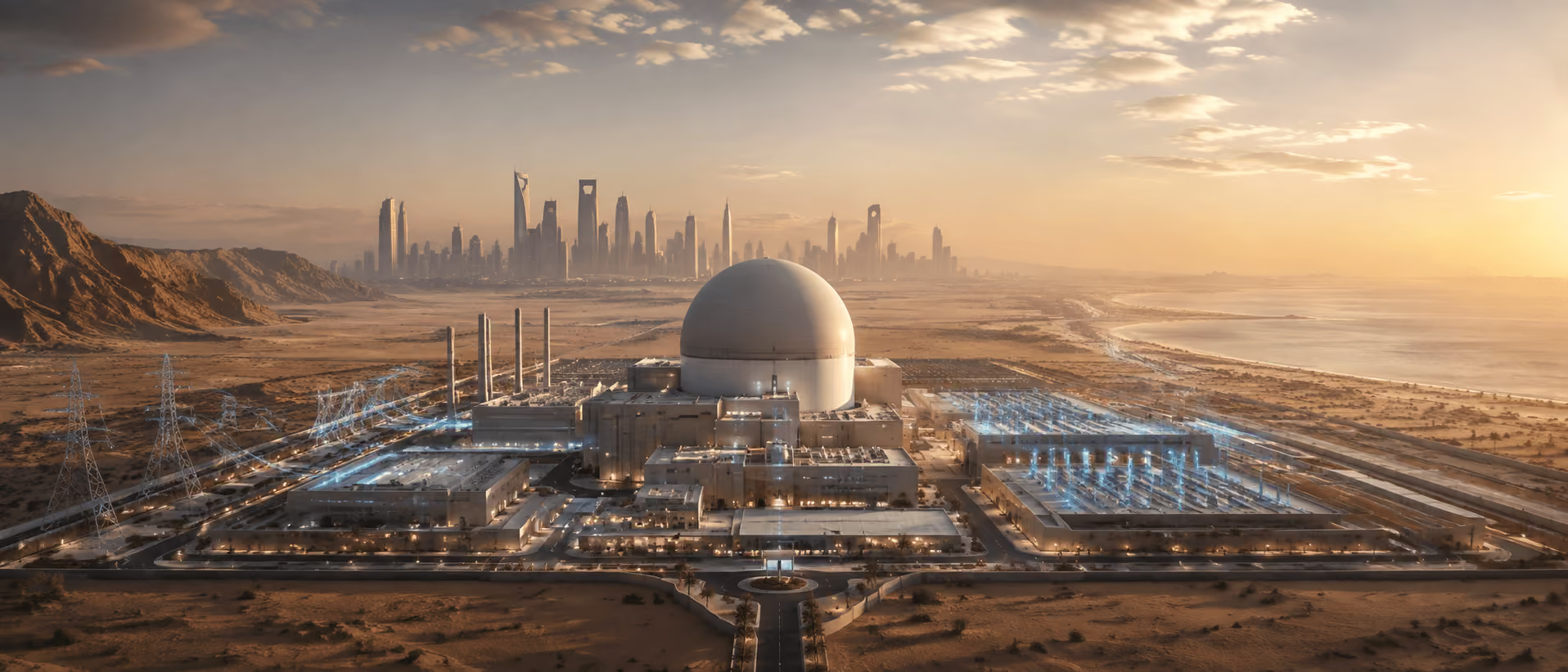
Saudi Arabia built its wealth on oil, but its long-term energy strategy is becoming broader than oil alone.
For decades, petroleum has been central to the kingdom’s economy, government revenue, and influence in global energy markets. At the same time, Saudi Arabia consumes oil and natural gas at home to meet rapidly growing electricity demand. According to the U.S. Energy Information Administration (EIA), natural gas supplied about 62% of Saudi electricity generation in 2023 and oil supplied about 38%, while renewables remained below 1%.
That creates a strategic question for Riyadh: as electricity demand expands with population growth, urban development, industry, and cooling needs, should more hydrocarbons be consumed in the domestic power system, or should a larger share of electricity come from other sources?
Nuclear energy is one part of Saudi Arabia’s answer. The kingdom’s official Saudi National Atomic Energy Project identifies reducing reliance on hydrocarbons and using petroleum for higher-value purposes and exports among the motivations for developing peaceful nuclear energy.
The commercial dimension became more important on July 22, 2026, when the United States and Saudi Arabia signed a peaceful nuclear cooperation agreement, commonly known as a Section 123 agreement, alongside a bilateral safeguards agreement. The U.S. Department of Energy (DOE) described the arrangement as the legal foundation for a decades-long, multibillion-dollar partnership and said it would expand access for American companies to Saudi Arabia’s nuclear program.
However, signing the agreement is not the same as completing every legal and commercial step. The DOE said the agreement would be transmitted to Congress for review, and the U.S. nuclear-cooperation process requires congressional review before an agreement can enter into force. Reactor awards, fuel-cycle projects, financing, licensing, and any sensitive technology cooperation would still require additional decisions and approvals.
This means the Saudi nuclear story is larger than a single reactor contract. It involves electricity diversification, potential demand for U.S. reactor technology and engineering, Saudi ambitions around uranium and the nuclear fuel cycle, and difficult questions about safeguards and nonproliferation.
Can U.S. technology help Saudi Arabia build a more diversified energy system while also creating a durable new market for American nuclear companies? The answer will depend on how the agreement moves through review and how Saudi Arabia ultimately structures its civil nuclear program.
Saudi Arabia Is Turning to Nuclear Energy to Reduce Its Dependence on Oil
Saudi Arabia’s energy challenge is not a lack of hydrocarbons. It is how to use them most efficiently as domestic electricity demand rises and the economy diversifies.
Oil still plays a material role in power generation, particularly during periods of high summer demand. Natural gas provides a larger share of Saudi electricity, but both fuels have alternative economic uses. Oil can be exported or refined into higher-value products, while gas can support industry, petrochemicals, and other domestic sectors.
For that reason, diversifying the electricity mix is both an energy-security issue and an economic decision. Solar and wind power are already part of Saudi Arabia’s diversification plans, while nuclear power offers a different characteristic: it can provide large volumes of firm electricity without depending on short-term weather conditions.
The objective is therefore not to replace oil with nuclear power overnight. A more realistic long-term model would combine natural gas, renewables, nuclear energy, and other technologies in a broader generation portfolio.
Saudi Arabia’s nuclear ambitions also extend beyond electricity generation. The official national program includes four broad components, including large nuclear power projects, smaller reactor technologies, development of parts of the nuclear fuel cycle, and regulatory capabilities.
The fuel-cycle component is particularly important. Saudi official material describes work across uranium exploration and mining, conversion, enrichment, and fuel manufacturing, while also emphasizing feasibility studies and localization opportunities. These are long-term ambitions rather than evidence that Saudi Arabia already operates a commercial enrichment industry.
If the kingdom proceeds with a large civil nuclear program, it would require more than reactors. It would need engineering, equipment, project management, fuel services, maintenance, training, safety systems, regulatory capacity, and long-term technical support. That is what makes the program potentially important to the U.S. nuclear industry.
What Does the U.S.-Saudi Nuclear Agreement Change?
The July 22, 2026 agreement creates the legal framework required for significant U.S.-Saudi civil nuclear cooperation under Section 123 of the U.S. Atomic Energy Act. It was signed by U.S. Energy Secretary Chris Wright and Saudi Energy Minister Prince Abdulaziz bin Salman together with a bilateral safeguards agreement.
The DOE said the agreement is intended to support a decades-long, multibillion-dollar partnership, expand American nuclear-technology exports, and provide U.S. companies with greater access to the Saudi nuclear-energy program.
For American suppliers, that matters because a national nuclear program creates demand across a wide supply chain. Reactor construction is only one part. Engineering, nuclear-grade components, control systems, fuel services, maintenance, training, cybersecurity, inspection, and specialized technical support can continue for decades.
But the agreement should not be described as if all of those projects have already been awarded. As of August 18, 2026, the agreement remains subject to the congressional review process. The signed framework can enable future cooperation, but individual commercial projects still depend on procurement decisions, financing, licensing, regulatory approvals, and project execution.
One potential beneficiary is Westinghouse. Reuters reported on July 22, 2026 that the broader U.S.-Saudi plan could involve Westinghouse AP1000 reactors and that potential reactor construction could be worth tens of billions of dollars. That remains a potential commercial opportunity, not a completed Saudi reactor award.
The agreement also matters because it addresses a more sensitive part of nuclear cooperation: the fuel cycle. Reuters reported that the framework creates a legal pathway for cooperation that could include uranium enrichment, while also noting that it does not oblige the United States to transfer enrichment capabilities or technology. Any actual enrichment project would require further study, approvals, safeguards, and commercial decisions.
That distinction is essential. A legal pathway is not the same as an operating enrichment facility, a technology-transfer commitment, or a final project authorization.
Why Is the U.S. Interested in Saudi Arabia’s Nuclear Program?
For Washington, Saudi Arabia’s nuclear program combines commercial, industrial, energy-security, and geopolitical interests.
The commercial opportunity is straightforward. A large Saudi program could create substantial demand for U.S. reactors, engineering services, components, fuel-related services, and long-term maintenance. The DOE has explicitly framed the agreement as a way to benefit American industry, workers, and supply chains.
The strategic dimension is equally important. Saudi Arabia has alternatives. Official Saudi project information has referenced engagement with potential nuclear suppliers or technology providers from the United States, Russia, France, South Korea, and China. Reuters has likewise noted that Riyadh could turn to other international partners if U.S. cooperation does not progress.
U.S. participation could therefore help American companies compete for a major infrastructure market while giving Washington a continuing role in the standards, safeguards, technology choices, and commercial relationships surrounding Saudi nuclear development.
For Riyadh, access to U.S. technology could broaden its supplier options and potentially connect the kingdom to an established reactor and services ecosystem. But Saudi Arabia’s stated interest in developing domestic capabilities means it is unlikely to view the program simply as a series of imported turnkey plants.
This is where uranium becomes central. Saudi Arabia has explored domestic uranium resources and has included localization of parts of the nuclear fuel cycle in its official long-term program. In January 2025, Reuters reported that Prince Abdulaziz bin Salman said the kingdom planned to monetize its mineral resources and discussed enrichment and yellowcake as part of that ambition.
If Saudi Arabia eventually develops more of the fuel cycle domestically, the potential market could extend into mining, conversion, fuel fabrication, specialized equipment, engineering, testing, and technical services. The scale and timing of that opportunity remain uncertain because the most sensitive parts of the fuel cycle require additional legal, regulatory, safeguards, and political decisions.
Uranium: The Hidden Part of Saudi Arabia’s Nuclear Ambition
If nuclear reactors are the most visible part of Saudi Arabia’s atomic-energy strategy, uranium and the fuel cycle may be the most sensitive.
A country does not need to mine, convert, enrich, and fabricate all of its own nuclear fuel to operate commercial nuclear power plants. Many nuclear-power countries buy fuel or fuel-cycle services from international suppliers.
Saudi Arabia, however, has expressed interest in developing more domestic capability. Its official nuclear fuel-cycle program covers uranium exploration and mining, conversion, enrichment, and fuel manufacturing, while emphasizing technical and economic feasibility studies and the localization of selected activities.
From an industrial-policy perspective, localization could allow the kingdom to retain more technical capability and economic value at home. From an energy-security perspective, it could reduce reliance on a single external supplier. But enrichment is also a dual-use technology: low-enriched uranium can fuel civilian reactors, while higher enrichment levels and related capabilities raise proliferation concerns.
This is why the U.S.-Saudi agreement has generated different assessments. The DOE says the agreement and bilateral safeguards arrangement advance high standards of nuclear safety, security, and nonproliferation. Reuters reported that the agreement does not require Saudi Arabia to adopt the same UAE-style renunciation of enrichment and reprocessing, and does not require the International Atomic Energy Agency (IAEA) Additional Protocol that some U.S. lawmakers and nonproliferation experts had advocated.
Those issues should not be simplified into a claim that the agreement automatically gives Saudi Arabia enrichment technology. Reuters reported that the framework creates a legal pathway for fuel-cycle cooperation, but does not compel the United States to transfer sensitive enrichment capabilities. Further technical studies and approvals would be required before any such project could proceed.
The commercial opportunity and the geopolitical sensitivity therefore grow together. The more Saudi Arabia localizes the fuel cycle, the broader the potential industrial market becomes—but the more important safeguards, oversight, licensing, and nonproliferation policy also become.
For investors or companies following the sector, the relevant question is not simply whether Saudi Arabia wants uranium-related capability. It is which parts of the fuel cycle are actually approved, financed, licensed, and contracted over time.
Which U.S. Companies Could Benefit from Saudi Arabia’s Nuclear Market?
The most visible potential U.S. beneficiary is Westinghouse, one of the major reactor-technology companies globally. Westinghouse’s AP1000 design has been discussed as a leading U.S. option for Saudi Arabia’s future large-reactor program.
Westinghouse is jointly owned by Cameco and Brookfield. Cameco’s acquisition announcement states that Cameco owns 49% of Westinghouse and Brookfield-related investors own the remaining 51%.
If Saudi Arabia ultimately selects AP1000 technology for multiple reactors, the opportunity would extend beyond reactor construction. Nuclear plants require long-term servicing, spare parts, engineering support, outage management, digital systems, fuel-related services, training, and other specialized capabilities over operating lives measured in decades.
However, Westinghouse should still be treated as a potential beneficiary rather than a confirmed winner. The 123 agreement creates a framework for U.S. participation; it is not itself a final reactor procurement contract.
The broader fuel-cycle industry could also benefit if Saudi Arabia proceeds with uranium, conversion, enrichment, or fuel-manufacturing projects. U.S. companies active in uranium mining, conversion, enrichment, fuel fabrication, nuclear engineering, and specialized equipment may find opportunities depending on how the Saudi program is structured.
Centrus Energy, for example, operates in the U.S. nuclear fuel and enrichment supply chain. But no specific Saudi contract for Centrus should be inferred from the cooperation agreement. Until a company is actually selected or discloses a project, it is more accurate to discuss the opportunity at the industry level rather than present individual firms as confirmed beneficiaries.
The same caution applies to the headline value of the market. Reuters has reported potential reactor construction worth tens of billions of dollars, while the DOE describes the partnership as multibillion-dollar and decades-long. Those figures describe the possible scale of a future program, not revenue already secured by U.S. companies.
Saudi Arabia’s supplier competition also remains open. China, Russia, France, South Korea, and the United States all have different reactor technologies, financing models, fuel arrangements, and strategic relationships. The ultimate commercial winners will depend on Saudi procurement decisions and the legal and regulatory conditions attached to each option.
What Does Saudi Nuclear Power Mean for the Oil Market?
Nuclear power could reduce the amount of oil and natural gas Saudi Arabia needs to burn for electricity over the long term, but the effect should not be overstated.
In 2023, EIA data show that oil still supplied about 38% of Saudi electricity generation, with natural gas supplying about 62%. The kingdom also experiences large seasonal increases in liquid-fuel use for power generation during periods of high summer demand.
If nuclear reactors eventually provide a meaningful share of electricity, some hydrocarbons that would otherwise have been consumed in power generation could be redirected to exports, refining, petrochemicals, or other higher-value uses. This logic is consistent with the official Saudi nuclear program’s stated goal of reducing reliance on hydrocarbons in electricity production.
But this would be a long-term effect. Large nuclear plants take years to license, finance, construct, commission, and integrate into an electricity system. Saudi Arabia is also expanding renewable energy and gas-fired generation, so the eventual change in oil consumption would depend on the whole power-sector mix rather than nuclear energy alone.
Nuclear power is therefore unlikely to transform the global oil market by itself. Oil prices will continue to depend on OPEC+ policy, global demand, inventories, production capacity, economic growth, and geopolitical developments.
The more relevant Saudi effect is strategic flexibility. Reducing domestic oil burn could give the kingdom more options in how it allocates crude between domestic use, exports, refining, and other industries.
This reinforces the broader point of the nuclear program: Riyadh is not trying simply to abandon oil. It is trying to make the overall energy system more diversified while preserving hydrocarbons for uses where they may create greater economic value.
Can Nuclear Energy Change the Future of Saudi Arabia’s Energy System?
Saudi Arabia’s nuclear strategy is best understood as one part of a wider energy transition, not as a direct replacement for the oil industry.
The kingdom wants to add new sources of electricity, reduce the role of direct hydrocarbon burning in power generation, and build domestic technical capability. Nuclear power could contribute firm generation alongside solar, wind, natural gas, storage, and other technologies.
The July 2026 U.S.-Saudi agreement could accelerate that strategy by creating a legal foundation for deeper U.S. participation and a potentially large market for American nuclear technology and services. But the agreement is still only one stage in a much longer process.
Congressional review, Saudi procurement decisions, financing, licensing, safety regulation, project economics, reactor selection, safeguards, fuel-cycle policy, and construction execution will all influence what is ultimately built.
The uranium question makes the outcome even more consequential. Saudi Arabia’s interest in domestic fuel-cycle capability could create additional industrial opportunities, but it also introduces nonproliferation and oversight questions that will remain central to U.S. and international scrutiny.
For American companies, the opportunity could extend from reactors to engineering, components, maintenance, fuel services, training, and selected parts of the nuclear supply chain. Yet none of these opportunities should be treated as guaranteed revenue before projects are awarded and implemented.
For Saudi Arabia, the strategic objective appears broader than generating nuclear electricity. It is to develop a more diversified energy system in which oil remains important but no longer carries the entire burden of economic and energy strategy.
If the program advances, the most important outcome may be a new relationship between Saudi hydrocarbons and other energy sources: nuclear and renewables supplying a larger share of domestic power, while oil and gas are allocated more selectively across exports, industry, and higher-value uses.
That would not end Saudi Arabia’s role as an oil power. It could instead change how the kingdom uses that role in a more diversified energy economy.