.svg)
.svg)
Why You Shouldn’t Keep All Your Money in Omani Banks
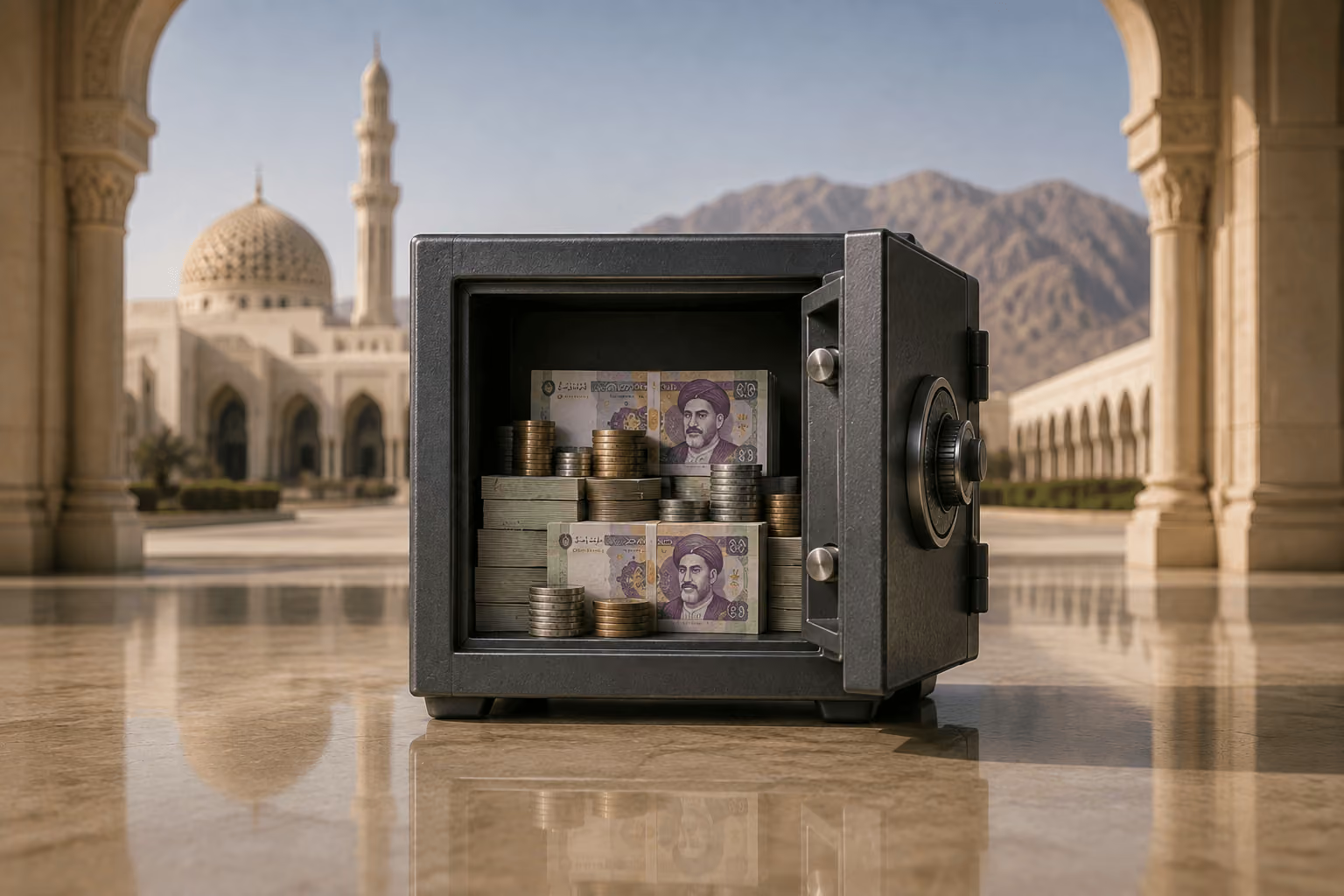
If all your savings are sitting in a bank account in Oman, you probably feel that your money is in one of the safest places possible.
But does keeping your money safe necessarily mean you are making the best use of your capital?
Not necessarily.
Deposit interest rates, inflation, purchasing power, and even the deposit insurance coverage limit are all factors you should consider before deciding to keep all your wealth in a bank.
The issue is not that banks are a bad place to keep your money. On the contrary, a bank can be an important part of a smart financial plan.
But the key question is:
Does it really make sense to keep all your money in a bank?
Is Keeping Your Money in an Omani Bank Really a Mistake?
No. A bank remains one of the safest and most practical options for holding part of your money.
A bank account is particularly important for everyday expenses, an emergency fund, and capital you may need in the short term.
The problem begins when all of your wealth is held in the bank.
In that situation, your money becomes almost entirely dependent on one source of return, one type of asset, and, if it is held with a single bank, one financial institution.
At the same time, the number you see in your bank balance does not necessarily represent a real increase in your wealth. If the interest rate on your deposit is lower than the growth in living costs and inflation, the purchasing power of your money can gradually decline.
So the question is not whether “banks are good or bad.”
The real question is how much of your money you should keep in the bank and what strategy you should have for the rest of your capital.
To answer that question, we first need to understand how bank interest in Oman actually affects the value of your money.
How Much Does Bank Interest in Oman Really Earn for Your Money?
Bank interest may look attractive at first, especially when you have a large amount of savings.
According to official Central Bank of Oman data, the average interest rate on rial-denominated time deposits held by the private sector was around 4.45% in May 2026. However, this is a market average, and the actual rate can vary depending on the bank and the type of deposit.
Now imagine you have OMR 100,000.
At an interest rate of 4.45%, the nominal annual return in this example would be approximately OMR 4,450.
But there is an important point to consider:
Bank interest alone does not tell you how much the purchasing power of your money has actually increased.
If the cost of goods and services also rises, part of that return will simply offset higher prices. For example, Oman’s annual inflation rate was reported at around 2.8% in June 2026 in the National Centre for Statistics and Information (NCSI) Consumer Price Inflation Report.
Therefore, when evaluating a bank deposit, you should not look only at the interest rate. The more important question is:
How much real return on my capital remains after accounting for inflation?
This difference between nominal interest and real wealth growth is one reason why, for larger amounts of capital, keeping all your money in a bank account may not be the best long-term strategy.
Does Keeping All Your Money in One Bank Carry Risk?
When it comes to bank savings, the first thing that usually comes to mind is security.
But financial security does not simply mean having your money in a bank account. If a large portion of your wealth is held with one bank, concentration risk also becomes important.
In Oman, the bank deposit insurance scheme provides protection for eligible deposits. However, the compensation limit is OMR 20,000 per depositor per bank. If an individual has deposits with several banks, the coverage limit is calculated separately for each bank.
This means that for someone with, for example, OMR 100,000 in savings, there is a significant difference between having money in banks and keeping all of that money in one bank.
Of course, this does not mean that amounts above OMR 20,000 would necessarily be lost if a bank failed. The Central Bank of Oman states that depositors with amounts exceeding the insurance limit may still have a legal claim to the remaining balance of their deposits. However, this process may take time.
So for larger amounts of capital, an important question arises:
Does it make sense to concentrate all your wealth in one bank, or even entirely in bank deposits?
This is where the concept of diversification becomes important in wealth management. Diversification can help reduce the risk of having your entire wealth dependent on a single option.
Why Does Investment Diversification Matter in Oman?
Imagine that all your wealth is held in a single bank account. Even if the bank is completely reputable, one question still remains:
Can one type of asset really meet all of your financial goals?
This is where the concept of investment diversification becomes important.
Interestingly, even Oman’s sovereign investment institution does not keep all of its capital in a single type of asset. The Oman Investment Authority (OIA) uses a range of assets across its portfolios, including equities, bonds, multi-asset funds, real estate, private investments, short-term assets, and bank deposits. It also allocates part of its investments to global markets.
The reason for this approach is simple:
Not all assets perform in the same way under different market conditions.
Therefore, diversification does not mean that you have to spread your money across dozens of different investments. The goal is to ensure that your entire wealth does not depend on the performance of a single bank, market, or type of asset.
For an individual, this diversification could involve a combination of cash, bank deposits, and long-term investments.
But the more important question is:
If we should not keep all our money in the bank, how much of our capital should remain there?
The answer depends on when you will need the money and what financial goal you have assigned to it.
How Much Money Should You Keep in the Bank?
There is no single number that works for everyone.
Someone who needs access to part of their savings every month is in a very different situation from someone who has set aside capital for the next five or ten years.
One practical approach is to start by dividing your money according to when you expect to need it.
Money You Will Need Soon
Everyday expenses, essential payments, and an emergency fund are generally better kept in liquid, low-risk assets. A bank account can be a suitable option for this portion of your money.
Money You Do Not Need Right Now
If a portion of your capital will not be needed for several years, you can consider other options that may complement bank deposits and potentially contribute to long-term capital growth.
However, this does not mean moving all your money into high-risk investments.
The goal is not to replace the bank. The goal is to build an appropriate balance between liquidity, security, and capital growth.
This becomes particularly important for larger amounts of capital because, even in Oman, deposit insurance coverage is capped at OMR 20,000 per depositor per member bank.
Therefore, as your wealth grows, deciding where and how to hold that wealth becomes increasingly important.
But if we move part of our money out of bank deposits, the next important question is:
What investment options in Oman can complement a bank account?
What Options Do You Have If You Do Not Keep All Your Money in the Bank?
When we talk about moving part of your money out of bank deposits, this does not necessarily mean turning to high-risk investments.
Oman’s financial market offers investors a range of options, from company shares and bonds to sukuk and investment fund units. The Muscat Stock Exchange also provides access to these instruments across different areas of the market.
Investment funds can also be worth considering for people who do not want to select individual assets themselves. According to Oman’s Financial Services Authority (FSA), investment funds pool money from different investors and invest it according to a specific strategy under professional management.
But there is one very important point to remember:
Just because something is called an “investment” does not mean it is necessarily suitable for your money.
Stocks can be volatile. Bonds and sukuk have their own conditions and risks, while investment funds can perform differently depending on their underlying assets and investment strategies.
That is why, before choosing any investment, you should first determine what your financial objective is, how long you can leave the money invested, and how much volatility you are comfortable with.
And this is exactly where another mistake can undermine the entire benefit of diversification: choosing an investment simply because it promises high returns.
Higher Returns Do Not Always Mean a Better Investment
Once we realize that keeping all our money in a bank is not the only option, we may be tempted to look for investments that promise higher returns.
But this is where we need to pause.
Higher potential returns generally come with higher risk, and no legitimate investment can guarantee high returns without risk.
In Oman, the financial market regulator, the Financial Services Authority (FSA), has also repeatedly warned about unlicensed investment platforms and companies and urged investors to verify the provider’s licensing status and credibility before transferring any money.
So if someone promises:
“High returns, fast profits, and zero risk,”
the statement should make you ask more questions rather than simply get excited.
Smart investing is not about chasing the highest possible return. It means evaluating return, risk, liquidity, and investment horizon together.
And perhaps most importantly, before deciding to move your money out of the bank, you need to understand what you are actually trying to achieve with that money.
Define the Purpose of Your Money Before Making Any Investment
Two people may each have OMR 50,000, yet the best financial decision for each of them could be completely different.
If one of them plans to buy a home next year, their need for liquidity is not the same as someone who is saving for the next 10 years.
That is why, before deciding whether to keep your money in the bank or invest part of it, ask yourself three simple questions:
- When will I need this money?
- How much risk can I tolerate if the value of my investment temporarily declines?
- Is my goal to preserve my wealth or grow my capital?
The answers to these three questions can completely change the direction of your financial decisions.
For money you may need soon, liquidity and security are more important. But for capital with a longer investment horizon, you may have more options to consider.
Even financial institutions do not manage capital with a single objective in mind. When managing its reserves, the Central Bank of Oman seeks to balance capital preservation, liquidity, and an appropriate combination of return and risk.
This is precisely the approach that individual investors can learn from:
Not every rial needs to serve the same purpose.
Part of your money should remain accessible, part can be set aside for financial security, and another portion—if appropriate—can be invested for long-term capital growth.
But one important question remains:
If we decide to invest part of our money, how can we determine whether an investment option is genuinely credible and suitable?
How to Choose a Suitable Investment Option in Oman
When you decide to move part of your money out of a bank deposit, the first temptation is often to look for the highest possible return.
But in wealth management, return is only one part of the decision.
A suitable investment option should be evaluated from at least four perspectives:
Risk, return, liquidity, and investment horizon.
An investment may offer high potential returns, but if you cannot quickly access your money when you need it, it may not be suitable for that portion of your capital.
On the other hand, an option with very low volatility may be appropriate for preserving liquidity, but it may not necessarily be the best choice for long-term capital growth.
That is why, before transferring your money, you should determine what role that capital plays in your overall financial plan.
In Oman, it is also important to verify the licensing and legal status of an investment service provider. The country’s capital-market regulator, the Financial Services Authority (FSA), has warned investors about unlicensed investment activities and suspicious financial offers.
So instead of simply asking:
“How much return does this investment offer?”
Ask more important questions:
- How much risk does it involve?
- When can the capital be withdrawn?
- Which institution provides or manages the investment?
- And most importantly:
- Does this option fit the overall objective of my investment portfolio?
This is where wealth management differs from randomly choosing an investment. The goal is not to find the “best investment,” but to build a combination of assets that aligns with your financial goals.
5 Common Money Management Mistakes in Oman
A poor financial decision does not always mean choosing a bad investment. Sometimes the problem begins with how your overall wealth is managed.
1. Keeping All Your Money in One Bank
If a large portion of your capital is held in a single bank, concentration risk increases.
In Oman, the current deposit insurance coverage is capped at OMR 20,000 per depositor per member bank. Therefore, for larger amounts of capital, how your money is structured and held becomes increasingly important.
2. Choosing an Investment Simply Because It Offers Higher Returns
Higher returns generally do not come without higher risk.
If an investment opportunity promises unusually high returns with no risk, you should verify the provider’s credibility and licensing before transferring any money.
Oman’s financial market regulator has also urged investors to verify investment offers through official sources and avoid unlicensed activities.
3. Forgetting About Liquidity
An asset may be attractive over the long term, but if it takes a significant amount of time to sell, it cannot replace your emergency cash.
For this reason, not all of your capital should be placed in assets that are difficult to access quickly.
4. Making Decisions Without Considering Your Investment Horizon
Money that you plan to use six months from now should not be managed in the same way as capital that you have set aside for the next 10 years.
Time is one of the most important factors determining which types of assets may be appropriate.
5. Trying to Find “The One Best Investment”
In wealth management, a single asset usually cannot simultaneously offer the highest liquidity, the lowest risk, and the highest return.
A better approach is to build a portfolio that reflects your financial goals, risk tolerance, and investment horizon.
Ultimately, managing money effectively in Oman is less about finding one specific place to put your money and more about building a balanced financial structure—one that can protect your capital while preserving opportunities for long-term growth.
So, Should You Keep All Your Money in an Omani Bank or Not?
The short answer is: For most people, putting all their capital into a single bank or a single type of asset is not an ideal approach to long-term wealth management.
Banks should still have a clear place in your financial plan, particularly for everyday expenses, emergency funds, and the portion of your capital where security and liquidity are the priorities.
However, for larger amounts of capital, simply keeping money in a bank account may mean missing other opportunities to manage risk and pursue long-term growth.
In Oman, eligible deposits are covered under the deposit insurance system up to OMR 20,000 per depositor per member bank. Amounts above this limit may still be subject to legal claims, but recovering them in the event of a bank liquidation can involve a legal and potentially time-consuming process.
Therefore, the right decision is not necessarily to “move your money out of the bank.” Instead, the better question is:
Which portion of my capital should remain liquid and low-risk, and which portion could be allocated to diversified assets for longer-term goals?
This is where wealth management becomes important.
A well-designed financial plan should balance security, liquidity, return, risk, and investment horizon rather than placing all of your capital into a single option.
Ultimately, the goal of wealth management is not to always achieve the highest possible return.
The goal is to manage your money in a way that matches the purpose you have for it.
Wealth Management: Beyond Keeping Money in the Bank
Money management becomes increasingly important as the amount of capital grows.
For a relatively small amount of savings, choosing an appropriate bank account may be all you need. But as your wealth increases, the questions also change:
- How much should remain liquid?
- How much should be kept in deposits?
- How can risk be distributed across different assets?
- And how can you plan for long-term capital growth?
This is where wealth management evolves from a simple decision about where to keep your money into a comprehensive financial strategy.
A professional approach to wealth management focuses not only on maximizing returns, but on creating a balance between capital preservation, liquidity, risk management, and long-term growth.
For investors in Oman, this becomes particularly important when their wealth grows beyond ordinary savings and financial decisions can have a significant impact on their future or their family’s financial security.
That is why perhaps the right question is no longer:
“Where should I put my money?”
The more important question is:
“How can I structure my capital so that my money remains accessible when I need it while also having the potential to work for me over the long term?”
This is where a coherent wealth management strategy can demonstrate its value.
Ultimately, a bank is one component of a financial portfolio—not necessarily the entire portfolio.
And that distinction can fundamentally change the way you think about saving and investing in Oman.