.svg)
.svg)
Can Oman Become Dubai’s New Rival in Trade and Logistics?

Dubai has long been one of the Middle East’s most important trade and logistics hubs. But now, Oman is entering the competition with a major advantage of its own: its geographic location and direct access to the ocean.
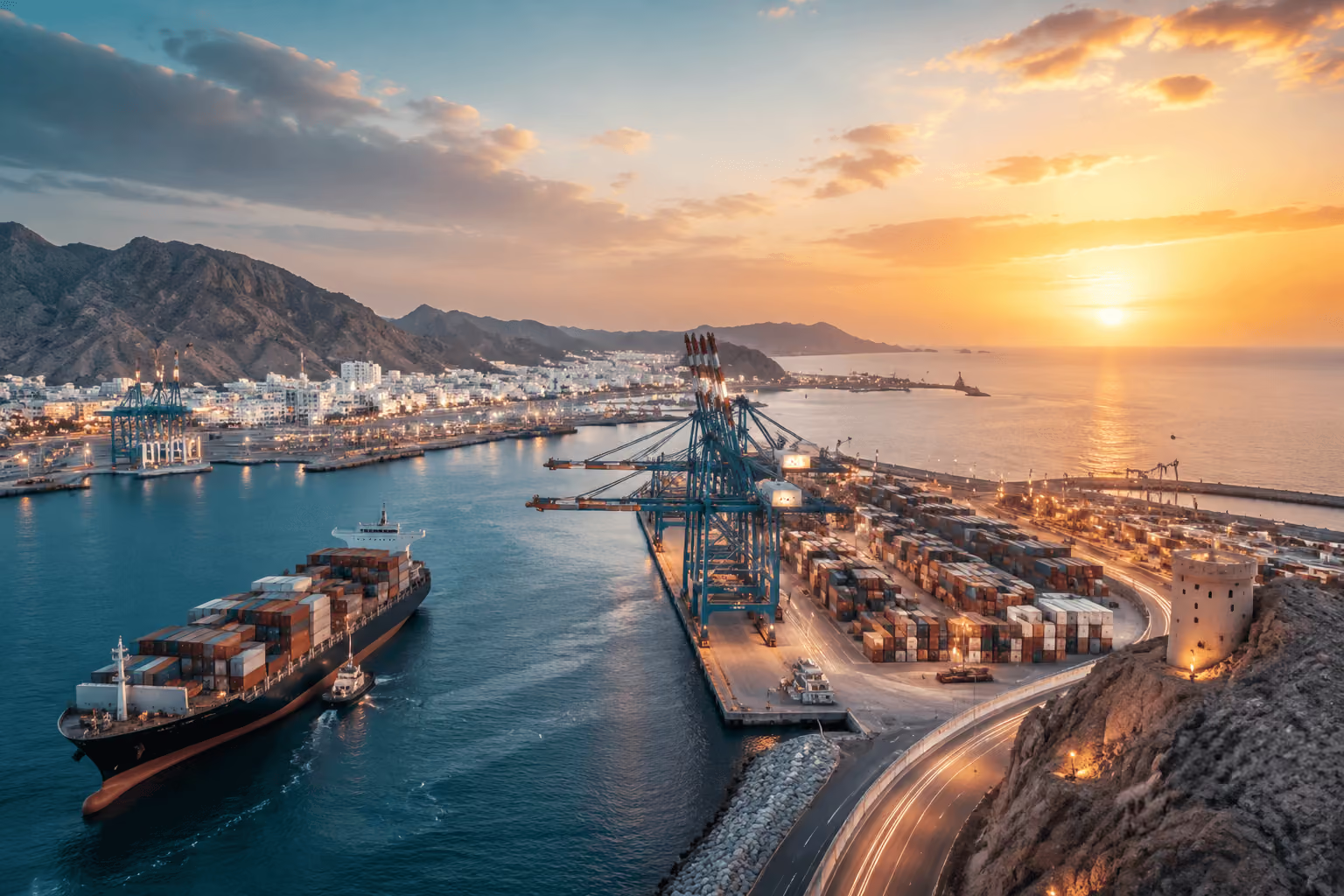
The ports of Sohar, Salalah, and Duqm could position Oman as an important route for moving goods between Asia, Africa, and the Middle East. The country is also investing in ports, free zones, and transportation infrastructure as it seeks to reduce its economic dependence on oil and capture a larger share of regional trade.
But one serious question remains: Can Oman really capture part of Dubai’s position in trade and logistics, or is the gap between the two countries still too wide?
The answer depends on more than one factor—from port locations and logistics costs to infrastructure, investment, and the ability to attract international companies. To understand where this competition could be heading, we first need to examine what makes Oman a serious contender on the region’s logistics map.
Oman’s Geographic Location: A Competitive Advantage That Should Not Be Overlooked
If Oman is to become a serious player in regional trade, its first advantage is already visible on the map.
Oman is located in the southeastern part of the Arabian Peninsula and, unlike many Gulf countries, has direct access to the Gulf of Oman and the Arabian Sea, and ultimately to the Indian Ocean. This location places Omani ports close to major shipping routes connecting Asia, the Middle East, and Africa.
For trade, this is a significant advantage. The shorter the route for moving goods and the more direct the access to open waters, the greater the potential for creating diversified supply-chain routes.
This is where Oman’s difference from Dubai becomes more apparent. Dubai has built one of the region’s most powerful transshipment centers around Jebel Ali Port. Oman, however, can capitalize on its direct access to the ocean and the development of multiple ports in different parts of the country.
Of course, geography alone cannot create a logistics hub. A strategic location becomes an economic advantage only when it is supported by modern ports, transportation networks, free zones, and competitive logistics services.
And this is where Oman’s story becomes even more interesting. The country is not relying solely on its geographic position. In recent years, it has begun making significant investments in its ports and economic zones.
Among these ports, three names stand out: Sohar, Salalah, and Duqm—three locations that could each play a different role in transforming Oman into a regional trade and logistics center.
Oman’s Ports: Three Key Players in the Competition with Dubai
Oman’s geographic position only gains its full value when it is transformed into infrastructure. This is where Sohar, Salalah, and Duqm enter the picture—three ports developed to serve different parts of the region’s trade and supply chain.
Sohar Port: Oman’s Industrial Gateway
Sohar can be considered one of the most important industrial and logistics pillars of Oman. Its proximity to regional trade routes, combined with the presence of the Sohar Freezone, makes it an attractive option for companies looking to combine manufacturing, warehousing, and exports.
A key advantage of Sohar is that it is not designed simply as a place for goods to pass through. The development of industries, warehouses, and commercial activities around the port can add greater value to the movement of goods and help transform Oman from a simple transit route into an integrated part of the supply chain.
Salalah Port: A Link Between Asia and Africa
In southern Oman, Salalah tells a different story.
Located close to major Indian Ocean shipping routes, Salalah has strong potential for transshipment and container handling.
For Oman, Salalah can serve as a bridge between Asian and African markets—an important connection for expanding regional trade.
Duqm Port: Investing for the Future
But perhaps Oman’s most ambitious project is the Port of Duqm and its surrounding economic zone.
Duqm is located along the Arabian Sea, outside the Strait of Hormuz. This gives it strategic importance and creates the potential for developing a major industrial, commercial, and logistics center.
Duqm has not yet reached the level of maturity of Jebel Ali, but its goal is not simply to compete in the short term. Oman is building an ecosystem designed to connect industry, logistics, trade, and investment in one location over the long term.
Three ports, three different strategic positions, and three different models for attracting trade.
But one question still remains: Are these infrastructure investments enough to bring Oman closer to Dubai’s logistics power?
To answer that, we need to take a closer look at the competitor itself: What exactly has Dubai built that makes competing with it so difficult?
Why Is Competing with Dubai Not Easy for Oman?
Oman may have an attractive geographic position, but Dubai has never relied on geography alone. Over several decades, the city has built a complete ecosystem for trade—one that would be time-consuming and costly for any competitor to replicate.
Dubai’s biggest advantage is Jebel Ali Port, one of the region’s largest port and logistics hubs. Combined with airports, road networks, free zones, and business services, it has created an almost seamless system for moving goods.
At the same time, international companies have maintained a presence in Dubai for years. This has created a self-reinforcing advantage: the more companies enter the market, the more business services and commercial connections develop, making Dubai even more attractive to new entrants.
This is the gap Oman needs to close.
Oman can offer competitive costs, more land, and greater room for future expansion. But attracting a significant share of regional trade requires more than building ports. Companies also need fast transportation networks, efficient customs services, warehousing, financing, skilled workers, and easy access to major markets.
However, Oman does not necessarily need to outperform Dubai in every area. If it can establish a clear advantage in areas such as transit trade, export-oriented industries, maritime transportation, and trade between Asia and Africa, it could attract part of the market.
In fact, the competition between Oman and Dubai may be less about fighting for a single position and more about competing through different models of regional trade.
And this raises an important question: Can Oman create an advantage through lower costs and greater development capacity that Dubai cannot easily replicate?
Why Might Companies Choose Oman as a Logistics Hub?
If Dubai’s advantage is its “ready-made ecosystem,” Oman can focus on something different: growth potential.
Oman has not yet reached Dubai’s level of development, and in some areas, that can become an opportunity. There is more room to develop industrial zones, warehouses, distribution centers, and logistics projects, while the government is also working to increase investment in these sectors.
Cost and Development Capacity
For some companies, operating costs and the ability to expand in the future are critical considerations. Oman can offer land, economic zones, and new infrastructure, making it an attractive option for businesses that do not necessarily need access to a massive urban market but place greater value on convenient access to maritime trade routes.
Free Zones and Export-Oriented Industries
Oman’s free and economic zones are also an important part of this strategy. Their purpose is not simply to attract commercial companies, but to create connections between manufacturing, exports, logistics, and maritime transportation.
If a company can manufacture or assemble products in Oman, store them in the same zone, and then export them through a nearby port, it can generate significantly more economic value than a simple transit route.
Access to New Markets
Oman’s position along the Arabian Sea also gives it an opportunity to look beyond the Gulf market. Connections with Africa, India, and Asian markets could become an important source of future trade growth.
This difference highlights an important point: Oman does not necessarily need to become a smaller version of Dubai. Its real advantage will emerge when it focuses on areas where it can offer something different and genuinely competitive.
But there is another side to the story. As attractive as Oman’s opportunities may appear, several obstacles could slow its transformation into a global logistics hub. Ignoring these challenges would make any comparison between Oman and Dubai unrealistic.
What Could Prevent Oman from Competing with Dubai?
Despite its major ports and strategic location, Oman still faces one major challenge: Dubai has spent decades building a complete commercial ecosystem.
Its ports, airports, free zones, financial services, and international business community are deeply interconnected—a competitive advantage that Oman will need time to develop.
Moreover, a powerful port cannot be built through infrastructure alone. Oman must be able to attract large volumes of cargo, international companies, and distribution centers while simultaneously expanding its road, rail, warehousing, and customs networks.
Regional competition is also intensifying. Saudi Arabia and the UAE are making substantial investments to strengthen their positions in trade and logistics.
Therefore, Oman cannot rely solely on its geographic location to close the gap with Dubai. It needs to demonstrate that it can operate faster, more competitively, and differently.
But if these obstacles can be overcome, one compelling question remains:
How much of the region’s trade could Oman realistically attract?
Can Oman Capture a Share of Regional Trade?
Oman is unlikely to replace Dubai in the short term, but capturing a share of regional trade is certainly achievable.
Oman’s advantages are particularly visible in areas where port infrastructure and access to open waters matter most—from transit and maritime transportation to export-oriented industries and trade with Asian and African markets.
In this context, the ports of Sohar, Salalah, and Duqm do not necessarily need to compete directly with Dubai across the entire logistics chain. Instead, each can target a specific part of the regional trade network.
If Oman can offer competitive costs, reliable infrastructure, and fast logistics services, companies will have a reason to use these routes. Even relatively small shifts in trade routes can translate into significant volumes of commerce at the regional level.
For this reason, Oman’s success should not necessarily be measured by whether it can push Dubai aside. If the country can establish itself as a complementary and independent hub for regional trade, it will have achieved an important strategic objective.
And this brings us to the final question: Will Oman eventually become a competitor to Dubai, or will it develop into a different commercial hub alongside it?
The Future of Oman-Dubai Competition: Rival or Complement?
The competition between Oman and Dubai is unlikely to resemble a direct race for a single position. Both have different strengths, and those differences could shape the future of regional trade.
Dubai continues to hold a major advantage in global trade networks, business services, air transportation, and logistics infrastructure. Oman, meanwhile, can focus on its ports, ocean access, development capacity, and connections with Asian and African markets.
If Oman can turn these advantages into a powerful commercial ecosystem, it could capture a larger share of the region’s flow of goods and investment.
So perhaps instead of asking, “Can Oman defeat Dubai?”, we should ask:
Can Oman build a new trade route attractive enough to give companies a reason to choose it?
If the answer is yes in the years ahead, Oman could become one of the Gulf’s most important logistics hubs—not necessarily as “another Dubai,” but as a distinct commercial center with its own competitive advantages.
Conclusion: Can Oman Become Dubai’s New Rival?
Oman still has a considerable gap to close before reaching Dubai’s position in trade and logistics. But that gap does not mean the country lacks opportunity.
Its strategic geographic location, access to open waters, ports in Sohar, Salalah, and Duqm, and expanding economic zones give Oman the opportunity to become an important player in regional logistics.
Dubai, however, benefits from an exceptionally strong commercial and infrastructure network—one that will take Oman time to build.
Therefore, Oman is unlikely to replace Dubai in the short term. Over the longer term, however, it could capture part of the region’s trade, transit, and investment flows.
Perhaps the future of Gulf trade will not be about choosing between Oman and Dubai, but about the emergence of two different hubs with different competitive advantages.
If Oman can turn its geographic position into a genuine commercial ecosystem, the question will no longer be “Can Oman become a rival to Dubai?”
The more important question will be:
How much of the region’s trade could be redirected toward Oman?