.svg)
.svg)
The Future of Hormuz: Alternative Oil Routes and the Role of Oman and the UAE
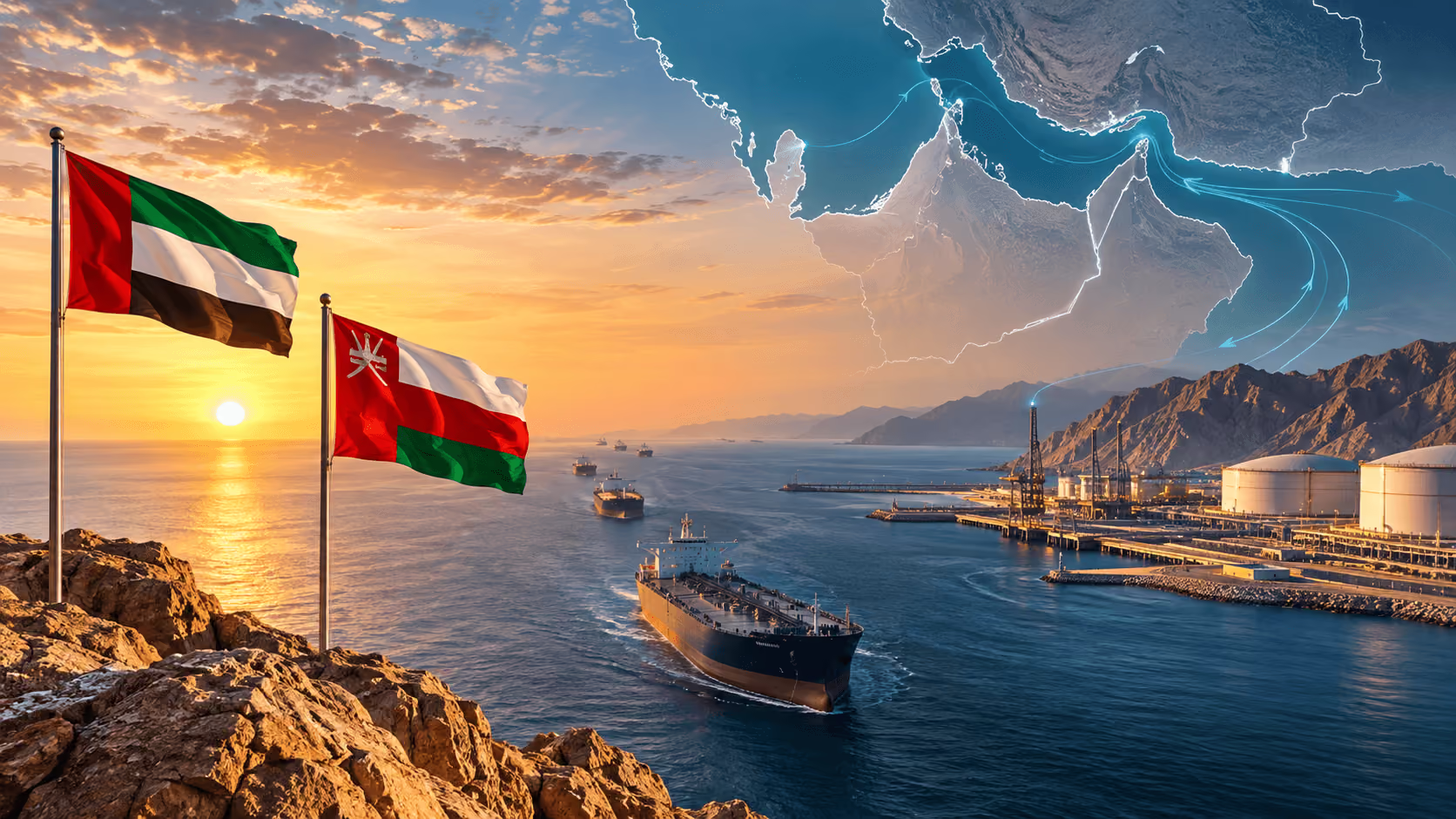
The Strait of Hormuz has long been one of the most important energy trade chokepoints in the world. Large volumes of crude oil, petroleum products, and liquefied natural gas (LNG) normally move through this narrow waterway before reaching markets in Asia and beyond. For that reason, disruption in Hormuz can quickly affect oil prices, shipping costs, insurance premiums, and the broader global economy.
The issue is no longer theoretical. After the regional conflict that began on February 28, 2026, tanker traffic through the strait fell sharply. A June 18 memorandum of understanding between the United States and Iran temporarily supported a recovery in flows, but renewed hostilities reversed part of that improvement. On August 11, 2026, Iran’s Supreme National Security Council secretary said the strait would remain closed unless U.S. conditions changed, and Reuters reported on August 12 that vessel traffic through Hormuz had fallen to only a small fraction of pre-war levels.
This crisis has reinforced a strategic question for Gulf exporters and global energy consumers: how much oil and gas can be moved through alternative routes if Hormuz becomes unreliable?
The United Arab Emirates (UAE) has spent years expanding export capacity through Fujairah, outside the strait. Oman follows a different model. It does not provide a large cross-border oil pipeline bypass for neighboring Gulf producers, but its ports, LNG facilities, storage capacity, and industrial projects sit on the Gulf of Oman and Arabian Sea, giving the country direct access to the Indian Ocean.
Can these investments reduce dependence on Hormuz? Which alternative routes have meaningful capacity? And what role could Oman and the UAE play in the future architecture of Gulf energy trade?
Why Is the Future of the Strait of Hormuz More Important Than Ever?
The scale of energy normally moving through Hormuz explains why the strait is so difficult to replace. According to the U.S. Energy Information Administration (EIA), total oil flows through the Strait of Hormuz averaged 20.9 million barrels per day in the first half of 2025. That was equivalent to about one-quarter of global maritime oil trade.
The same EIA analysis estimated that 11.4 billion cubic feet per day of LNG passed through Hormuz in the first half of 2025, representing more than 20% of global LNG trade and originating primarily from Qatar.
Those figures show why no existing pipeline or port network can fully replace Hormuz in the short term. Alternative infrastructure can reduce the severity of a disruption, but it cannot reproduce the full volume normally carried through the strait.
The 2026 crisis has made that constraint visible. Temporary reopening in June helped Gulf exports recover, but the renewed disruption in July and August showed that route security can change quickly. As a result, energy security increasingly depends not only on production capacity, but also on the ability to move, store, process, and export energy through more than one corridor.
Can the World Reduce Its Dependence on the Strait of Hormuz?
Regional producers have several alternatives, but the available bypass capacity is much smaller than normal Hormuz flows. The most important routes are Saudi Arabia’s East-West Pipeline and the UAE’s Abu Dhabi Crude Oil Pipeline to Fujairah.
Saudi Aramco’s East-West Pipeline connects oil infrastructure near the Persian Gulf with Yanbu on the Red Sea. The system has a nameplate capacity of about 5 million barrels per day and was temporarily expanded to around 7 million barrels per day through converted infrastructure. However, not all of that capacity is available as incremental export capacity during a crisis.
The UAE’s pipeline to Fujairah can move up to about 1.8 million barrels per day from onshore fields to an export terminal on the Gulf of Oman. In its March 2026 chokepoint assessment, the EIA estimated that the Saudi and UAE systems together could provide roughly 4.7 million barrels per day of bypass capacity during a disruption.
That is strategically important, but still far below the roughly 20 million barrels per day that normally transit Hormuz. Alternative routes therefore function as resilience infrastructure rather than full replacements.
How Has the UAE Reduced Its Dependence on Hormuz Through Fujairah?
The UAE has one of the most developed bypass strategies in the Gulf. Its Abu Dhabi Crude Oil Pipeline carries crude from onshore fields to Fujairah, allowing part of the country’s exports to reach international markets without passing through the Strait of Hormuz.
The current pipeline has a maximum capacity of about 1.8 million barrels per day. This gives the UAE greater flexibility than Gulf exporters that depend almost entirely on Hormuz, although it does not make the country immune to regional disruption.
Fujairah’s role extends beyond the pipeline. The Port of Fujairah describes itself as a major regional hub for liquid bulk cargo, oil trading, storage, and bunkering. The adjacent Fujairah Oil Industry Zone reports storage capacity of roughly 70 million barrels across different oil products.
The UAE is also expanding the bypass system. In May 2026, ADNOC said a new West-East Pipeline was under construction and expected to become operational in 2027. ADNOC said the project would double its export capacity through Fujairah.
This matters because the strategic value of Fujairah is not limited to one pipeline. The combination of export infrastructure, storage, marine services, and access to the Arabian Sea makes the emirate one of the Gulf’s most important energy gateways outside Hormuz.
Oman’s Advantage: Geography, LNG, Storage, and Duqm
Oman’s role is different from the UAE’s. Oman does not currently have a major cross-border pipeline designed to redirect large volumes of crude from neighboring Gulf producers to Omani ports. It therefore cannot be treated as a direct substitute for the Saudi or UAE bypass systems.
Its advantage lies in location and domestic infrastructure. Important Omani ports and energy assets sit on the Gulf of Oman and Arabian Sea, outside the Strait of Hormuz. This gives Oman direct access to the Indian Ocean and allows its own energy exports to avoid the chokepoint.
One example is Oman LNG at Qalhat near Sur. Oman LNG operates three liquefaction trains with a nameplate capacity of 10.4 million tonnes per annum. Because the plant is outside Hormuz, Omani LNG exports are not dependent on passage through the strait.
Duqm is another important part of this strategy. OQ8’s Duqm Refinery has a nameplate processing capacity of 230,000 barrels per day and exports refined products to international markets. The wider Duqm ecosystem includes the Port of Duqm, liquid bulk facilities, ship repair, industrial land, and the Ras Markaz crude storage terminal.
According to OQ, the Ras Markaz terminal has total storage capacity of 26.7 million barrels, including capacity dedicated to the Duqm refinery.
These assets do not turn Oman into a replacement route for all Gulf crude exports. Instead, they strengthen Oman’s position as an energy storage, refining, logistics, and maritime-services hub with direct access to open waters.
How Could These Changes Affect Global Oil Investment and Trade?
The 2026 disruption has shown that the value of energy infrastructure depends on more than production capacity. Pipelines, export terminals, storage facilities, refineries, and ports become more valuable when they help maintain energy flows during a chokepoint crisis.
This is particularly important for Asian buyers. EIA data show that 89% of crude oil and condensate moving through Hormuz went to Asian markets in the first half of 2025. China, India, Japan, and South Korea together accounted for 74% of all Hormuz crude oil and condensate flows during that period.
For these importing countries, diversification can include alternative suppliers, larger strategic inventories, more flexible shipping arrangements, and investment in infrastructure that reduces dependence on a single route.
Fujairah and Duqm fit into that broader trend in different ways. Fujairah offers a direct crude-oil bypass and a mature oil-storage and trading ecosystem. Duqm and other Omani facilities offer refining, storage, maritime services, and direct access to the Indian Ocean without requiring transit through Hormuz.
Alternative infrastructure does not eliminate regional risk. Ports and pipelines outside the strait can still face security threats, higher insurance costs, operational constraints, and wider disruptions to shipping. Their value is therefore best understood as diversification: they reduce dependence on one vulnerable point rather than removing risk entirely.
Three Scenarios for the Future of the Strait of Hormuz
The 2026 crisis has already demonstrated that severe disruption is possible. The forward question is now less about whether Hormuz can be disrupted and more about how long restrictions can last, how quickly traffic can normalize, and how much permanent investment in alternative infrastructure follows.
Scenario 1: Negotiated Reopening and Relative Stability
Under this scenario, diplomacy produces a durable reopening of the strait and tanker traffic gradually returns closer to pre-conflict levels. Insurance costs and security requirements would also be expected to ease over time.
Even in this case, Saudi Arabia, the UAE, Oman, and major energy-importing countries would have little incentive to abandon diversification projects. The 2026 disruption has demonstrated the financial and operational cost of relying too heavily on a single maritime chokepoint.
Scenario 2: Intermittent Reopening and Periodic Disruption
A second scenario is a cycle of partial reopening, renewed tension, temporary restrictions, and changing insurance or security conditions. This would create a less predictable operating environment for energy companies and shipping operators.
In such a market, the strategic value of Fujairah, the East-West Pipeline, storage facilities, and Omani logistics infrastructure could continue to rise because companies would place greater value on routing flexibility and inventory buffers.
Scenario 3: Prolonged Closure or Severe Disruption
The most disruptive scenario is an extended closure or near-closure. The 2026 conflict has shown that this is no longer only a theoretical stress test. Even with Saudi and UAE bypass capacity, alternative routes cannot replace the normal volume moving through Hormuz.
A prolonged disruption could therefore keep pressure on oil and product markets, increase shipping and insurance costs, force additional production shut-ins in Gulf countries, and encourage consuming countries to draw on inventories or seek more distant supply sources.
The economic effect would depend on the duration of the disruption, the amount of spare pipeline capacity actually available, strategic stock releases, demand conditions, and the speed at which producers outside the Gulf could respond.
Conclusion
The future of the Strait of Hormuz is not simply a question of whether the waterway is open or closed on a particular day. The deeper issue is how the 2026 crisis changes the way Gulf producers and global energy buyers think about resilience.
Hormuz remains too important to be replaced. In the first half of 2025 it carried about 20.9 million barrels per day of oil and more than 20% of global LNG trade. Existing bypass pipelines can redirect only a fraction of that volume.
The UAE has built the clearest direct bypass strategy through Fujairah and is now expanding it further. Oman’s role is different but still strategically important: its LNG facilities, Duqm refinery, storage infrastructure, ports, and maritime services provide energy and logistics capacity outside the strait.
The result is not a future in which Hormuz becomes irrelevant. It is a future in which energy security increasingly depends on a network of alternative pipelines, storage hubs, ports, refineries, and shipping options that can keep at least part of regional trade moving when the main chokepoint is disrupted.
For global energy markets, the lesson is straightforward: the value of a barrel of oil depends not only on production and price, but also on whether that barrel can reach the market reliably.