.svg)
.svg)
Should You Buy the Foldable iPhone or Apple Stock? Which Is the Better Financial Choice With $2,000?
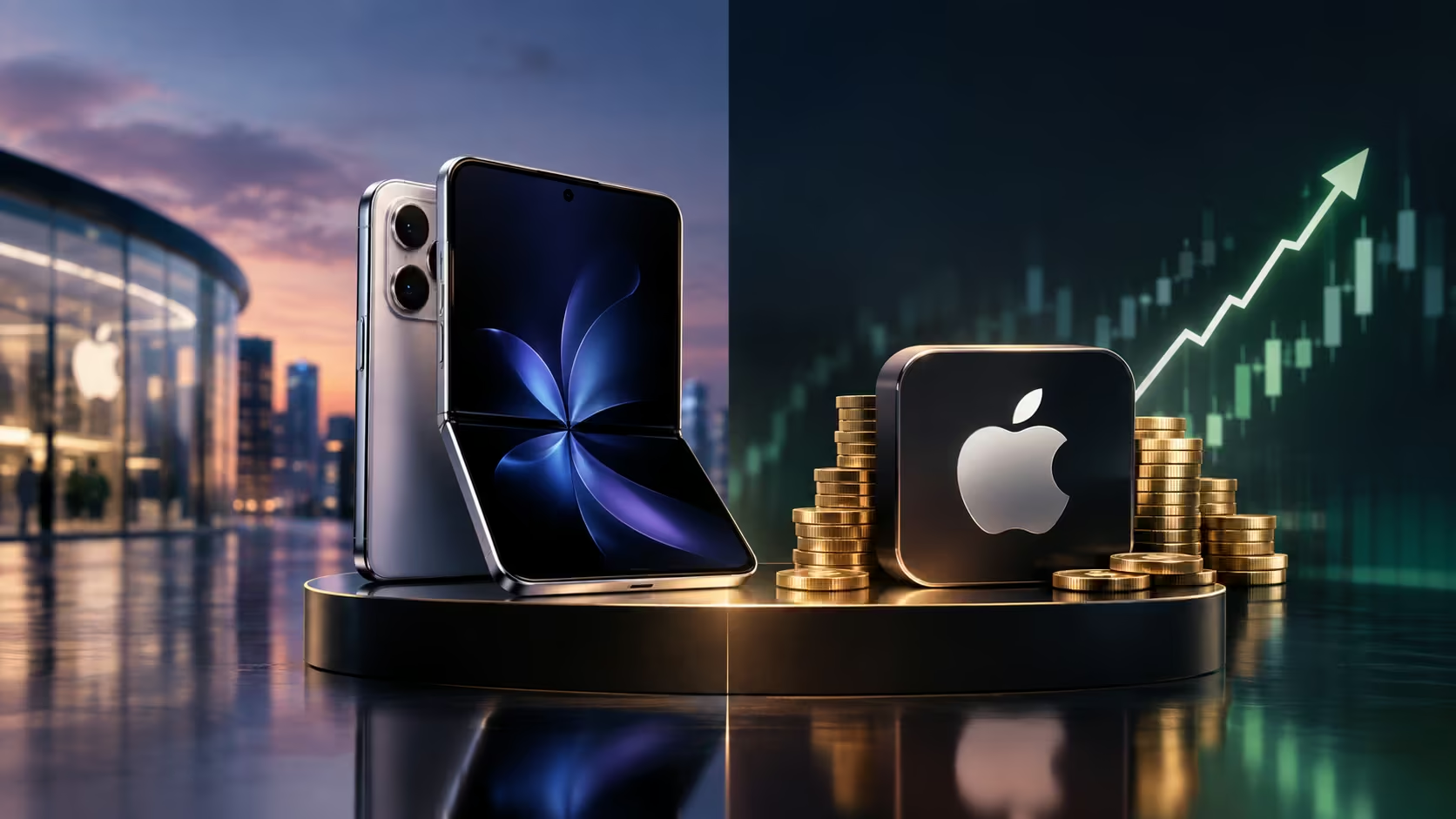
From the Foldable iPhone to Apple Stock: Should You Buy the Phone or Own a Piece of Apple?
Imagine setting aside $2,000 for Apple’s latest product. On one side is Apple’s new foldable iPhone—a product that, after years of anticipation, has now been unveiled for the foldable smartphone market. On the other side is stock in the very company that made that phone.
This raises a simple but tempting question:
What would you gain if, instead of buying the foldable iPhone, you invested that same $2,000 in Apple stock?
This question is not simply about choosing between a phone and a few shares. It reflects the difference between buying a product and owning a small part of the company that makes it.
Over several decades, Apple has evolved from a computer company into one of the world’s largest corporations. With products such as the iPod and, later, the iPhone, the company changed consumer behavior and built a vast ecosystem spanning hardware, software, and services.
Now, the foldable iPhone has been announced, marking one of Apple’s most significant hardware shifts in recent years. But for an investor, the most interesting part of the story may not be the phone itself.
The bigger question is: What could the foldable iPhone mean for Apple’s financial future?
From Computers to the Foldable iPhone: Apple Wants to Change the Market Again
About five decades ago, Apple started out in the computer business. Later, with products such as the iPod and, especially, the iPhone, the company did more than introduce new products—it changed how people used technology.
Now, with the introduction of the iPhone Duo, its first foldable iPhone, Apple has entered a market where competitors such as Samsung have already been active for years. With a starting price of $1,999, the device has become one of the most expensive iPhones in the company’s history. Source: Apple’s announcement.
But for investors, the interesting part is not the phone itself.
In fiscal 2025, Apple generated more than $416 billion in revenue, with approximately $209.6 billion coming from iPhone sales and more than $109 billion from Services, including businesses such as the App Store and cloud services. Source: Apple’s fiscal 2025 statements.
For Apple, therefore, the iPhone is more than a device. It can be the entry point into a much larger ecosystem.
And this is precisely where the $2,000 price tag turns the story from a technology purchase into an investment question: Should you spend that money on the product, or should you buy a small ownership stake in the company that made it?
A $2,000 Foldable iPhone: Buying a Product or Buying Apple Stock?
At around $2,000, the foldable iPhone may initially look like nothing more than an expensive smartphone. But from an investment perspective, that same number raises a very different question.
With Apple shares trading at around $337, $2,000 would buy approximately 5.9 shares of Apple, before commissions and other transaction costs. Source: September 17, 2026 historical closing price.
This is where the difference between a consumer’s perspective and an investor’s perspective becomes clear. A consumer asks, “Is this iPhone worth $2,000?” An investor asks a different question:
“How much value could this product create for Apple itself?”
The answer does not depend solely on how many foldable iPhones Apple sells. Apple generates revenue from the device itself, but if buyers later use Apple services, apps, or other products within its ecosystem, the economic value of each customer to the company can increase.
That is why the more interesting comparison may not simply be whether you should buy the foldable iPhone. It may be whether, with the same money, you want to remain only a consumer of an Apple product—or also become a partial owner of the company behind it.
Could the Foldable iPhone Become a New Growth Engine for Apple?
Despite its $2,000 price tag, it would be unrealistic to expect the foldable iPhone alone to transform Apple’s revenue. Foldable phones still represent a relatively small portion of the global smartphone market, and Counterpoint Research forecasts up to 6 million foldable iPhone shipments in 2026. Source: Counterpoint Research forecast.
For a company generating more than $400 billion in annual revenue, that figure alone would not be decisive. The product’s real value could lie elsewhere.
Some users have kept their iPhones for years because newer models have not offered significant differences from previous generations. A completely different design, such as a foldable iPhone, could encourage some of these users to upgrade and re-enter the purchasing cycle.
At the same time, the higher price could increase the average amount customers spend on Apple products, while new buyers could eventually become customers of Apple’s services as well.
For investors, therefore, the key question is not simply how many million units the foldable iPhone sells. The more important question is whether it can reignite the iPhone upgrade cycle and strengthen the growth of Apple’s broader ecosystem.
To answer that question, however, we first need to look at the company’s current financial position.
How Strong Is Apple’s Financial Position?
Apple’s recent performance shows that the company still has a powerful revenue-generating engine. In the quarter ended June 2026, Apple’s revenue reached $109.4 billion, up 16% from the same period a year earlier. Earnings per share also increased by 29%. Source: Apple’s fiscal 2026 third-quarter results.
During the same period, iPhone revenue reached $54.3 billion, while the Services segment generated $30.7 billion in revenue. The number of active Apple devices also reached a new record, surpassing 2.5 billion. Source: Apple’s quarterly financial statements.
These figures highlight an important point: Apple’s strength does not come solely from iPhone sales. As the number of active users within its ecosystem grows, Apple’s opportunities to generate revenue from services and other products grow as well.
However, strong growth alone is not enough to make an investment decision. If the market already expects substantial growth from Apple, the stock’s valuation must be considered alongside the company’s performance.
Apple Stock: A Great Company Does Not Necessarily Mean Buying at Any Price
Apple shares, trading under the ticker AAPL, closed at around $337 on September 17, 2026, giving the company a market capitalization of approximately $4.92 trillion. Its price-to-earnings (P/E) ratio was around 38. Source: AAPL historical prices.
These figures highlight an important point: the market has high expectations for Apple’s future growth, and a significant portion of those expectations is already reflected in the stock price.
Therefore, even if the foldable iPhone proves successful, shareholders are not concerned only with how many units it sells. What matters is how much additional profitability the product ultimately contributes to Apple, especially relative to the price investors are paying for the stock today.
At the same time, if iPhone growth slows, competition in artificial intelligence intensifies, or Apple faces greater challenges in markets such as China, the stock’s relatively high valuation could make investors more sensitive to negative developments.
On the other hand, continued growth in Services, an expanding installed base of active devices, and successful new products could create additional paths for growth.
So the question is no longer simply, “Is Apple a good company?”
The more important question is: “Does the current stock price make sense given the expectations we have for Apple’s future?”
What Are the Risks and Opportunities of Apple Stock?
The foldable iPhone could be an opportunity for Apple, but it is not the only factor that will determine the company’s future.
One of the most important opportunities is the continued growth of Apple’s Services business and its broader ecosystem. As the number of active users increases, the company’s ability to generate revenue from different services and products can grow as well. In the third quarter of fiscal 2026, Apple also reported a new record in its installed base of active devices. Source: Apple’s quarterly financial statements.
On the other hand, artificial intelligence remains one of Apple’s key challenges. In 2026, the company has been focusing on developing new Siri capabilities and Apple Intelligence, but competition in the field is intense. Source: Apple’s Siri AI update.
China also remains an important variable for Apple, both as a major sales market and as part of its supply chain. Apple says Siri AI and other new Apple Intelligence features are not yet available there while it works through regulatory requirements. Source: Apple’s regional availability notice.
The foldable iPhone could therefore contribute to Apple’s growth, but investors need to consider it alongside the growth of Services, artificial intelligence, China, iPhone sales, and the stock’s current valuation—not as a single product capable of determining the company’s future on its own.
Can You Buy Apple Stock From Oman or Dubai?
You do not need to live in the United States or have a U.S. bank account to invest in Apple stock. Investors in Oman and Dubai can also explore and trade shares of companies such as Apple through trading platforms that provide access to U.S. stock markets.
Investors can look for AAPL, Apple’s ticker symbol, on a platform that offers access to U.S. shares, then review the platform’s eligibility rules, fees, and trading conditions before deciding whether to invest.
One important feature for new investors is the availability of fractional shares. This means you do not necessarily need enough money to purchase one full share of Apple. Depending on the platform, you may be able to own a fraction of a share, although the available features, minimum investment requirements, and fees depend on the platform you use.
If someone has set aside around $2,000 to buy the foldable iPhone, they could, in theory, choose to allocate some or all of that money toward owning a portion of the company that makes the product instead of spending the entire amount on the device.
However, unlike a smartphone, a stock is an asset exposed to price fluctuations and the possibility of loss. The two choices are therefore fundamentally different in nature.
Perhaps the Real Question Is Not “iPhone or Stock”
When we spend $2,000 on a product, we usually think about what we are going to receive in return. Investing changes that perspective.
Apple is an interesting example of this difference. One person may line up to buy the latest iPhone, while another may look at the same product as a signal of potential future revenue opportunities for the company.
Neither perspective necessarily replaces the other. Buying a product can be a consumption decision, while buying stock is an investment decision with a different level of risk and a different time horizon.
The important thing is to understand exactly what we are buying—and why—before spending the money.
Because sometimes the most valuable question about a new product is not “How much do I like it?” but rather:
“What value does this product create for the company that made it?”
From a $2,000 Purchase to a Financial Decision
For one person, $2,000 could be the cost of buying Apple’s latest iPhone. For another, it could be capital allocated toward buying shares of the same company that made the product.
The fundamental difference lies in what you ultimately receive: a product to use today or a stake in a company that could become a financial asset for the future.
The foldable iPhone could offer users a different experience and, if successful, create new growth opportunities for Apple. But for a shareholder, the success of a product becomes more meaningful when it contributes to growth in Apple’s revenue, profitability, and ecosystem value.
On the other hand, buying stock does not guarantee a profit. The share price can decline, and factors such as a high valuation, competition in artificial intelligence, iPhone sales performance, and conditions in key markets such as China can affect investment returns.
So perhaps the central question is not “Is the foldable iPhone better than Apple stock?” but rather:
“With $2,000, is our goal to buy a product or to build a financial asset for the future?”
Making that decision requires considering the price, risk, investment horizon, and financial objectives together. After all, a consumer purchase and an investment may involve the same amount of money, but they are fundamentally different financial decisions.


.webp)