.svg)
.svg)
UAE Capital Markets: Structure, 2025 Performance and Key Trends

Overview of the UAE Capital Markets
The United Arab Emirates has several distinct capital-market venues rather than one single exchange. The main onshore equity markets are the Dubai Financial Market (DFM) and Abu Dhabi Securities Exchange (ADX), while Nasdaq Dubai operates from the Dubai International Financial Centre (DIFC) with an international market framework. Together, these venues support public equity, debt, sukuk, funds, derivatives, and other listed instruments.
For investors, the important point is that market structure, regulation, liquidity, ownership rules, and product availability differ across venues. This article provides a practical overview of the UAE capital markets, updates key figures through 2025, and explains several trends that matter when evaluating public-market opportunities. For a broader starting point on local investment choices, see How to Invest in Dubai: Property and Diversification.
Key Institutions of the UAE Capital Market
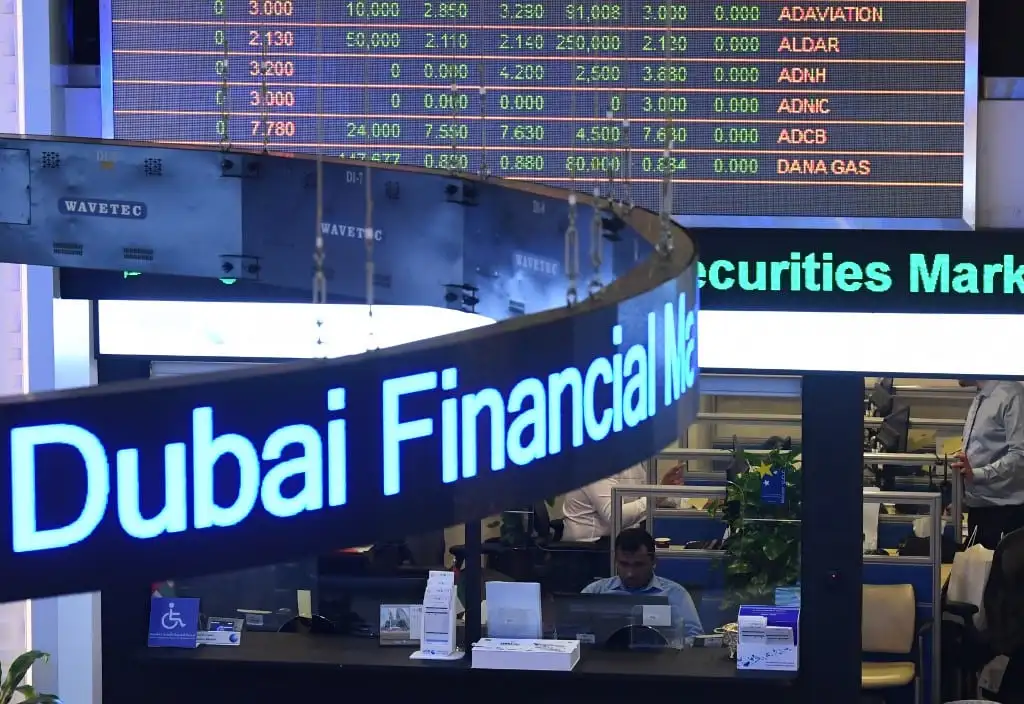
Dubai Financial Market (DFM). DFM began operations in 2000 and is a major public market for securities listed in Dubai. Its market rules are approved by the UAE Securities and Commodities Authority (SCA), which also oversees the federal regulatory framework for the onshore securities markets. DFM lists equities as well as other approved instruments and has expanded its institutional and international investor base over time.
Abu Dhabi Securities Exchange (ADX). ADX is Abu Dhabi’s principal public securities exchange. Its market rules are also approved by the SCA. By the end of 2025, ADX reported market capitalization of AED 3.13 trillion and annual trading value of AED 385 billion, making it one of the region’s largest public markets by capitalization.
Nasdaq Dubai. Nasdaq Dubai is based in the DIFC and operates as an exchange and clearing house licensed by the Dubai Financial Services Authority (DFSA). Its product set includes shares, debt securities, sukuk, funds, structured products, futures, options, and other instruments permitted under its licence. Its international framework and fixed-income listings make it structurally different from the onshore DFM and ADX markets.
Structural Features of the UAE Financial Market
Diversity of instruments. Investors can access listed shares, bonds, sukuk, exchange-traded funds, derivatives, and other instruments depending on the venue and eligibility rules. This diversity allows the capital markets to serve both corporate financing needs and investor portfolio construction.
Distinct regulatory frameworks. DFM and ADX operate within the onshore federal securities framework, while Nasdaq Dubai is an authorised market institution in the DIFC supervised by the DFSA. Investors should therefore verify the relevant exchange, regulator, issuer disclosures, and product rules rather than treating every UAE-listed instrument as if it operates under the same regime.
Foreign ownership. The UAE has significantly liberalised company ownership. The UAE Government states that 100% foreign ownership is permitted for many mainland businesses, while strategic-impact activities and other restricted sectors can remain subject to additional requirements. Listed-company foreign ownership limits can also depend on the issuer and applicable rules, so investors should check the current company-level position before trading.
Market infrastructure. Both Dubai and Abu Dhabi have continued investing in electronic trading, settlement, investor onboarding, data services, and new market products. These developments improve access, but they do not remove market, liquidity, concentration, or valuation risk.
Market Status and Key Trends
2025 Market Performance
By the end of 2025, DFM reported a market capitalization of AED 992 billion, total traded value of AED 174 billion, and a 17.2% rise in the DFM General Index for the year. DFM also reported that foreign investors represented 51% of trading activity and institutional investors 71%.
ADX reported year-end 2025 market capitalization of AED 3.13 trillion, up 4.6% from the end of 2024, and total annual trading value of AED 385 billion, up 12.6%. Foreign-investor trading values represented around 39% of total ADX trading value, while institutional investors represented 78%. These figures come from the exchanges’ own 2025 disclosures and are a more reliable reference than unsourced mid-year estimates.
Sources: DFM 2025 results and ADX 2025 results.
Trading Activity and Investor Participation
The 2025 data show that both foreign and institutional investors are meaningful participants in the UAE’s largest public markets. This does not by itself indicate that a market is undervalued or that future returns will be positive. Higher trading activity can improve liquidity and price discovery, but individual securities can still vary significantly in free float, trading depth, volatility, and concentration.
For investors, headline market capitalization should therefore be considered alongside the liquidity of the specific security, its valuation, financial condition, governance, and the role it would play in a diversified portfolio.
Nasdaq Dubai and Debt-Market Growth
Nasdaq Dubai’s 2025 annual review reported 60 new debt listings with a combined value of USD 30.6 billion, including 51 sukuk issuances and nine bond issuances. The exchange also reported that outstanding sukuk exceeded USD 100 billion during the year. This highlights the importance of debt and Islamic-finance instruments to Dubai’s capital-market ecosystem, in addition to the better-known equity markets.
Source: Nasdaq Dubai Annual Review 2025.
Initial Public Offerings and Primary-Market Development
A major feature of UAE capital-market development has been the pipeline of public listings in Dubai and Abu Dhabi. Several widely followed offerings illustrate that trend:
- DEWA: Dubai Electricity and Water Authority’s 2022 IPO raised AED 22.3 billion, according to DEWA’s final price announcement.
- ADNOC Gas: The company listed on ADX in March 2023 after an IPO that raised approximately USD 2.5 billion.
- ADNOC Logistics & Services: ADNOC L&S listed on ADX in June 2023, not 2024.
- Dubai Taxi Company: DTC began trading on DFM in December 2023 after raising approximately AED 1.2 billion.
- Parkin: Parkin listed on DFM in March 2024, adding another government-related company to Dubai’s public equity market.
These transactions expanded the range of listed sectors and increased the number of investable companies. They should not, however, be treated as evidence that every IPO is attractive. Investors still need to assess valuation, free float, earnings quality, governance, sector exposure, and liquidity.
Key Trends in Market Behavior and Infrastructure
Digitalisation and market infrastructure. ADX reported several infrastructure milestones in 2025, including a new trading engine, expanded multi-asset capabilities, new index and ETF products, and the region’s first digital-bond initiatives. DFM has also continued to expand electronic investor services, market data, and access channels. Technology can improve market efficiency and access, but it does not eliminate investment risk.
Sustainable finance. Sustainable debt activity has become more visible in the UAE market. Nasdaq Dubai’s 2025 review recorded multiple green and sustainability-linked sukuk and bond listings. This development sits alongside the UAE’s Net Zero 2050 Strategy, which identifies climate-finance mechanisms as one of the enablers of the transition. The existence of a green or sustainability label does not remove credit, duration, liquidity, or issuer-specific risk.
Regulatory Reforms and Investor Considerations
The UAE’s company-law reforms have expanded foreign ownership across many activities, but restrictions remain in strategic sectors and individual listed companies can have their own foreign-ownership limits. Investors should therefore verify current issuer disclosures rather than rely on a general assumption of unrestricted ownership.
Regulatory jurisdiction also matters. DFM and ADX operate under the onshore securities framework overseen by the SCA, while Nasdaq Dubai is regulated by the DFSA within the DIFC. Product rules, disclosure obligations, investor classifications, and dispute mechanisms can differ across those frameworks.
For an investor, the practical conclusion is to look beyond market-growth headlines. Exchange size, IPO activity, foreign participation, digital infrastructure, and new products can all strengthen the market ecosystem, but the suitability of any investment depends on the specific security, valuation, liquidity, risk tolerance, time horizon, and overall portfolio. A broader discussion of this principle is available in Asset Allocation for a Resilient Investment Portfolio.


.avif)

