.svg)
.svg)
Bab el-Mandeb Strait: Why It Matters for Oil and Trade
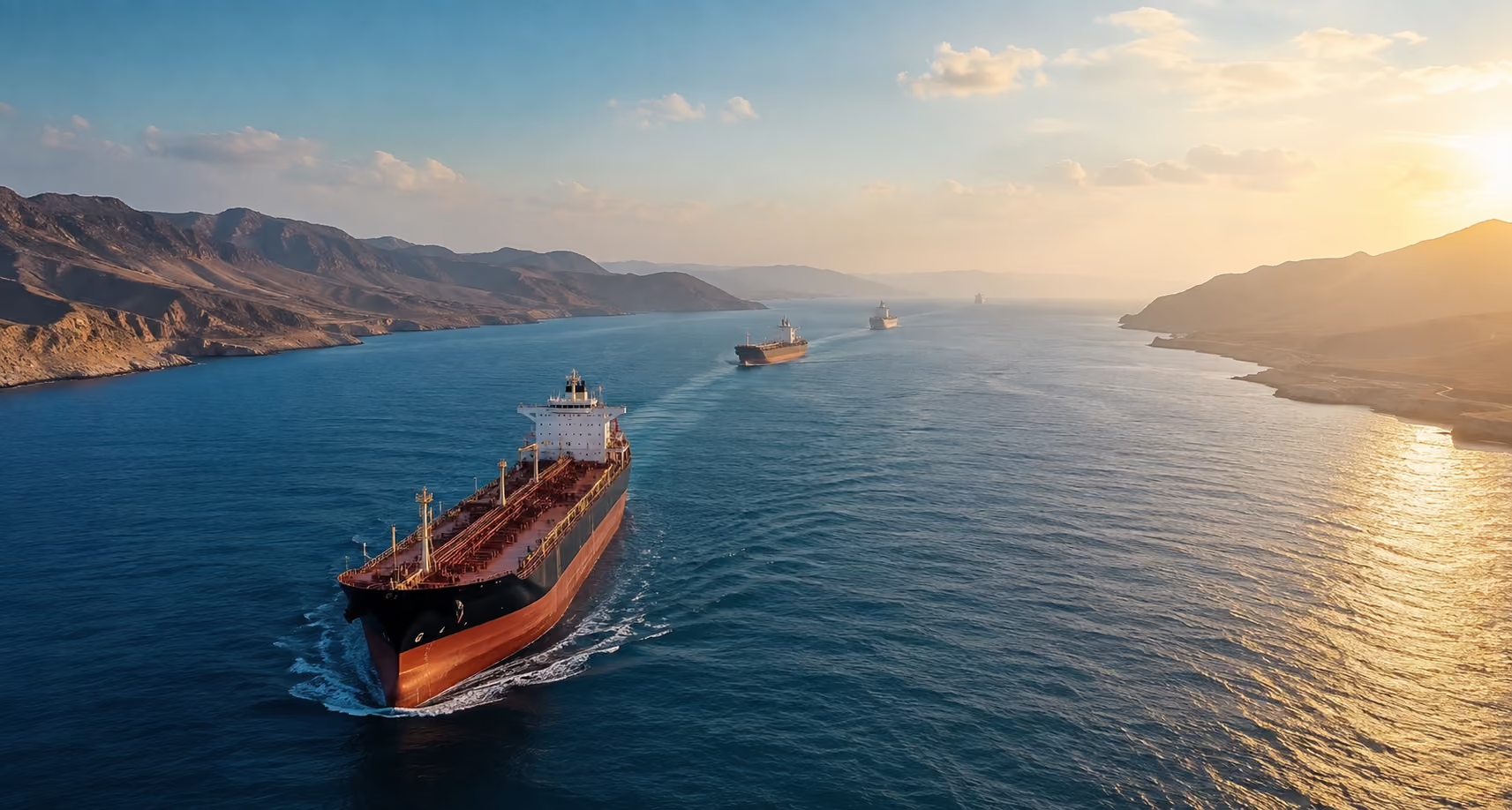
The Bab el-Mandeb Strait is a narrow maritime passage with an influence far greater than its size. It connects the Red Sea with the Gulf of Aden and the Arabian Sea, forming part of the shortest sea route between Asia and Europe through the Suez Canal.
When security deteriorates near this chokepoint, ships do not need to be physically blocked for trade to be disrupted. The risk of attack can raise insurance costs, cause shipping companies to change routes, delay deliveries, and influence oil-market expectations.
The energy dimension is substantial. According to the U.S. Energy Information Administration (EIA), an estimated 5.4 million barrels per day of crude oil and petroleum liquids passed through Bab el-Mandeb in the first quarter of 2026. The route also carries containerized goods, industrial inputs, food products, and other cargo moving between the Indian Ocean and the Mediterranean.
This article explains where Bab el-Mandeb is, why it matters for oil and global trade, how the Red Sea security crisis changed shipping behavior, and what investors and businesses should monitor next.
Where Is the Bab el-Mandeb Strait?
Bab el-Mandeb lies between Yemen on the Arabian Peninsula and Djibouti and Eritrea in the Horn of Africa. It links the Red Sea to the Gulf of Aden and the Arabian Sea. Ships using the Suez Canal to travel between Europe and Asia generally also pass through Bab el-Mandeb.
The EIA describes the strait as approximately 18 miles wide at its narrowest point, with tanker traffic concentrated into two shipping channels. This geography creates a natural bottleneck: disruption in a relatively small area can affect traffic across a much larger trade corridor.
Bab el-Mandeb and the Suez Canal therefore operate as connected parts of the same route. A vessel that cannot safely enter the southern Red Sea may also be unable to use the Suez Canal, even when the canal itself remains open.
Why Bab el-Mandeb Matters for Oil and Global Trade
Bab el-Mandeb is important for both energy security and general commerce. Oil and refined products moving between the Persian Gulf, Europe, North Africa, and parts of Asia may transit the strait. It is also used by container ships carrying manufactured goods and industrial components.
EIA data show that total oil flows through the strait increased from 3.7 million barrels per day in the first quarter of 2025 to 5.4 million barrels per day in the first quarter of 2026. That 2026 figure included approximately 3.2 million barrels per day of crude oil and condensate and 2.2 million barrels per day of petroleum products.
The wider Red Sea–Suez route is equally significant for non-energy trade. UN Trade and Development (UNCTAD) reported that the Suez Canal handled about 12% to 15% of global trade in 2023. A related UNCTAD analysis estimated that approximately 22% of global seaborne container trade passed through the canal that year.
Goods carried along this corridor include:
- Crude oil, refined petroleum products, and liquefied natural gas
- Electronics, machinery, and automotive components
- Clothing, textiles, and consumer products
- Food, agricultural commodities, and fertilizers
- Industrial raw materials and intermediate goods
The route's economic importance means that a security shock can affect far more than the energy sector.
A Full Closure Is Not Required to Disrupt Trade
A common misconception is that Bab el-Mandeb must be completely closed before the global economy feels an effect. In practice, commercial shipping decisions are based on risk as well as physical access.
A shipowner must consider the value of the vessel, its cargo, crew safety, insurance coverage, contractual obligations, and the possibility of delay. If the expected cost of using the Red Sea becomes too high, a company may reroute even though the strait remains technically open.
Marine insurers may also raise war-risk premiums, narrow coverage, or impose additional conditions. These changes increase the effective cost of using the corridor and can make an alternative route commercially preferable.
Why Ships Reroute Around the Cape of Good Hope
The main alternative is to sail around the Cape of Good Hope at the southern tip of Africa. This avoids the Red Sea and Suez Canal but adds distance, time, fuel consumption, and crew costs.
The World Bank estimated that rerouting between Europe and Asia can add roughly 3,000 to 3,500 nautical miles and seven to ten days to a typical journey, with up to $1 million in additional fuel costs for a round trip. Actual costs vary by vessel type, speed, fuel price, and route.
Longer voyages also reduce the effective capacity of the global fleet because each ship completes fewer trips in a given period. This can tighten available shipping capacity and raise freight rates even without a fall in the number of vessels.
How the Red Sea Security Crisis Developed
Yemen's Conflict and the 2022 Truce
The current maritime risk is connected to Yemen's unresolved conflict. The Houthi movement, also known as Ansar Allah, seized Sana'a in 2014 and later became the dominant authority across much of northern and western Yemen.
A United Nations-brokered truce began on April 2, 2022. The United Nations reported that the six-month truce produced the longest period of relative calm since the war began and significantly reduced violence and civilian casualties. However, it did not produce a comprehensive political settlement, and the underlying military, political, and economic disputes remained unresolved.
Attacks Following the Gaza War
After the Gaza war began in late 2023, the Houthis announced attacks against ships they described as connected to Israel. Vessel ownership and commercial relationships are often complex: a ship may be registered in one country, owned in another, managed by a third company, and carrying cargo for multiple customers.
This uncertainty increased perceived risk for vessels with no obvious connection to the conflict. The International Maritime Organization (IMO) reported in May 2024 that around 50 dangerous maritime attacks had occurred since the seizure of the Galaxy Leader in November 2023, causing deaths among seafarers and major disruption to regional and global trade.
Further serious incidents were recorded in 2025. The important economic point is not only the number of attacks, but the way a relatively small number of successful strikes can change the risk calculations of the entire shipping industry.
How International Forces Responded
The United States, the United Kingdom, European countries, and other naval powers increased maritime-security operations in response to attacks on commercial shipping. Their objectives included protecting crews and vessels, supporting freedom of navigation, and reducing disruption to trade.
Operation ASPIDES
The European Union launched EUNAVFOR ASPIDES as a defensive maritime-security operation. In February 2026, the Council of the European Union extended its mandate through February 28, 2027.
Naval protection can reduce risk, but it cannot guarantee that every vessel will transit or remove every missile, drone, or maritime threat. Shipping companies still make independent decisions based on their own risk policies, insurance terms, schedules, and customer requirements.
What Changed in July 2026?
The security situation again affected traffic in late July 2026. On July 27, Reuters reported, citing Kpler shipping data, that only 11 commodity vessels had passed through Bab el-Mandeb the previous day—the lowest daily total in months—after Houthi attacks on Saudi oil facilities along the Red Sea coast.
Seven of the vessels were oil tankers. The data did not show a complete closure, but it demonstrated how quickly traffic can fall when operators reassess security conditions. Some ships continued through the strait, while others waited, changed schedules, or used alternative routes.
Traffic later increased, illustrating that daily vessel counts can be volatile and should not be treated as proof of a permanent blockade. The more reliable conclusion is that Bab el-Mandeb remained operational but highly sensitive to military developments and shipping-company risk assessments.
For a comparison with another major Middle Eastern chokepoint, see Dar Al Tharwah's analysis of a potential Strait of Hormuz closure.
Economic Effects of Bab el-Mandeb Disruption
Oil Prices and Geopolitical Risk Premiums
Oil prices respond to expected disruptions as well as confirmed supply losses. If traders believe that fewer cargoes may reach market, transportation costs may rise, or alternative routes may become congested, futures prices can incorporate a geopolitical risk premium.
This does not mean every attack will push oil prices higher. Prices also depend on global demand, inventories, spare production capacity, OPEC+ decisions, the U.S. dollar, and the availability of alternative supplies. Dar Al Tharwah's article on why oil prices can fall after geopolitical risk eases explains how quickly that premium can expand or contract.
Shipping Costs and Supply Chains
Longer routes increase fuel use, crew time, charter costs, and the amount of working capital tied up in cargo. Delays can also affect manufacturers that rely on tightly timed deliveries of components or raw materials.
UNCTAD has warned that prolonged Red Sea disruption can delay deliveries, increase costs, and create inflationary pressure. The effect is not uniform: high-value or time-sensitive products may be affected differently from bulk commodities, and companies with larger inventories may absorb delays more easily than businesses operating with minimal stock.
Egypt and Suez Canal Revenue
Egypt is particularly exposed because Suez Canal tolls are an important source of foreign-currency revenue. When vessels avoid Bab el-Mandeb, they generally also avoid the Suez Canal. Reduced transits can therefore weaken canal receipts and affect ports, bunkering services, and other maritime businesses in the region.
The economic impact depends on how long rerouting continues and how quickly traffic returns after security improves. Shipping companies may require sustained evidence of safety before restoring normal schedules.
Inflation and Monetary Policy
Higher freight and energy costs can eventually reach consumer prices through transport, manufacturing, and imported goods. The transmission is neither immediate nor guaranteed, but it becomes more important when disruption is prolonged or occurs alongside other supply shocks.
Central banks consider energy and transport costs when assessing inflation. A temporary rise may have limited policy impact, while a persistent shock could complicate interest-rate decisions. For regional context, Dar Al Tharwah's analysis of UAE inflation and purchasing power explains how imported costs and global monetary conditions can affect households and investors.
Could Bab el-Mandeb Be Completely Closed?
It is militarily possible to disrupt traffic, but maintaining a complete and prolonged closure would be difficult. The route is economically important to many countries, and international naval forces have strong incentives to preserve navigation.
More importantly, a formal closure is not necessary for severe economic effects. The strait can remain physically open while losing part of its commercial function if too many shipping companies judge the route to be unsafe or uneconomic.
For analysis, it is therefore useful to distinguish among three scenarios:
- Normal but elevated risk: Most ships transit, but insurance and security costs remain higher.
- Partial commercial avoidance: A substantial share of vessels reroutes, reducing traffic and raising freight costs.
- Severe disruption or temporary closure: Traffic falls sharply because of attacks, mines, military operations, or direct restrictions.
Each scenario has different implications for oil flows, shipping capacity, delivery times, and inflation.
What Will Determine the Outlook?
The future of Bab el-Mandeb traffic will depend on several connected factors:
- The course of Yemen's conflict and any political negotiations
- Developments in Gaza and the wider regional security environment
- Relations among Iran, the United States, Israel, Saudi Arabia, and other regional powers
- The frequency and effectiveness of attacks on commercial vessels
- The effectiveness of international maritime-security operations
- War-risk insurance prices and shipping-company risk policies
- The availability and cost of alternative routes
If attacks decline and security improves, shipping companies have a financial incentive to return because the Red Sea–Suez route is shorter. Confidence may recover gradually rather than immediately, particularly after repeated interruptions.
Conclusion: A Small Strait With Global Consequences
Bab el-Mandeb is not merely a geographic passage between Yemen and the Horn of Africa. It is a strategic link connecting the Indian Ocean, the Red Sea, and the Suez Canal.
Its importance comes from the combination of energy flows and general trade. EIA data show that 5.4 million barrels per day of oil and petroleum liquids passed through the strait in the first quarter of 2026, while UNCTAD data demonstrate the broader importance of the connected Suez route for global and containerized trade.
Recent experience shows that the strait does not need to be formally closed to create economic damage. Security concerns alone can redirect ships around Africa, raise fuel and insurance costs, reduce effective fleet capacity, delay supply chains, weaken Suez Canal revenue, and add to inflationary pressure.
For investors and businesses, the disciplined response is not to assume a single outcome. The relevant task is to monitor verified vessel traffic, security developments, oil-market fundamentals, shipping costs, and the broader asset-allocation implications of geopolitical risk.

