.svg)
.svg)
Pablo Escobar and the Rules of Money: Lessons on Wealth and Power
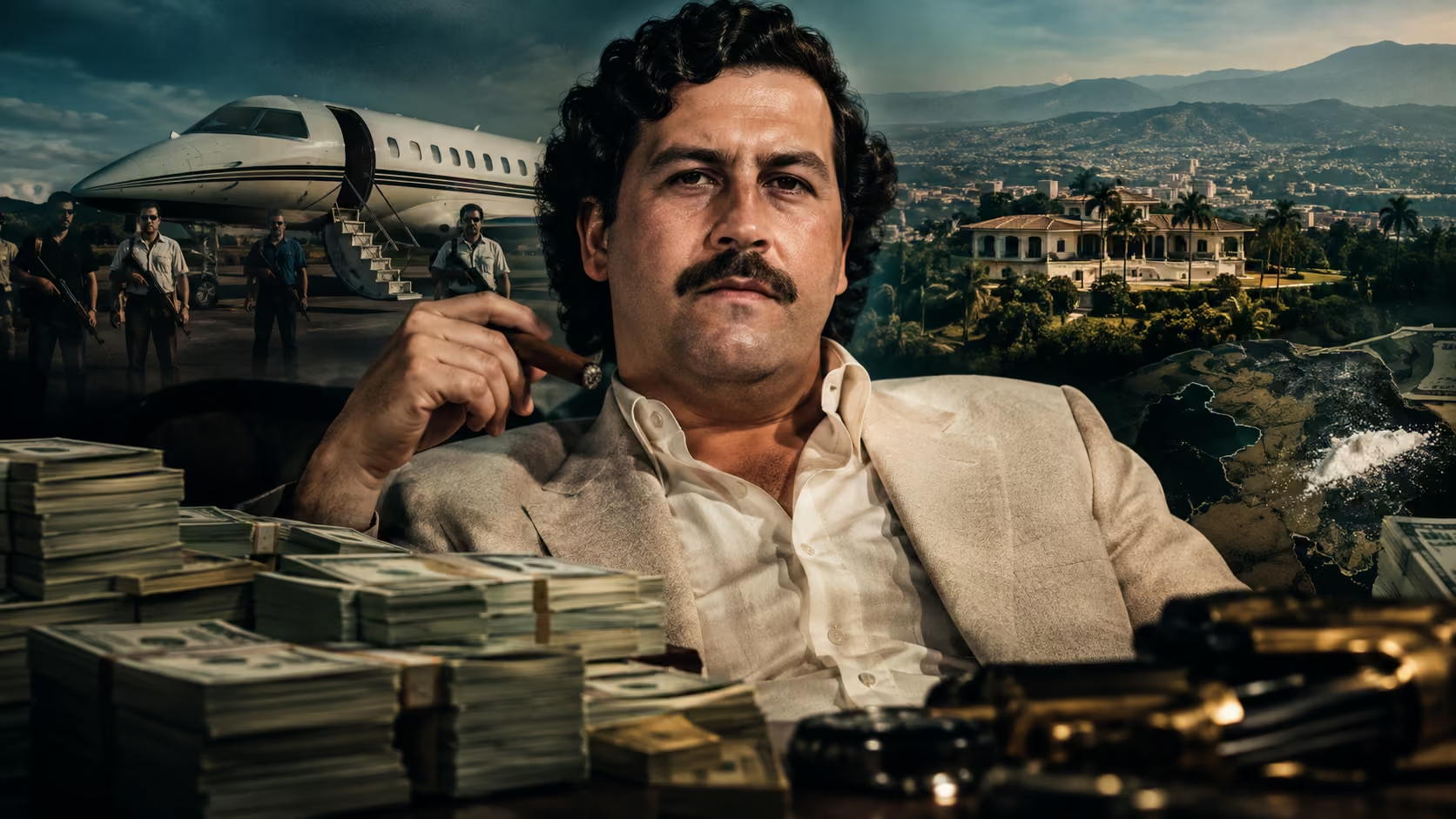
Pablo Escobar’s criminal empire caused profound human and institutional harm. This article does not present his conduct as a model. Instead, it examines—critically and cautiously—how illicit money was converted into influence, why that power was fragile, and which legitimate lessons about systems, reputation, relationships, and risk can be separated from the crimes that produced it.
He went from being a local criminal in Colombia to becoming one of the richest and most powerful people in the world.
At the height of his power, he had billions of dollars, controlled a vast network of people, entered politics, and gained so much influence that the Colombian government faced one of the most serious security crises in the country’s modern history.
But Escobar’s story is not only a story about drugs, violence, and crime.
If we step away from the darkest parts of his life, his story raises an important question about money:
How can money turn into power?
And more importantly:
What can we learn from Escobar’s rise about money, investment, networking, and wealth building?
We are not here to learn how to build a criminal empire.
We are here to understand how a man who realized that money was more than something to spend used it to build a network, influence, and power, and why he ultimately failed to protect what he had built.
How Did Pablo Escobar Become So Wealthy?
To understand how Escobar became so rich, we have to go back to a time when his name meant very little to most people.
Escobar started his criminal career with relatively small-scale activities. But eventually, he entered the massive and highly profitable drug trade.
His illegal business expanded rapidly, and he became the leader of the Medellín Cartel, an organization associated with drug trafficking, money laundering, extortion, and violence, as documented by the U.S. Department of Justice.
As the network grew, so did the money.
In 1987, when Forbes published its first international billionaires list, Pablo Escobar was included.
In 1989, Forbes estimated his net worth at about $3 billion; estimates of illicit wealth remain inherently uncertain.
The exact figure has never been established because much of Escobar’s wealth was hidden, illegal, and outside the formal financial system.
But even the most conservative estimates tell us something important:
Pablo Escobar had become one of the wealthiest people in the world.
But money was not the end of the story.
His money gradually became something else.
Power.
How Did Money Turn into Power for Pablo Escobar?
Imagine someone with a few million dollars.
They can buy a house, start a business, or make investments.
Now imagine having several billion dollars.
At that level, money does more than give you purchasing power.
It can give you access.
It can bring more people into your network.
It can help you build businesses.
It can give you access to media, political circles, influential individuals, and new opportunities.
Escobar used money to do exactly that, although in ways that were deeply destructive and illegal.
He entered politics.
He built homes for poor communities.
He funded football fields.
He created a public zoo.
And he worked hard to create an image of himself as someone who cared about ordinary people.
As a result, some poor communities in Medellín saw him as a benefactor and even compared him to Robin Hood.
There is an important lesson here.
Escobar understood that power does not come only from the amount of money you have. It also comes from the people, information, and relationships connected to that money.
And that brings us to one of the most important lessons from his rise:
Networking.
The Strangest Prison in History: When Money and Power Come Together
Now let’s look at one of the strangest chapters of Escobar’s life.
It was 1991.
Escobar decided to surrender to the Colombian government.
But there was a condition.
He was not going to a normal prison.
The place where he was held became known as La Catedral, or “The Cathedral.”
The conditions inside were far removed from what most people imagine when they hear the word prison.
Comfortable rooms, recreational facilities, and living conditions that looked more like a private estate than a conventional prison.
But the most unusual part was not the comfort.
It was the influence Escobar continued to have from inside.
His control over the environment became so significant that the Colombian government eventually decided to move him to another facility.
When government forces arrived to transfer him, Escobar escaped.
The story shows just how powerful the combination of money and networks can become.
But it also reveals something else.
The larger the network becomes, the harder it is to control.
The more money you have, the more risks you may create.
And the more power you accumulate, the more costly a fall can become.
Rule No. 1: Don’t Just Spend Your Money. Put It to Work.
One interesting aspect of Escobar’s financial rise was the way he continually reinvested money into expanding his operation.
He did not simply earn money and spend it.
He used money to expand the system that generated more money.
His methods were illegal and destructive and should never be treated as a model for business or investing.
But the basic financial principle is easy to understand:
Money that is only consumed eventually disappears.
Money placed into productive assets or legitimate businesses can potentially generate more income over time. The legitimate lesson is to connect saving and investing to a structured plan rather than imitate the source of Escobar’s wealth. A broader explanation appears in Dar Al Tharwah’s guide to wealth management.
This is one of the basic principles of wealth building.
When your income increases, you do not necessarily have to spend all of it on a more expensive lifestyle.
You can put part of it toward the future.
You can invest in a business.
You can acquire productive assets.
Or you can make investments that fit your financial goals and risk tolerance.
The goal is simple:
Don’t let all of your money leave your hands.
Let part of it work for your future.
Rule No. 2: Build a System Around Your Wealth
Escobar could never have built and maintained a multibillion-dollar empire by himself.
Behind him was a huge network of people and processes.
People who provided information.
People who carried out tasks.
People who managed connections.
And people who connected different parts of the organization.
Escobar had not simply accumulated money.
He had built a system.
In the legitimate business world, that system can look completely different.
A sales system.
A financial system.
A professional team.
Cost management.
Capital management.
Business processes.
And risk management.
If every part of a business depends on one person, the business is fragile.
Sustainable wealth is more likely to be built when income, assets, and operations are organized into a system that can be managed and improved over time.
Rule No. 3: The Most Important Lesson from Escobar’s Rise Is Networking
If we had to choose just one lesson from Escobar’s rise to power, networking would probably be at the top of the list.
Escobar did not become powerful alone.
People connected him to other people.
Information moved through relationships.
Opportunities came through connections.
And his influence grew through an increasingly large network.
This is not unique to Escobar.
In the legitimate business world, many opportunities also come through relationships.
Imagine two entrepreneurs who each have $1 million in capital.
The first person knows almost nobody outside their immediate circle.
The second has relationships with investors, business owners, lawyers, accountants, entrepreneurs, and industry experts.
They both have $1 million.
But they do not necessarily have access to the same opportunities.
Why?
Because the second person has another form of capital:
A network.
A strong network can create access to information.
It can create opportunities.
It can introduce you to the right partner.
It can connect you with investors.
And sometimes, one relationship can completely change the direction of a business.
So if you are thinking about how to build wealth, do not only look at the amount of money you have.
Look at the people you know.
And more importantly:
Who knows you, and who trusts you?
Networking Means Building Relationships Before You Need Them
Some people only contact others when they need something.
You might not hear from them for months.
Then suddenly, a message arrives:
“Can you do me a favor?”
Or:
“Do you know someone who can help me?”
Or:
“Can you introduce me to an investor?”
That is not really networking.
That is more like using your contact list in an emergency.
Real networking starts much earlier.
Before you need anything.
You meet people.
You share knowledge.
You help when you can.
You introduce people to useful opportunities.
Sometimes you simply stay in touch.
Why?
Because a valuable relationship is a lot like an investment.
You invest in it before you need it.
That is one of the most important ideas behind long-term wealth building.
Rule No. 4: Money Can Open the Door, but Reputation Keeps You Inside
Escobar was able to use money, influence, and connections to open many doors.
But there was a fundamental problem.
Much of his power was built on fear, violence, and illegal activity.
As his power grew, so did the number of people who wanted to bring him down.
This creates an important lesson for the business world.
Money may help you open doors.
But money alone cannot build a lasting relationship.
Trust matters.
A customer needs to know that they can rely on you.
A business partner needs to know that you keep your promises.
An investor needs to know that you provide accurate information.
A colleague needs to know that you will not disappear when things become difficult.
These things take time to build.
And their value can sometimes be greater than money itself.
Rule No. 5: The More Wealth You Build, the More Important Risk Management Becomes
Escobar was extremely successful at generating money.
But his approach to risk was a completely different story.
The more powerful he became, the more enemies he created.
The government wanted him.
Rival groups fought against him.
Security forces were hunting him.
Eventually, neither his money nor his network could protect him.
Escobar was killed in 1993.
This is where one of the most important lessons about investment and wealth building appears:
Building wealth is not enough. You also have to protect it through diversification, liquidity, due diligence, and decisions consistent with your goals and risk tolerance. For a practical example, see how bank deposits, inflation, liquidity, and diversification can fit within a broader financial plan.
A professional investor does not only ask:
“How much can I make?”
They also ask:
“How much could I lose if I am wrong?”
That simple question can completely change the way you approach investment and wealth management.
Rule No. 6: The People Around You Are Part of Your Capital
Money is one form of capital.
But it is not the only one.
Knowledge is capital.
Skills are capital.
Reputation is capital.
And relationships are capital too.
Escobar’s story shows this in an extreme way.
His power came from a combination of:
Money + Network + Information + Influence
If he had only had money, he could never have created the same level of power.
The people around him helped turn money and information into influence.
In the legitimate business world, this principle can be even more valuable.
An entrepreneur may have capital but lack access to a good financial professional.
An investor may have money but lack the right information about a market.
A business owner may have a strong product but no suitable partner to help expand it.
Sometimes the thing standing between you and a major opportunity is not money.
It is one valuable connection.
That is why, if you are serious about wealth building, do not invest only in your bank account.
Invest in yourself.
Invest in knowledge.
Invest in skills.
Invest in your reputation.
And invest in the right relationships.
Rule No. 7: Money Without Direction Can Become Your Biggest Risk
Perhaps one of the biggest mistakes people make when thinking about wealth building is assuming that having more money automatically means having a better life.
Money is a tool.
And like any tool, the result depends on how you use it.
Money can help grow a business.
It can provide financial security for a family.
It can create investment opportunities.
It can buy education and expertise.
But it can also make bad decisions bigger.
Escobar’s story shows this contradiction perfectly.
He had money.
He had power.
He had a network.
He had influence.
But all of these resources were moving in a direction that ultimately destroyed his own life and the lives of countless others.
So the important question is not simply:
“How can I make more money?”
There is another question worth asking:
“What is the money I have going to make bigger?”
What Can We Learn from Pablo Escobar About Wealth Building?
If we look at Escobar’s story through the lens of money, several important lessons emerge.
Do not simply consume all your money.
Turn part of your income into productive assets and investments.
Build systems around your money.
Take risk management seriously.
Invest in your knowledge and skills.
Protect your reputation.
And above all:
Take networking seriously as part of wealth building.
Because many great opportunities begin as something much smaller than money.
They begin with a relationship.
An introduction.
A conversation.
A dinner.
A meeting.
A phone number.
Or even a friendship that eventually turns into a major business partnership.
That is why some of the most valuable investments you make may not initially look like investments at all.
Sometimes they are simply investments in people.
Money Creates Power, But It Also Amplifies What You Already Have
Money is an amplifier.
If you have a strong business, money can help you scale it.
If you have a strong network, money can give you access to more opportunities.
If you have financial knowledge, money can increase your ability to invest.
But if you make poor decisions, money can make those decisions much bigger too.
Escobar’s story demonstrates this perfectly.
He had money, power, influence, and an enormous network.
But all of those resources were directed toward a system that eventually destroyed him.
So when thinking about wealth building, the question should not only be:
“How much money can I make?”
It should also be:
“What kind of life, business, and future am I building with that money?”
The Final Lesson from Escobar’s Story
Pablo Escobar accumulated enormous wealth during his lifetime.
Money.
Power.
Influence.
Connections.
Fame.
But none of them could guarantee him one thing:
A future.
And perhaps that is the most important lesson of his story.
Wealth building is not simply about accumulating more money.
It is about building a combination of assets, knowledge, skills, reputation, and relationships that can continue creating value over time.
Escobar demonstrated that money can become power.
But his life also demonstrated that power without risk management, credibility, and a legitimate foundation can be extremely fragile.
So if there is one lesson worth taking from his story, perhaps it is this:
Build wealth, but do not build only wealth.
Build knowledge.
Build credibility.
Build assets.
Build systems.
And most importantly, build valuable relationships.
Because sometimes a major financial opportunity begins long before the money appears.
It begins with a person you meet today.
And you may not even realize how valuable that relationship will become until years later.
That is the deeper lesson behind networking and wealth building.
Invest in relationships before you need them.
Because the strongest financial networks are not built when you are looking for something.
They are built long before you need anything at all.