.svg)
.svg)
Buying a Luxury Car or Investing: Which Is the Better Financial Decision?
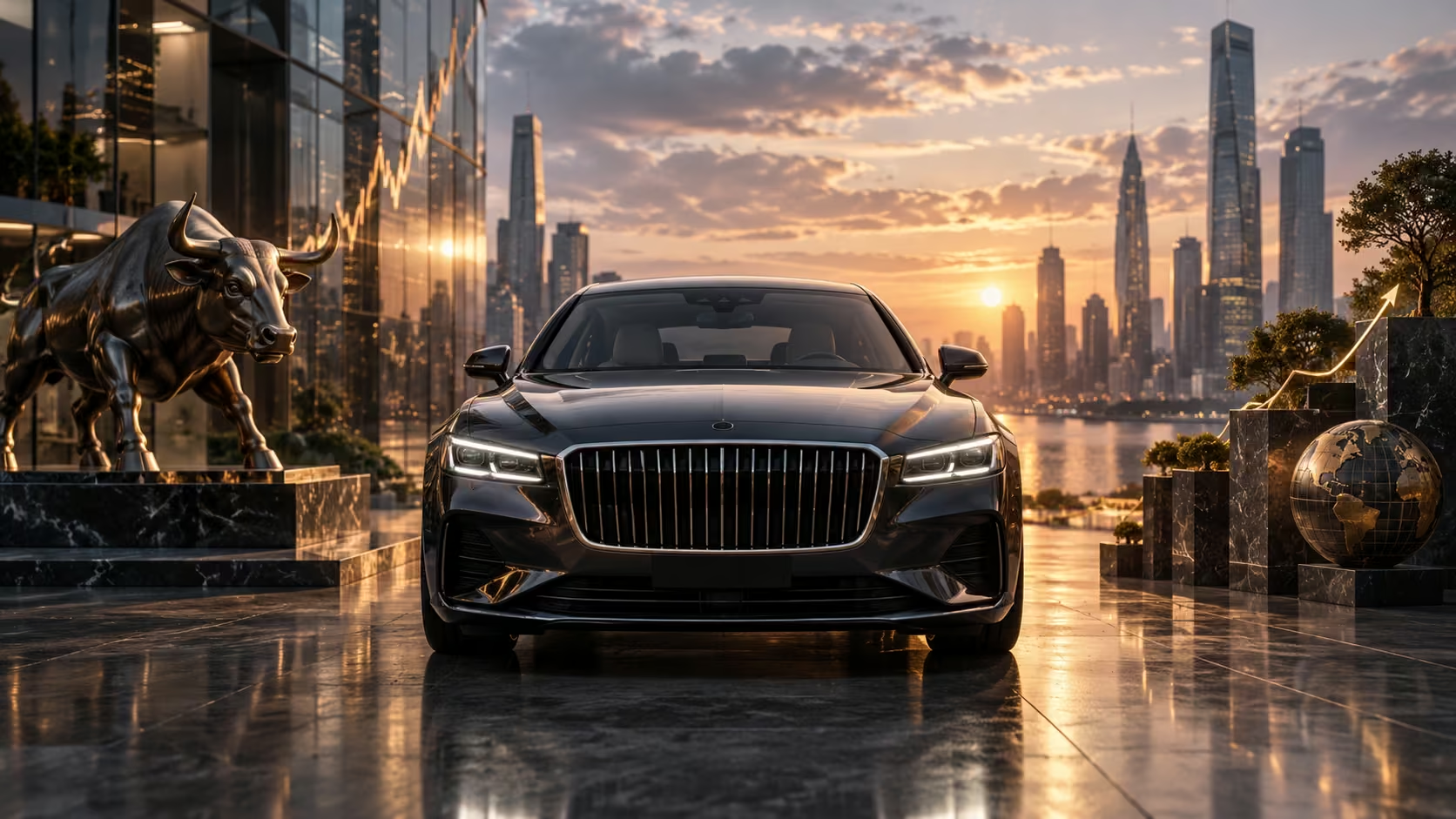
If you had enough money to buy a luxury car, would you rather get behind the wheel of an expensive vehicle today or put that same money to work so that it could be worth more several years from now?
At first glance, the choice seems simple: enjoyment and comfort today or building wealth for the future?
Buying a luxury car is not necessarily a bad financial decision. But when a significant amount of capital is involved, the purchase price is not the only factor that matters. Depreciation, maintenance costs, and most importantly, the opportunity cost of the capital should also be considered.
So the real question is not whether a car is better than an investment. The question is: Which choice makes more financial sense given your circumstances?
Is a Luxury Car Really an Asset?
When you spend a significant amount of money on a luxury car, it is natural to consider it one of your assets. After all, a car has monetary value and can be sold at any time. But from a financial perspective, having value does not necessarily make something an investment.
A car is generally a consumption asset. Along with its financial value, you use it for transportation, comfort, and enjoyment. By contrast, a capital or productive asset can generate income or returns for you over time.
The problem begins when someone uses a large portion of their capital to purchase a vehicle that generates no income and does not necessarily preserve its value. A car may face depreciation year after year, while its owner continues to pay for insurance, servicing, repairs, tires, and other maintenance costs.
This does not mean that buying a luxury car is a bad decision. If a person's income and assets are sufficient to make the purchase without creating financial pressure, it can be a perfectly reasonable personal choice to improve their quality of life.
But if you have to choose between buying the car and investing the same amount of money, your perspective needs to change. You are no longer simply deciding which car to buy; you are deciding what happens to a portion of your capital.
And this is exactly where an important question arises: Is the real cost of a luxury car simply the amount you pay to purchase it? The answer is more complicated than the price tag suggests.
What Is the Hidden Cost of Buying a Luxury Car?
When you see the price of a luxury car, the first number that probably comes to mind is the purchase price. But the true cost of owning a car begins there—it does not end there.
The first cost is depreciation. Many vehicles lose part of their value after purchase, and the extent of that decline depends on factors such as the brand, model, production year, mileage, and market conditions. The amount you pay for a car today, therefore, is not necessarily the amount you will receive when you eventually sell it.
Then come the ongoing expenses: insurance, routine servicing, repairs, tires, fuel, and maintenance. With luxury vehicles, some of these costs can be significantly higher than those of ordinary cars.
But there is another cost that is often overlooked: the opportunity cost of capital.
Suppose you have set aside $200,000 to buy a car. Once you purchase the vehicle, that $200,000 is no longer available for investment in another asset. The true cost of your decision, therefore, is not simply the price of the car; it also includes the return you could potentially have earned by putting that capital to work elsewhere.
That is why a more complete comparison looks something like this:
True cost of the car = Purchase price − Future resale value + Ownership costs + Opportunity cost of capital
Of course, this formula does not mean that investing will always generate a higher return than buying a car. Markets involve risk, and no return is guaranteed. The goal is simply to consider all the costs and forgone opportunities before making a decision.
Now imagine that the money you were planning to spend on the car is invested instead of being tied up in a consumption asset. The difference between these two paths may not seem significant in the first year. But over time, the effect of compound returns can completely change the equation.
What Happens If We Invest the Money Instead?
Suppose you have $200,000 available to buy a luxury car. You can either spend that money on the vehicle or invest it.
To illustrate the difference, assume that your investment generates an average annual return of 8%, with the returns reinvested. Under this hypothetical scenario, the $200,000 would grow to approximately:
PeriodApproximate Investment Value3 years$252,0005 years$294,00010 years$432,000
Note: The figures in the table represent a hypothetical scenario and do not account for taxes, investment fees, or the impact of inflation. They are provided solely to illustrate the effect of compound returns and should not be interpreted as guaranteed returns.
By contrast, during the same period, a luxury car will generally face depreciation, ownership costs, and a decline in value, although it will still retain some resale value.
So the real comparison is not simply “car price” versus “investment amount.” You need to consider how much the car will be worth in the future and how much the alternative investment could potentially be worth over the same period.
Put simply, the important question is:
If I do not spend this money on a car today, how much capital could I potentially have several years from now?
Answering that question can make the financial decision much clearer.
But does this mean that buying a luxury car is always the wrong decision?
Absolutely not.
When Can Buying a Luxury Car Be a Financially Reasonable Decision?
Buying a luxury car is not always a financially unreasonable decision. If your income, savings, and other assets are sufficient to ensure that purchasing the car does not undermine your core investments, you can view it as an expense for comfort and lifestyle.
For example, if buying the car does not force you to use up all your liquidity, take on significant debt, or put your investment plan on hold, the financial pressure of the purchase will be much lower.
The choice of vehicle also matters. Some models depreciate less, have stronger resale markets, and come with more manageable ownership costs. So even if you decide to buy a luxury car, making a more informed choice can help reduce its financial cost.
But there is an important boundary: when buying a car consumes a large portion of your capital, the decision is no longer simply about lifestyle. It becomes a significant capital allocation decision.
In such circumstances, it may be worth asking yourself: After buying the car, will I still have enough capital available for future financial opportunities?
If the answer is yes, buying the car can be part of your financial plan. If the answer is no, investing part of that money and postponing the purchase may make more financial sense.
This distinction shows why the car's price alone is not a good measure for making the decision. The car's price relative to your total assets and income matters much more.
When Is Investing the Car Money the Better Choice?
If buying a luxury car is going to consume a significant portion of your capital, investing may be a more attractive option—particularly when your primary goal is to preserve your money's value and build wealth over the long term.
The main advantage of investing is that, rather than being converted into a consumption asset, your capital can be placed in assets that have the potential to generate returns or income. Of course, no investment is risk-free, and the choice of assets should reflect your risk tolerance, time horizon, and financial goals.
Another important consideration is diversification. Instead of concentrating a large portion of your capital in a single vehicle, you can spread your capital across different assets to reduce your portfolio's dependence on one market or asset.
Investing also gives you greater flexibility. If an attractive opportunity appears in the market, having liquid capital or easily tradable assets can allow you to take advantage of it. By contrast, a large portion of the money spent on a car is tied up in a consumption asset.
However, investing can only be a better choice if the investment itself is appropriate. Putting money into an unsuitable or excessively risky asset simply to avoid buying a car is not necessarily a smart financial decision.
So after comparing the car with investing, an even more important question arises: How can you determine which option is more suitable for your own financial circumstances?
Buying a Car or Investing: Which Is Right for You?
There is no universal answer to this question. The right decision depends on your financial situation, goals, and even how much you actually use the vehicle.
To make the decision, consider these questions:
1. What Percentage of Your Capital Will the Car Consume?
If the car would account for a large portion of your assets, think carefully about the opportunity cost of that capital before making the purchase.
2. How Much Capital Will You Have Left After the Purchase?
If you still have an emergency fund and sufficient capital for your other financial goals after buying the car, the financial pressure of the decision is lower.
3. What Is the Purpose of This Money?
If your primary goal is comfort and personal use, a car can be a reasonable choice. But if your goal is to grow your capital and build wealth, investing deserves more serious consideration.
4. How Much Practical Use Will You Get From the Car?
A car that you use every day provides a different level of consumption value from one purchased primarily for display or social status.
5. What Is the Alternative Investment?
Comparing a car with an “unspecified investment” does not tell you much. You need to know what asset the money would be invested in, what level of risk it carries, and how long the investment would be held.
Ultimately, if you can purchase the car without damaging your financial structure, it can be a lifestyle choice. But if you have to stop investing or use a large portion of your assets to buy it, the true cost of the car will be far higher than the price on its sticker.
And if you do decide to buy, one important question remains: Can you own a luxury car while minimizing the impact on your capital?
If You Buy a Car, How Can You Minimize the Financial Loss?
If, after reviewing your financial circumstances, you decide to buy a luxury car, making the right choice can significantly reduce its future costs. The goal is not to turn the car into an investment; it is to control its ownership costs and depreciation.
Choose a Car With a Strong Resale Market
The brand and model can have a significant impact on demand in the used-car market. A vehicle with strong resale demand can generally be sold more easily and with more manageable depreciation.
Don't Focus Only on the Purchase Price
Before buying, consider insurance, routine servicing, parts, repairs, and fuel consumption. A car may have an attractive purchase price but still create high ownership costs.
Don't Put All Your Capital Into the Car
One of the most important principles is to preserve part of your capital for investments and liquidity. If buying the car requires you to spend all your savings, even an otherwise suitable vehicle can become a poor financial decision.
Consider How Long You Plan to Keep the Car
If you know you will keep the vehicle for a long time, its long-term ownership costs should also be included in your calculations. By contrast, frequently replacing cars can increase depreciation and transaction costs.
Ultimately, the best car is not necessarily the most expensive model on the market. It is the one that fits your income, assets, and financial goals.
If your real goal is to build wealth, where should buying a luxury car rank among your financial priorities?
Conclusion: Should You Buy a Car or Grow Your Capital?
Buying a luxury car can be enjoyable, but it should not be confused with investing. A car is generally a consumption asset that, alongside the benefits of personal use, comes with costs such as depreciation, insurance, and maintenance.
Investing, by contrast, is intended to grow capital over time—although no return in financial markets is guaranteed, and every investment carries its own level of risk.
Therefore, if buying a car represents only a small part of your financial position and does not compromise your savings, liquidity, or investments, it can be a reasonable choice. But if purchasing a luxury car means spending a large portion of capital that could potentially grow in the future, the opportunity cost deserves serious consideration.
Perhaps the best decision is not always “car or investment.” You can first build a solid financial foundation and investment portfolio, then allocate a portion of your income or investment gains toward purchasing a car.
Ultimately, the issue is not whether a luxury car is good or bad. The real question is whether buying it aligns with your financial goals.
Wealth is not built only by how much money you have today; it is built by the decisions you make about your money for tomorrow.