.svg)
.svg)
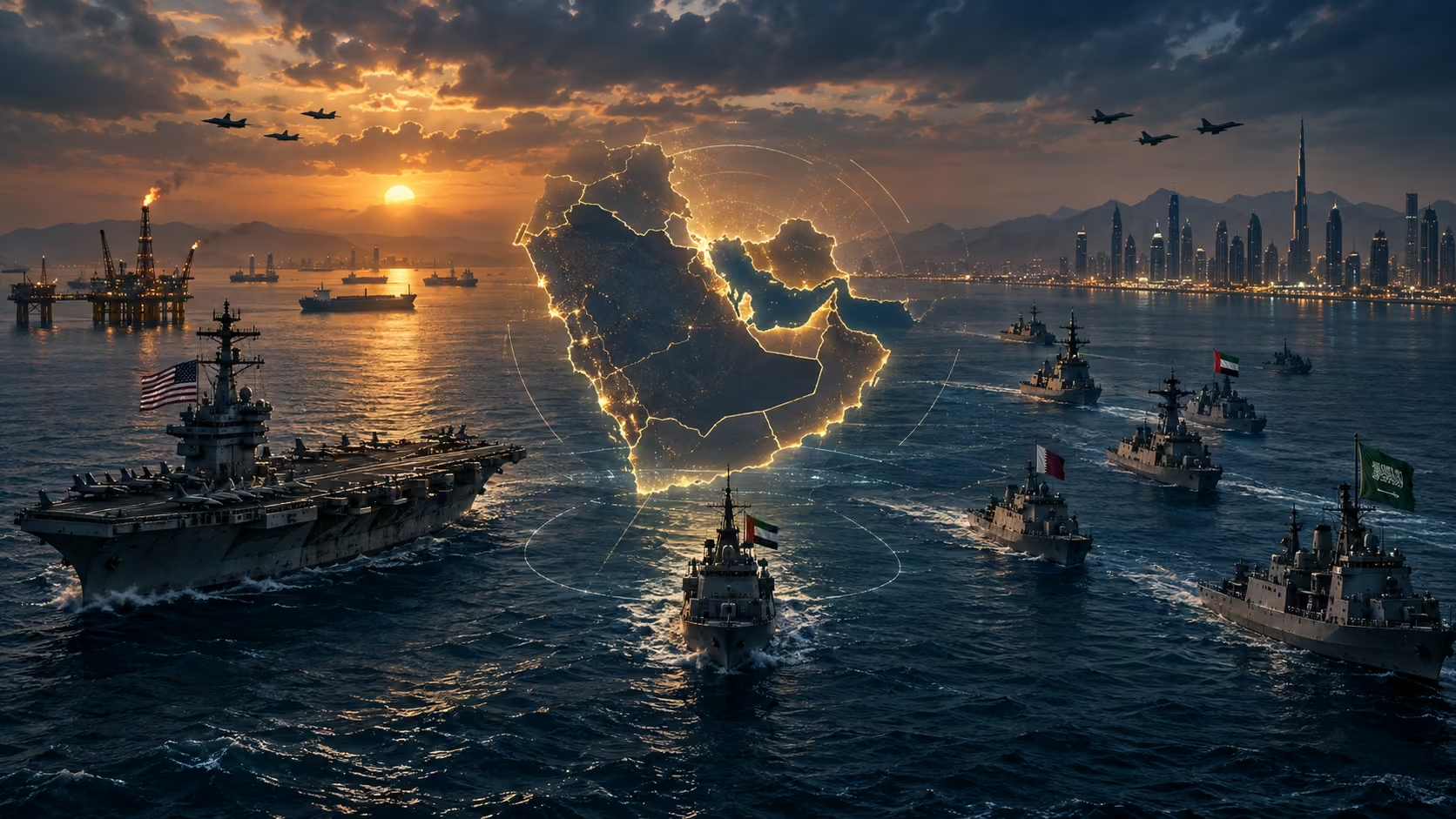
Lindsey Graham's Death: Impact on the Middle East Economy

On July 11, 2026, U.S. Senator Lindsey Graham died at age 71. After more than two decades in the Senate, he had become one of Washington’s most visible voices on national security, Iran, Israel, defense policy, and the United States’ role in the Middle East.
For investors, the significance of his death is not the headline alone. The relevant question is whether his absence changes congressional priorities, sanctions policy, defense spending, or the political tone surrounding U.S. engagement with the region.
Financial markets generally respond to the expected economic consequences of political events rather than to the events in isolation. That means any sustained effect on oil, gold, defense companies, or Gulf economies would depend on subsequent policy decisions—not simply on the loss of one senator.
This article examines what changed after Graham’s death, what did not, and which developments investors should monitor when assessing the potential implications for the Middle East economy and global markets.
Why Lindsey Graham Mattered in U.S. Foreign Policy
Graham represented South Carolina in the U.S. Senate from 2003 until his death in 2026. During that period, he developed a prominent public role in debates involving:
- U.S. national security and defense spending
- Iran and its nuclear program
- U.S.–Israel relations
- Sanctions and military deterrence
- Security partnerships with Gulf countries
- Russia, Ukraine, and China
He generally supported a strong international role for the United States and frequently advocated tougher pressure on Iran, close strategic cooperation with Israel, and sustained investment in U.S. defense capabilities.
His influence should not be overstated, however. American foreign policy is produced through the interaction of the White House, Congress, the State Department, the Department of Defense, intelligence agencies, courts, and allied governments. One senator can influence debates and legislation, but cannot determine the entire direction of U.S. policy alone.
Who Replaced Lindsey Graham in the Senate?
The succession question has already been resolved. Darline Graham was appointed to fill the South Carolina vacancy on July 13, 2026, and took the oath of office on July 14, 2026.
This update matters because earlier analysis focused on the uncertainty surrounding the appointment. Investors should now pay attention to Senator Darline Graham’s voting record, committee work, legislative priorities, and positions on sanctions, defense, and foreign policy rather than treating the seat as vacant or the successor as unknown.
Early continuity does not guarantee that every policy position will remain unchanged. Congressional influence develops through committee assignments, coalition building, legislation, and relationships with the executive branch. The practical market question is therefore whether the transition produces measurable changes in policy—not whether the new senator shares a family name.
How Financial Markets Interpret Political Changes
Financial markets continuously reassess probabilities. A political development can alter expectations about sanctions, military activity, trade, energy supply, government spending, or diplomatic relations even before formal policy changes occur.
Initial reactions are often driven by uncertainty, but those moves may fade if institutions continue operating normally and policy remains broadly consistent. Lasting price changes usually require evidence that the event will affect earnings, supply and demand, interest rates, fiscal policy, or risk premiums.
For Graham’s death, the relevant transmission channels include:
- U.S. sanctions and negotiations involving Iran
- Congressional support for Israel and regional defense cooperation
- Defense authorization and appropriations
- Perceived risks to Middle Eastern energy production and shipping routes
- Investor demand for defensive assets during geopolitical uncertainty
Potential Effects on U.S.–Iran Policy
Graham was a consistent advocate of strong sanctions and pressure on Iran. His absence removes one influential hardline voice, but it does not automatically create a more conciliatory U.S. policy.
Future policy will still depend on the President, party control of Congress, Iran’s nuclear activities, regional security conditions, relations with U.S. allies, and the positions of other senators and committees. Investors should therefore avoid treating Graham’s death as a direct signal that sanctions will be eased or negotiations will expand.
A more useful framework is to monitor concrete indicators such as proposed legislation, sanctions announcements, diplomatic meetings, military deployments, and official statements from the administration and congressional leaders.
Could the Transition Affect Oil Prices?
The Middle East remains central to global energy supply, so changes in U.S. policy toward Iran, Israel, or Gulf partners can influence oil-market expectations. However, Graham’s death by itself is unlikely to determine the direction of oil prices.
Oil prices are shaped by a wider set of variables, including:
- Global supply and demand
- OPEC+ production decisions
- Commercial inventories and spare production capacity
- Economic growth in major consuming countries
- Sanctions and disruptions affecting producers or shipping routes
- The geopolitical risk premium embedded in futures prices
If future U.S. decisions reduce the perceived probability of conflict or supply disruption, part of the geopolitical risk premium could decline. If policy becomes less predictable or regional tensions rise, the opposite could occur. The U.S. Energy Information Administration similarly identifies supply, demand, inventories, and geopolitical disruptions as important drivers of oil-price expectations.
For a broader explanation of how markets price geopolitical risk before events occur, see Dar Al Tharwah’s analysis of oil, war, and investment strategy.
Could Gold Respond to the Political Uncertainty?
Gold can attract demand when investors seek diversification during periods of political or financial uncertainty. A short-lived increase in uncertainty around U.S. foreign policy could therefore support gold sentiment, but the relationship is not automatic.
Gold prices also respond to:
- Real and nominal interest rates
- The strength of the U.S. dollar
- Inflation expectations
- Central-bank demand
- Broader risk appetite and liquidity conditions
Research on central-bank reserves published by the International Monetary Fund shows that gold’s safe-haven behavior can vary across shocks and market conditions. Investors should therefore evaluate gold within a diversified portfolio rather than assume that every negative political headline will push its price higher.
Dar Al Tharwah’s guide to oil and gold prices before major events explains why expectations can move prices before the news and why prices sometimes reverse after an event is confirmed.
Defense Companies and U.S. Military Spending
Graham strongly supported U.S. defense spending and military readiness. His death removes one advocate from congressional debates, but defense budgets are determined by a much broader process involving national-security assessments, authorization bills, appropriations, the administration, and bipartisan coalitions.
Defense companies may respond if the transition contributes to measurable changes in procurement, military aid, weapons programs, cybersecurity spending, or regional commitments. Without such policy evidence, attributing sector performance to this single event would be speculative.
Investors following defense contractors should focus on enacted budgets, contract awards, program cancellations, and official policy rather than political commentary alone.
Implications for Israel and Gulf Countries
Graham was a prominent supporter of Israel, but the U.S.–Israel relationship has deep institutional and bipartisan foundations. His absence may alter the tone or composition of some congressional debates, yet it is unlikely by itself to transform the strategic relationship.
Gulf countries—including the UAE, Saudi Arabia, Qatar, Kuwait, Bahrain, and Oman—also maintain extensive security, trade, and investment relationships with the United States. The economic effects of any policy change would likely appear through several channels:
- Regional security and defense cooperation
- Oil prices and energy revenues
- Foreign direct investment and capital flows
- Tourism and business confidence
- Government spending and fiscal planning
If geopolitical risk declines, investment confidence and tourism could benefit. If U.S. security commitments become less predictable, regional governments could increase defense spending or deepen partnerships with Europe and Asia. These are scenarios to monitor, not predetermined outcomes.
Possible Effects on the UAE
The UAE’s diversified economy is connected to regional security, global trade, tourism, real estate, and capital markets. Reduced tensions could support confidence and investment, while renewed instability could affect risk premiums, energy revenues, and business activity.
Investors should distinguish between short-term market sentiment and structural economic change. The UAE’s financial-market development, fiscal capacity, infrastructure, and international connectivity matter more to its long-term outlook than the departure of any single U.S. senator. For local context, see Dar Al Tharwah’s overview of UAE capital markets.
What Investors Should Watch Next
Darline Graham’s Legislative Record
Monitor committee assignments, sponsored legislation, votes, and public positions on Iran, Israel, Russia, defense spending, and sanctions.
U.S. Policy Toward Iran
Watch official sanctions actions, negotiations, nuclear-policy statements, and regional military developments rather than relying on assumptions about a single political transition.
Defense Budgets and Procurement
Enacted spending, contract awards, and authorization bills provide stronger evidence for defense-sector analysis than political rhetoric.
Oil and Gold Risk Premiums
Compare geopolitical headlines with actual changes in supply, inventories, interest rates, the dollar, and investor positioning.
Gulf Investment and Economic Indicators
Track tourism, foreign investment, real-estate activity, capital-market performance, and regional risk measures. Inflation and interest-rate conditions also remain important for Gulf investors; see Dar Al Tharwah’s analysis of UAE inflation.
Conclusion: Focus on Policy, Not the Headline Alone
Lindsey Graham’s death was a significant political event because of his long record and visibility in U.S. foreign-policy debates. It removed one influential advocate of a forceful U.S. role in the Middle East, strong defense spending, support for Israel, and pressure on Iran.
Yet the immediate succession has been completed, and U.S. policy remains institutionally driven. A key development following his death is that Darline Graham has been appointed and sworn in. Investors should now evaluate her actions and the broader decisions of Congress and the administration.
Any durable effect on oil, gold, defense companies, or Gulf economies will depend on measurable changes in sanctions, diplomacy, security commitments, energy supply, and government spending. A disciplined investor should treat the event as a reason to monitor policy developments—not as a direct instruction to buy or sell an asset.