.svg)
.svg)
The UAE’s Exit from OPEC: Behind a Historic Decision
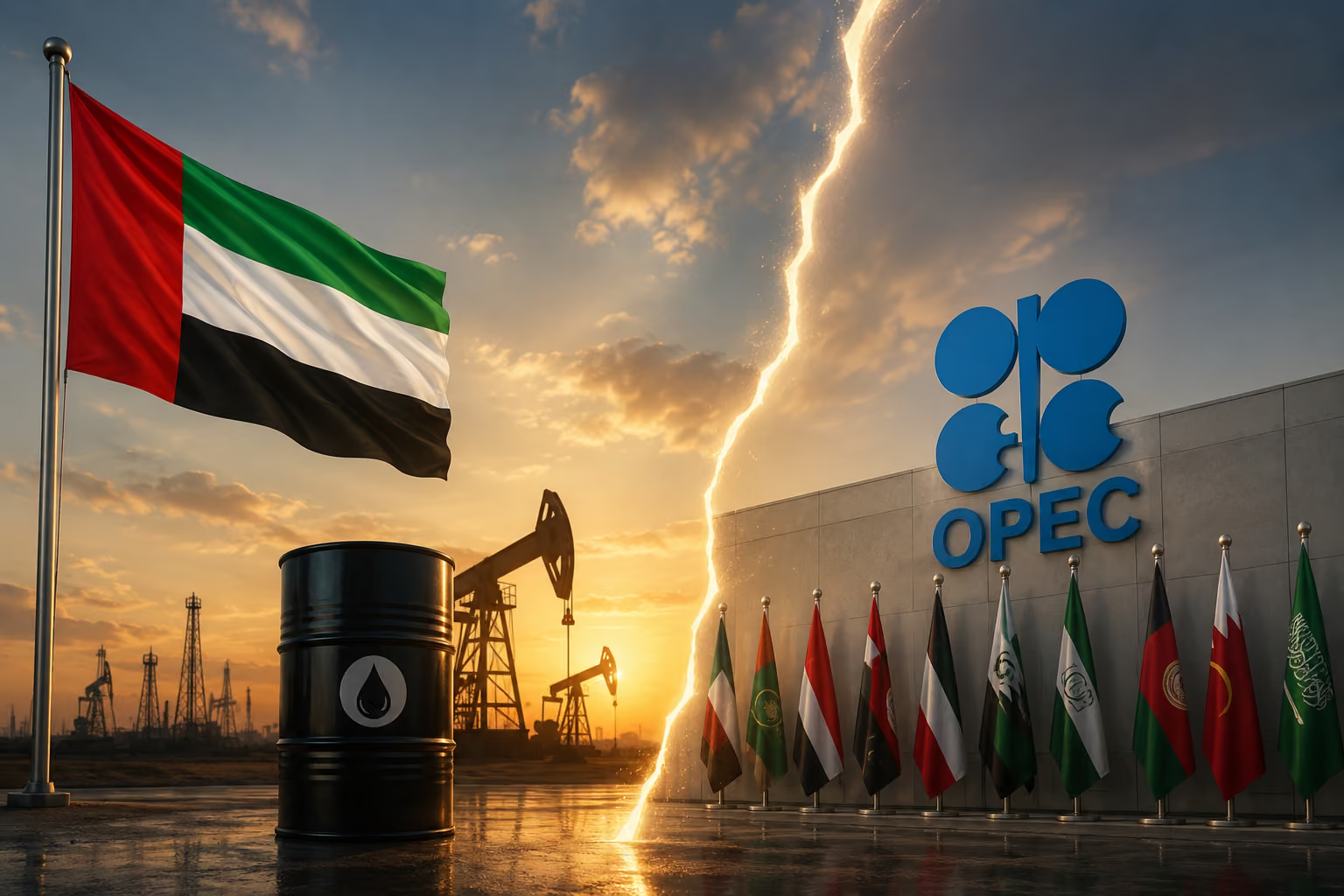
When an oil-producing country decides to step away from OPEC and the OPEC+ cooperation framework after nearly six decades of membership, the issue is not merely an administrative change or a disagreement among oil producers. It can signal a broader shift in the strategies of major energy-exporting nations. The UAE announced this withdrawal on 28 April 2026, with effect from 1 May 2026.
But why did the UAE decide to move away from OPEC’s traditional framework? Was this decision driven by political disagreements, or was it an economic calculation aimed at gaining a larger share of the global oil market?
In recent years, the UAE has made significant investments to expand its oil production capacity. However, production limits imposed through OPEC+ agreements prevented the country from fully utilizing its growing output potential. This issue became one of the main sources of tension between the UAE and the quota-based structure of the organization. From the UAE’s perspective, maintaining these restrictions meant that part of its major investments remained underutilized.
However, the significance of this development extends far beyond the oil industry. A change in production policy by one of the world’s largest oil exporters can influence energy prices, inflation, interest rates, oil company stocks, and even capital flows in global financial markets.
In this article, we examine the reasons behind the UAE’s decision to move away from OPEC, the roots of its disagreement with the organization’s structure, and what this shift could mean for the future of the oil market and investors.
What Is OPEC and Why Do Oil Production Quotas Matter?
To understand the UAE’s disagreement with OPEC, it is first important to understand how the organization manages the oil market.
OPEC (Organization of the Petroleum Exporting Countries) is a group of oil-producing nations that works to coordinate oil policies and maintain balance in the global energy market.
The organization’s most important tool for influencing oil prices is managing production levels among its members. By setting production quotas, member countries attempt to keep oil supply at a level that prevents severe price declines.
Alongside OPEC, the OPEC+ alliance was formed, bringing together OPEC members and non-member producers such as Russia to cooperate on decisions related to oil production.
However, this quota system has become one of the main points of disagreement among members in recent years because countries do not have identical conditions. Some nations have increased their production capacity and believe they should have greater flexibility to utilize these resources.
The UAE has been one of the most prominent examples of this situation.
Why Did the UAE Decide to Move Away from OPEC’s Traditional Policy?
The UAE’s decision to distance itself from OPEC’s traditional framework was not a sudden move. It can be understood against several years of growing differences between the country’s development plans and OPEC+ production policies.
Over the past years, the UAE has made substantial investments in its oil sector. Expanding oil fields, increasing production capacity, strengthening export infrastructure, and developing the capabilities of its energy companies have all been part of a broader strategy aimed at increasing the UAE’s role in the global oil market.
However, one major challenge remained: the gap between the UAE’s production capacity and the amount of oil it was allowed to produce.
Put simply, the UAE had built a larger production system, expanded its infrastructure, and prepared for higher output, but OPEC+ restrictions prevented it from fully using that capacity.
From an economic perspective, this issue was highly significant for the UAE. When a country invests billions of dollars to increase production capabilities, it expects those investments to translate into higher exports, greater revenues, and stronger economic growth. Leaving part of that capacity unused can reduce the return on investment.
On the other hand, some major OPEC members were concerned that increasing the UAE’s production quota could encourage other countries to make similar demands. If every country sought higher production based on newly expanded capacity, controlling global oil supply would become more difficult and OPEC’s ability to coordinate the market could weaken.
Therefore, the disagreement between the UAE and OPEC was not only about production levels; it was about a much larger question:
Should the priority of the oil market be maintaining prices through supply restrictions, or should countries with greater production capacity be allowed to capture a larger share of the market?
The Main Disagreement Between the UAE and OPEC: The Production Baseline
One of the most important points of disagreement between the UAE and OPEC+ was an issue known as the “production baseline.” The EIA documented this dispute in July 2021; the subsequent agreement provided for higher baselines from May 2022, including for the UAE.
The baseline is a reference number used by OPEC to calculate each country’s production quota. In agreements related to production cuts or increases, the amount of oil each country is allowed to produce is determined based on this figure.
The UAE argued that the baseline assigned to the country no longer reflected the reality of its oil industry. The reason behind this objection was clear: the UAE had significantly increased its production capacity in recent years, but this growth had not been fully reflected in the quota calculations.
From the UAE’s perspective, it did not make economic sense to make large investments in expanding production capacity while being unable to fully utilize that capacity.
On the other hand, other OPEC members were concerned that changing the baseline for one country could create a new wave of requests from other producers seeking higher quotas. Under such circumstances, maintaining agreement among members would become increasingly difficult.
Therefore, the UAE’s disagreement with OPEC was ultimately a disagreement over the future of oil market management: should production be restricted to support prices, or should producers be allowed to utilize their newly expanded capacity?
Behind the UAE–Saudi Arabia Disagreement: Two Views on the Future of Oil
The disagreement between the UAE and OPEC cannot be viewed as merely a technical dispute over production quotas. Behind this issue are two different perspectives on the future of the oil market.
Saudi Arabia, as one of the world’s largest oil producers, has traditionally emphasized supply management and maintaining market balance. For Saudi Arabia, oil prices are highly important because a significant portion of government revenues and development projects depend on energy income.
In contrast, the UAE has followed a different path. The country has focused on expanding its oil production capacity and gaining a larger share of the global market.
One interpretation of the UAE’s strategy is based on maximizing the opportunity available in the current oil market: as long as global demand for oil remains strong, the country aims to produce more, generate higher energy revenues, and redirect those earnings into other sectors of the economy.
These revenues can be invested in areas such as technology, artificial intelligence, tourism, infrastructure, renewable energy, and financial markets.
Therefore, the main difference between the UAE and Saudi Arabia can be seen less as a political confrontation and more as a difference in economic strategy.
One perspective emphasizes:
Lower production
Controlled supply
Higher oil prices
The other perspective emphasizes:
Higher production
Greater market share
Using oil revenues to build the economy of the future
In recent years, the UAE has moved closer to the second approach.
Was the UAE’s Exit from OPEC an Economic Decision or a Political One?
When an important oil-producing country decides to distance itself from a decades-old organization like OPEC, it is natural for many observers to look for political reasons behind the decision. Regional disagreements or external pressures are possible interpretations, rather than reasons established by the official announcement.
However, the UAE’s official announcement emphasized its long-term economic strategy and national interests. This supports an economic interpretation, without establishing that political factors played no role.
Over recent years, the UAE has followed a clear strategy to increase its role in the global energy market. Through expanding production capacity, investing in oil infrastructure, and strengthening its energy companies, the country has sought to establish a stronger position in the global oil industry.
From this perspective, OPEC+ production restrictions became an economic challenge for the UAE. A country with greater production capacity naturally wants to use that capacity to increase exports and generate higher revenues.
Of course, the role of political and geopolitical factors in the oil market cannot be ignored. Energy has always been closely connected to international relations, regional security, and the strategies of major global powers.
One question that emerged was whether the United States or major oil-consuming countries supported higher UAE production. The reason behind this speculation is clear: under normal conditions, increased oil supply can help reduce energy prices and ease inflationary pressures.
However, the official announcement does not establish that the UAE’s decision was the result of direct pressure or instructions from a foreign country. A more reasonable interpretation is to view this development within the framework of the UAE’s broader economic strategy: gaining greater control over its oil resources and taking advantage of opportunities in the global energy market.
Ultimately, the key message behind this decision is that some oil-producing nations are increasingly seeking to shape their energy policies based on domestic economic interests and long-term development plans.
How Does the UAE’s Exit from OPEC Affect Oil Prices and the Global Energy Market?
One of the most important questions following this development is whether the UAE’s exit from OPEC could change global oil prices.
The answer is that the UAE alone cannot determine the direction of the oil market, but its decision can become one of the factors influencing the balance between supply and demand. The UAE stated that additional production would be introduced gradually, in line with demand and market conditions.
The oil market is shaped by multiple factors, including production levels from major producers such as Saudi Arabia, Russia, and the United States, China’s economic growth, geopolitical developments, sanctions, and the security conditions of energy transportation routes.
However, an increase in production from a major oil producer like the UAE can send an important signal to the market. If oil supply increases and other producers follow the same path to protect their market share, the possibility of excess supply could rise.
Under such conditions, oil prices may come under downward pressure.
However, lower oil prices do not have the same impact across all areas of the economy.
For oil companies, especially those with higher production costs, declining oil prices can reduce revenues and weaken profitability. These companies may be forced to cut back on some development projects.
In contrast, large energy companies with lower production costs, extensive reserves, and diversified operations such as refining and petrochemicals usually show greater resilience during periods of lower oil prices.
On the other hand, cheaper oil can create opportunities for sectors such as transportation, aviation, and energy-intensive industries, as fuel and production costs decline.
Another important impact is related to inflation. Energy is one of the key cost factors in the global economy. Lower oil prices can reduce inflationary pressure and give central banks more room to lower interest rates.
Changes in interest rates can also affect financial markets and influence capital flows between assets such as stocks, bonds, gold, and currencies.
Therefore, a decision related to oil production in the Gulf region can affect various parts of the global economy through a broad economic chain.
What Does the UAE’s Exit from OPEC Mean for Investors?
For investors, the significance of the UAE’s exit from OPEC goes beyond changes in oil production levels. This development may indicate a shift in the behavior of major energy producers and the beginning of a more competitive period in the oil market.
In the past, many investors relied heavily on official OPEC decisions when forecasting oil prices. However, today’s market environment is more complex. In addition to organizational agreements, investors must also analyze the actual behavior of countries such as the UAE, Saudi Arabia, Russia, and the United States.
If the UAE increases production and other producers also seek to expand supply in order to protect their market share, oil prices could face greater downward pressure. Under these conditions, weaker oil companies with high production costs or heavy debt levels may face greater risks.
On the other hand, companies with low production costs, strong balance sheets, and stable cash flows are generally better positioned to withstand periods of market volatility.
However, the impact of this development is not limited to energy stocks. Oil prices are a major factor affecting many sectors of the economy.
For example:
Lower energy prices could benefit transportation and aviation companies.
Production costs for certain industries could decline.
Inflationary pressures could decrease.
Monetary policies of central banks could change.
For this reason, investors should not view the UAE’s exit from OPEC only as news related to the oil industry. This development could become part of a broader chain of events that eventually affects different financial markets.
However, it is important to remember that the oil market is always surrounded by uncertainty. Wars, sanctions, political crises, disruptions to export routes, and sudden changes in global demand can completely alter market expectations.
Therefore, a rational investment approach is not to focus on a single scenario, but to consider multiple possibilities — from lower oil prices due to increased supply to higher prices caused by geopolitical disruptions.
Is the UAE’s Exit from OPEC the End of the Organization’s Influence?
The UAE’s decision has raised an important question: will OPEC lose its previous ability to manage the global oil market in the future?
The answer is that it is still too early to declare the end of OPEC’s role. The organization remains one of the most influential players in the global energy market, and its members continue to control a significant share of the world’s oil production and reserves.
However, the decision of a former member like the UAE to leave the organization shows that managing the oil market may become more challenging in the future.
OPEC’s main challenge is balancing the different interests of its members. Some countries prefer limiting supply in order to keep oil prices at higher levels, while others prefer increasing production to capture a larger share of the market.
At the same time, the global oil market is no longer influenced by OPEC alone. U.S. oil production, Russia’s policies, China’s economic growth, the expansion of clean energy, and changes in transportation technologies all play important roles in shaping the future of the energy market.
Therefore, the UAE’s exit should not be viewed as the end of OPEC’s power. Instead, it should be seen as a sign of changing conditions in the energy market and the growing importance of competition among producers.
Conclusion: What Does the UAE’s Exit from OPEC Mean for the Future of Oil?
The UAE’s exit from OPEC cannot be viewed simply as a political disagreement or a short-term decision. Instead, it appears to be the result of a long-term economic calculation: a country that has invested heavily in expanding its production capacity now wants greater control over its output levels and oil revenues.
The core disagreement between the UAE and OPEC’s structure centered on one key question:
Should oil production be restricted to protect prices, or should countries with greater capacity be allowed to capture a larger share of the market?
It appears that the UAE has chosen the second path: making greater use of its oil resources during a period when global demand for oil remains strong and transforming energy revenues into capital for developing other sectors of the economy.
For investors, the most important message from this development is that the oil market may be entering a period of increased competition for market share. This could influence oil prices, energy company stocks, inflation, interest rates, and global capital flows.
Ultimately, the UAE’s exit from OPEC is not just a story about the oil industry; it is part of a broader transformation in the global energy economy. A transformation that shows oil-producing countries are reassessing their strategies to build a future that is not entirely dependent on oil.