.svg)
.svg)
The Changing Security Order in the Gulf: Is the U.S. No Longer the Dominant Power?
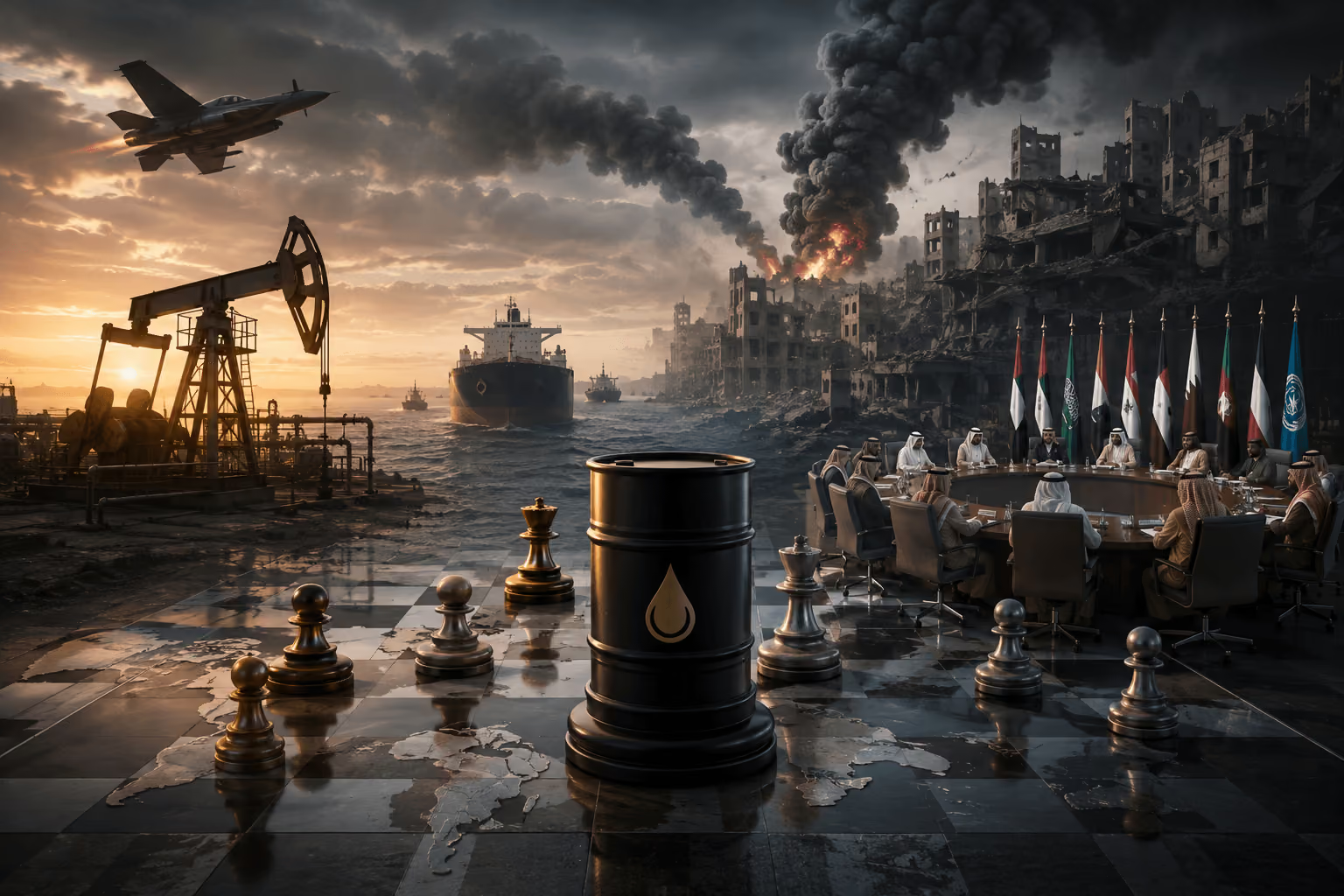
For decades, Gulf security was closely associated with one name: the United States. But today, that equation is changing.
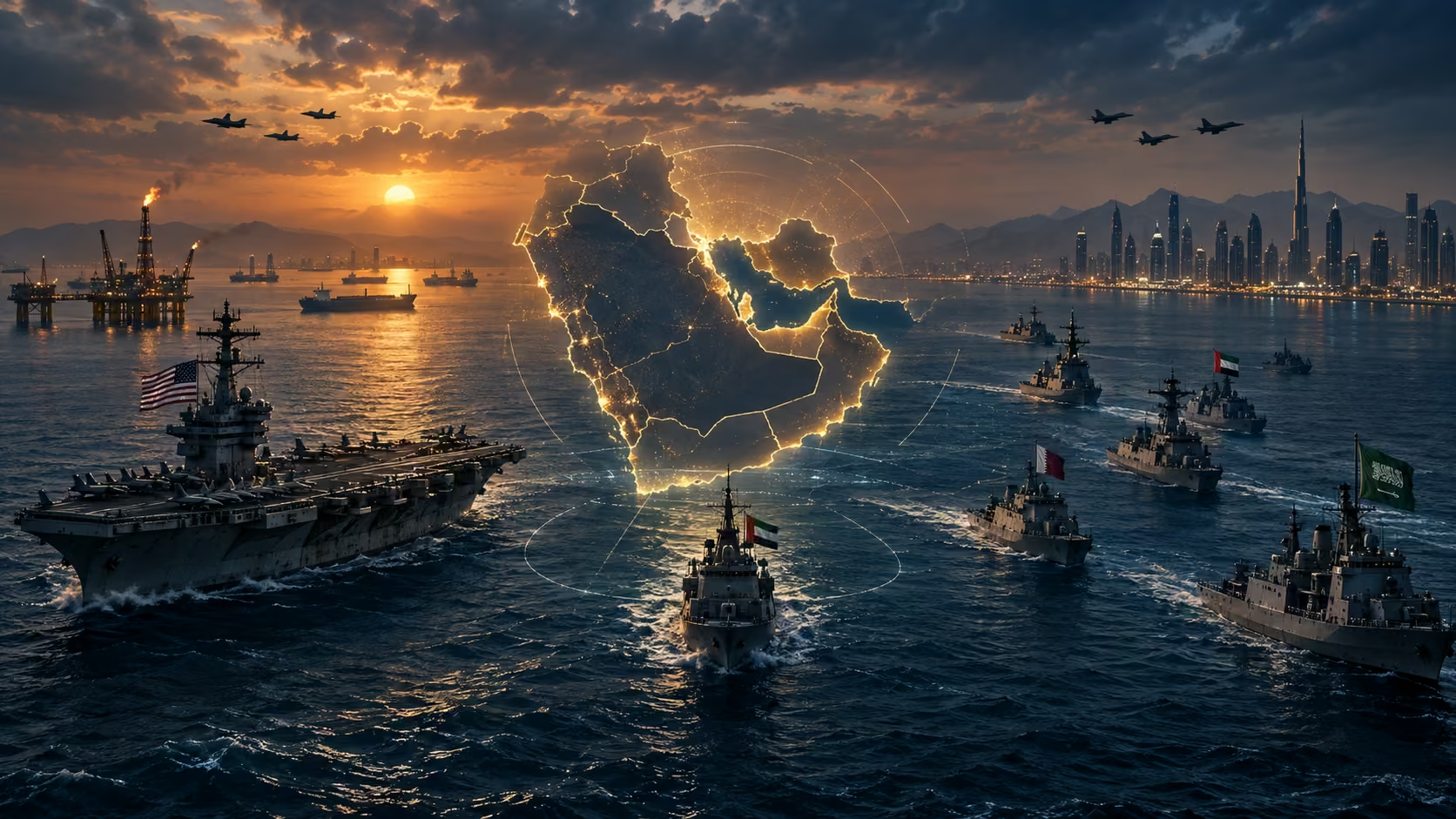
Gulf countries no longer want their security and economic futures to depend on a single power. Saudi Arabia, the UAE, and Qatar continue to maintain strategic relationships with Washington, but at the same time, they are expanding their ties with China and other regional powers.
China is no longer simply a buyer of Gulf oil. It has become an important partner in trade, technology, and investment. At the same time, regional countries are seeking greater strategic autonomy by strengthening their defense capabilities, diversifying their economies, and pursuing more active diplomacy.
This does not mean the United States is being pushed out of the Gulf. Rather, it signals the emergence of an order in which no single power is expected to remain the region’s only option.
But why is this shift happening now, and what kind of security order is the Gulf moving toward?
The answer could shape the future of one of the world’s most important regions for energy and capital.
How Did the Old Gulf Security Order Take Shape?
To understand why the Gulf security order is changing today, it is important to return to the point when this architecture first emerged.
After World War II, the strategic importance of the Gulf grew rapidly because of its geographic position, vast energy reserves, and competition among major powers. Britain was initially the region’s most important external power, but as London’s influence declined, the United States became the Gulf’s principal security actor.
The Iran-Iraq War and, later, Iraq’s invasion of Kuwait in 1990 accelerated this process. The United States played a decisive role in liberating Kuwait through Operation Desert Storm, after which Washington’s defense cooperation with the Gulf Cooperation Council states expanded significantly. Military bases, large-scale arms sales, military training, and defense agreements became the main pillars of this security architecture.
A relatively clear model had therefore emerged: Gulf states relied on the United States for hard security, while Washington maintained its strategic presence and influence in one of the world’s most important energy regions.
But the problem became apparent when it was clear that the presence of a major power did not necessarily mean the region was fully protected.
The 2019 drone and missile attacks on Saudi oil facilities, alongside regional conflicts and growing competition among Iran, Saudi Arabia, the UAE, and other actors, raised a critical question: Could the traditional security architecture actually respond to the Gulf’s emerging threats?
This uncertainty opened the door to an important shift. Rather than simply seeking a stronger security guarantor, Gulf countries began building a more diversified network of relationships and strategic options.
And this is precisely where China enters the story.
Why Do Gulf Countries No Longer Want to Rely Solely on the United States?
For years, relying on the United States was a logical choice for Gulf countries. But changes in the region’s geopolitical environment have encouraged them to develop more options.
Regional wars, attacks on energy infrastructure, and uncertainty over the extent of the U.S. commitment to Gulf security have shown regional governments that having only one powerful security partner can itself become a vulnerability.
As a result, the emerging strategy is not necessarily about “replacing the United States with China.”
Instead, Gulf countries are pursuing a model often described in geopolitical terms as multi-alignment: maintaining security relationships with the United States while simultaneously expanding economic, political, and even military ties with China, Russia, and regional powers.
This approach offers one major advantage: choice.
When a country can cooperate with Washington on defense, expand trade and technology ties with Beijing, and maintain diplomatic relations with regional powers at the same time, it has greater leverage in negotiations and is less likely to be forced to choose sides in great-power competition.
China has become one of the most important players in this equation precisely because of this dynamic—not necessarily as a replacement for the United States, but as an option that strengthens the strategic weight of Gulf countries.
How Did China Enter the Gulf’s New Strategic Equation?
China’s entry into the Gulf did not begin with warships or military bases. It began with oil, trade, and investment.
Over the past two decades, China has become one of the most important economic partners of the GCC countries. Energy was the starting point, but cooperation quickly expanded into infrastructure, technology, industry, investment, and trade.
The relationship was attractive to both sides. China needed energy and new markets, while Gulf countries needed capital, technology, and diversified economic partners to support their development projects.
But a more important turning point came when Beijing demonstrated that it could also play a role in the region’s political affairs.
China’s mediation of the 2023 Iran-Saudi Arabia agreement presented a different image of Beijing’s role. A country previously known primarily as an economic partner had now entered the field of one of the region’s most important geopolitical disputes.
For Gulf countries, this is precisely where China’s importance lies.
Beijing is not necessarily going to replace Washington as the provider of military security in the region. Existing evidence suggests that China still has little interest in taking on a military role in the Gulf comparable to that of the United States.
But China’s presence creates a new option—one that allows regional countries to expand their economic and political relationships without cutting their cooperation with the United States.
In other words, China’s importance to the Gulf is not determined only by the power China itself possesses. It is also determined by the option it gives regional countries.
And this is where an interesting paradox emerges: the deeper Gulf countries’ relationships with China become, the less the United States can afford to ignore the region. Washington must instead adapt to a Gulf that is becoming more independent and more diversified in its partnerships.
The U.S. Is Still the Gulf’s Leading Security Power—So What Has Changed?
If China is expanding its influence in the Gulf, does that mean the United States is losing the region?
Not exactly.
The United States remains the most important security partner for many Gulf countries. Its extensive military presence, regional bases, defense cooperation, and advanced weapons sales continue to make Washington one of the main pillars of regional security.
What has changed is the position of the United States in the strategic thinking of regional governments.
Gulf countries no longer want to build their security around the assumption that a foreign power will always be ready to guarantee their security under every circumstance. As a result, while maintaining their defense relationships with the United States, they have simultaneously expanded their ties with China, Russia, and regional powers.
This approach can be viewed as a form of balancing and strategic autonomy—not an exit from the U.S. orbit, but an effort to create more options in case circumstances change.
Even developments such as the 2026 Iran-U.S. war and the vulnerability of some U.S. military bases in the region have once again highlighted the limitations of the traditional security model.
As a result, the real competition is no longer simply about “the United States or China.”
The game has become more complex. Gulf countries want to benefit simultaneously from U.S. security, Chinese capital and markets, and their own regional relationships, while reducing their dependence on any single partner.
But this is more than a shift in foreign policy. A larger project is underway: transforming Gulf countries from consumers of security into actors capable of generating their own power.
And this is where the difference between “buying power” and “building power” becomes crucial.
From Buying Weapons to Building Power: How Is the Gulf Pursuing Defense Independence?
For years, one of the simplest ways to strengthen military capabilities in the Gulf was to purchase advanced equipment from foreign powers. But buying fighter jets, missiles, or defense systems does not necessarily mean achieving defense independence. A country that depends on foreign suppliers for equipment, spare parts, technology, and even military training still derives part of its military capability from others.
This is why Gulf countries have taken a step further in recent years: localizing the defense industry.
Saudi Arabia, through its Vision 2030 strategy, has set a target of localizing 50% of government defense spending by 2030. The UAE, meanwhile, is developing domestic capabilities through companies such as EDGE in areas including unmanned systems, weapons, and defense technologies.
This shift is not simply a military project. A domestic defense industry can support technology transfer, build local supply chains, develop specialized talent, and accelerate the growth of advanced industries—the same path Gulf countries are pursuing as they seek to reduce economic dependence and develop knowledge-based economies.
Strategic independence in the Gulf, therefore, is not only about who provides security for these countries. It is also about how capable these countries are of protecting their own interests.
But power is not built with missiles and fighter jets alone. A country seeking a larger role in the emerging global order must also be capable of generating power through its economy, technology, capital, and diplomacy.
And this is where the differences between Gulf countries become more visible. Saudi Arabia, the UAE, and Qatar may be moving in the same broad direction, but each has chosen a different model for becoming more strategically independent.
Saudi Arabia, the UAE, and Qatar: Three Different Models of Strategic Independence
If Gulf countries are all seeking to reduce their dependence, they are not following the same path. Saudi Arabia, the UAE, and Qatar represent three distinct models of strategic independence.
Saudi Arabia: Building Power from Within
Saudi Arabia is seeking to transform its geopolitical weight from that of a major oil exporter into a multidimensional economic, military, and political power. Vision 2030 is not simply an economic diversification project; the development of a domestic defense industry is also part of this broader strategy. Riyadh has set a target of localizing 50% of its military spending by 2030.
At the same time, Saudi Arabia has diversified its relationships among the United States, China, and regional powers. This approach gives Riyadh more options and greater leverage in its foreign policy.
The UAE: Combining Capital, Technology, and Influence
The UAE has chosen a different path. It is seeking to convert economic and technological capabilities into geopolitical influence. The development of ports and trade networks, foreign investment, artificial intelligence, and defense industries are all components of this strategy.
The creation of the defense company EDGE also shows that Abu Dhabi is not simply relying on foreign purchases of military equipment. It is seeking to develop domestic capabilities to produce advanced technologies and defense systems.
Qatar: Power Through Diplomacy
Qatar, meanwhile, follows another model. Rather than relying on geographical size or military strength, it uses energy, wealth, diplomacy, and mediation to increase its strategic weight.
Doha can simultaneously host a U.S. military presence, maintain extensive economic relations with China, and play a mediating role in sensitive regional disputes. This ability to maintain relationships with different sides gives Qatar a form of strategic influence that extends far beyond its geographical size.
Strategic independence in the Gulf, therefore, has no single formula. Saudi Arabia relies on scale and national power, the UAE on technology and capital, and Qatar on energy and diplomacy.
But as regional countries begin building these networks of relationships, another group of actors cannot be ignored: regional powers that are seeking their own role in the emerging security architecture of the Gulf.
Regional Powers Enter the Game: What Roles Do Iran, Turkey, and Pakistan Play?
The changing security order in the Gulf is not limited to competition between the United States and China. Alongside these two major powers, regional actors are also expanding their roles, each using different tools to influence regional security.
Iran is one of the most important of these actors. Its geographical position, missile and drone capabilities, and control over the Strait of Hormuz provide Tehran with leverage that cannot be ignored. Gulf Arab states, in response, are seeking to avoid relying solely on external security guarantees and to develop a wider range of defense options. Recent developments have also once again placed the vulnerability of regional energy routes and infrastructure at the center of the security debate.
Against this backdrop, Turkey and Pakistan are becoming increasingly important. Turkey has significant military capabilities and a growing defense industry, while Pakistan possesses substantial military capabilities and nuclear deterrence. The signing of the Joint Defense Agreement of Mecca between Saudi Arabia, Turkey, and Pakistan in August 2026 signals an effort to create new layers of security cooperation alongside traditional relationships with the United States. The agreement emphasizes mutual defense and cooperation in areas such as defense industries and joint capabilities.
The significance of this development can be summarized in one point: Gulf security is no longer simply a two-way relationship between Washington and the Arab states.
The more security, economic, and political partners the region has, the more options its countries have for managing crises.
But this multi-layering of relationships is not only about responding to military threats. Ultimately, a country seeking greater power in the new Gulf order must be able to turn security into economic stability—and economic stability into investment power.
What Does the New Gulf Security Order Mean for the Economy and Investment?
When a country no longer wants to depend on a single foreign power, it does not change only its defense policy. It also diversifies its economic and investment strategy.
In recent years, Gulf countries have directed billions of dollars toward sectors such as technology, infrastructure, renewable energy, artificial intelligence, tourism, and logistics. Sovereign wealth funds have also become major instruments for investment both inside and outside the region. The objective is clear: reduce dependence on oil and transform oil wealth into assets capable of building future economic power.
But the recent crisis has added another layer to this strategy.
The vulnerability of energy and trade routes to disruptions around the Strait of Hormuz has encouraged Saudi Arabia and the UAE to invest more heavily in alternative routes, ports, and pipelines. Economic security, in other words, is no longer determined solely by the size of a country's oil and gas reserves. It also depends on its ability to move those resources to global markets.
This shift in perspective is creating new investment opportunities. Ports, logistics, energy infrastructure, data centers, technology, and advanced industries are no longer simply economic projects. They are becoming part of the Gulf countries' broader strategies for resilience and national power.
As a result, investors looking at the future of the Gulf should not focus only on oil prices or stock markets. A more important question is: Which countries are building the infrastructure needed to withstand geopolitical shocks?
Perhaps this is the clearest difference between today's Gulf and the Gulf of the past. The region is no longer simply seeking greater security. It is increasingly turning security, capital, and infrastructure into instruments of global power.
What Does the Changing Gulf Security Order Mean for Investment?
The changing security order in the Gulf is not merely a political transformation; it is also reshaping the region’s investment landscape.
To reduce their vulnerabilities, Gulf countries have increased investment in areas such as infrastructure, ports, logistics, technology, artificial intelligence, renewable energy, and defense industries. The objective is not simply to diversify their economies. These projects are part of a broader effort to build economies that are more resilient and strategically independent.
For investors, this means that the Gulf’s future opportunities will no longer be limited to oil and gas. As the region moves toward diversified economies, strategic infrastructure, and advanced technology, new industries are likely to become increasingly important.
Ultimately, the key question is not whether the United States will leave the Gulf. The more important question is how far regional countries can protect their interests and increase their power without relying on a single external power.
Conclusion: The Gulf Is Not Choosing Power; It Is Building Power
The Gulf’s security order is not collapsing; it is changing shape.
The United States remains one of the most important pillars of regional security, but Gulf countries no longer want to tie their futures to a single power. Expanding relations with China, strengthening cooperation with regional powers, developing domestic defense industries, and investing in technology and infrastructure are all part of a broader objective: greater strategic autonomy.
These countries are not trying to choose between the United States and China. They want to be able to work with both while maintaining their own decision-making power.
If this trend continues, the Gulf in the coming years may become not a region dominated by a single power, but one of the most important arenas of competition and power balancing in a multipolar world.
And perhaps this is the most important transformation of all: Gulf countries no longer want simply to buy their security from others; they want to become part of the global balance of power themselves.