.svg)
.svg)
Middle East Geopolitics After Oil: Oman and the UAE
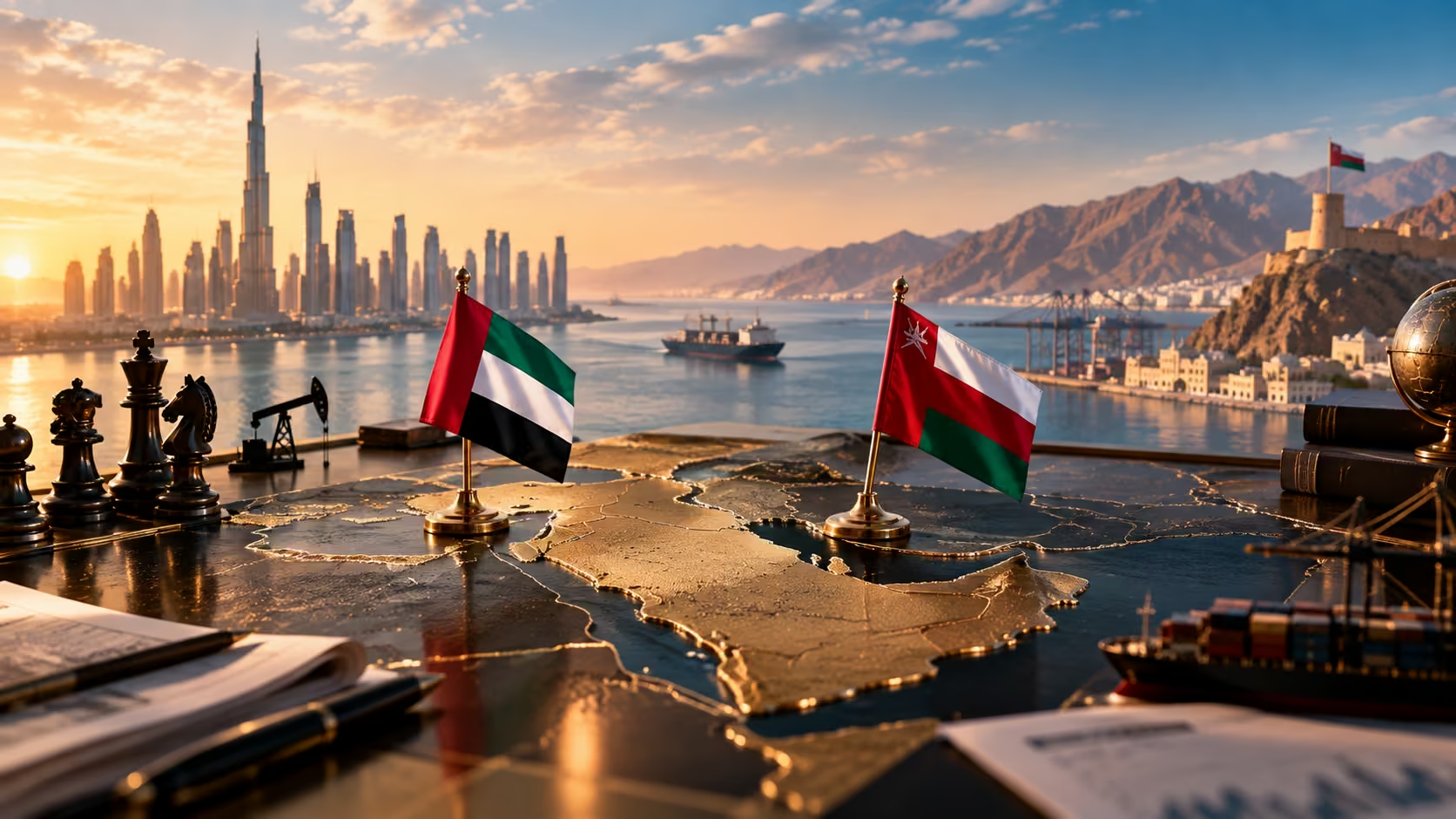
For decades, oil has shaped not only the Middle East’s economy but also part of its balance of power. But now, a major question is emerging: If the world eventually needs less oil, what will happen to the power of the Gulf states?
The transition to new energy sources, the growth of technology and artificial intelligence, massive investment, and shifting global trade routes are redefining what power means in the region. Countries such as the UAE and Oman are trying to build their position in the post-oil era before the age of oil comes to an end.
But this competition is not simply about replacing oil with solar energy or hydrogen. The bigger question is this: Which country can turn today’s oil wealth into tomorrow’s technology, infrastructure, trade, and geopolitical influence?
The UAE is pursuing a path built around capital, technology, and global trade. Oman, meanwhile, is betting on its geographic position, ports, logistics, and new energy sectors. These different strategies raise a shared question:
In a post-oil Middle East, what will determine power?
Why Is the Era of “Oil as Power” Changing?
Oil is not going to disappear overnight. Something more significant is happening: oil is no longer the only resource capable of defining a country’s economic and geopolitical power.
For decades, the economies of the Gulf states have been closely tied to hydrocarbon revenues. These revenues enabled governments to build infrastructure, finance public spending, invest abroad, and expand their regional influence. But as the global economy moves toward low-carbon energy, clean technologies, and greater efficiency, dependence on a single source of revenue is becoming a long-term risk. The International Monetary Fund (IMF) identifies economic diversification as one way Gulf Cooperation Council countries can reduce their vulnerability to oil-market fluctuations.
But this shift is not only about energy.
In the future economy, capital, technology, data, digital infrastructure, ports, supply chains, and the ability to attract foreign investment could become just as important as natural resources. Disruptions to regional energy routes have also shown that control over infrastructure and alternative transportation and export routes can itself become a geopolitical asset.
For this reason, Gulf countries are not simply looking for a “replacement for oil.” They are building a new model of economic power.
The UAE is focusing on technology, investment, a knowledge-based economy, artificial intelligence, and new energy sources. Its science, technology, and innovation policies explicitly aim to prepare the economy for a post-oil world.
Oman, meanwhile, is pursuing a more diversified and sustainable economy under Oman Vision 2040, with technology, knowledge, and innovation at its core. Sectors such as logistics, investment, industry, and renewable energy are central to this transformation.
Therefore, the main question is no longer “When will oil run out?”
The real question is: Before oil loses the importance it once had, which country can transform today’s resources and revenues into tomorrow’s economic power?
The answer takes us to the heart of the Gulf’s new competition, where energy is no longer just a commodity but part of a much larger contest for capital, technology, and regional influence.
How Will Middle Eastern Geopolitics Change After Oil?
If oil is no longer the region’s only source of power, what will replace it?
The answer is not simply “renewable energy.” In the Middle East of the future, capital, technology, ports, supply chains, digital infrastructure, and new energy sources could become just as geopolitically important.
For decades, the power of the Gulf states was largely tied to their oil reserves and exports. But in the new economy, a country that can produce affordable energy, attract capital, develop technology, and remain connected to major global trade routes can preserve its influence even as its dependence on oil declines.
This is why ports and geographic position are gaining new importance. Oman, with access to the Arabian Sea and Indian Ocean, and the UAE, with its extensive global trade and international infrastructure networks, are both leveraging their advantages to establish a stronger position in the post-oil economy.
As a result, the Gulf’s future competition will not be solely about energy. It will be about turning energy, capital, and geography into economic and geopolitical power.
And the UAE is one of the clearest examples of this transformation—a country seeking to turn its oil revenues into capital for building the economy of the future.
The UAE: Turning Oil Revenues into Economic and Technological Power
The UAE understood early on that its future economic power could not come solely from oil wells. As a result, the country’s strategy has moved beyond simply “replacing oil” toward transforming oil wealth into new forms of economic assets.
Global trade, financial services, tourism, logistics, technology, and foreign investment now form a significant part of the UAE’s economic model. The government is also pursuing its “We the UAE 2031” vision, which aims to double GDP from AED 1.49 trillion to AED 3 trillion while focusing on economic development, investment, and growth.
But perhaps the most interesting part of this strategy is technology.
Through its UAE National Strategy for Artificial Intelligence 2031, the country aims to become one of the world’s leaders in AI, with a focus on data infrastructure, specialized talent, research, and the use of AI across sectors such as energy, logistics, and tourism.
This means the UAE does not want to be merely a consumer of technology; it wants to control a meaningful part of the value chain of the digital economy.
If this strategy succeeds, oil will not simply have been a source of revenue for the UAE. It will have served as capital that helped build a new economy.
And this raises an even bigger question: Can artificial intelligence and technology play the same role in the UAE’s future power that oil played in its past?
Artificial Intelligence: The UAE’s New Oil?
If oil helped build the UAE’s economic infrastructure in the last century, perhaps artificial intelligence could become part of the infrastructure of its future power.
The UAE began investing in AI years ago and, through its National Strategy for Artificial Intelligence 2031, has set the goal of becoming one of the global leaders in the field. The strategy goes beyond simply adopting AI; it also focuses on developing talent, building data infrastructure, supporting research, and creating a broader AI ecosystem.
The importance of this becomes clearer when AI is viewed as more than just a technology.
Advanced chips, data centers, affordable electricity, capital, and access to technology companies are all becoming components of a new chain of economic power. The UAE has also pursued international cooperation on AI and technology infrastructure to expand its access to advanced technologies.
Therefore, the UAE’s goal is not simply to build a few artificial intelligence companies. It is to create a technology ecosystem capable of attracting capital, specialized talent, and global companies.
If this model succeeds, the UAE could evolve from an economy largely supported by energy revenues into one that derives part of its economic power from computing, data, and technology.
But technology is only one side of this transformation. For Oman, the key advantage may lie somewhere else: geography.
Oman: Power That Comes From Geography
While the UAE is trying to build its position in the future economy through capital and technology, Oman is betting on a different asset: geography.
Oman’s location along the Arabian Sea and the Indian Ocean makes it an important connection point between the Gulf and the markets of Asia, Africa, and major global trade routes. This is why ports and logistics are not simply another industry in Oman’s economic strategy; they are part of a broader effort to turn the country’s geographic position into economic value.
This approach is also reflected in Oman Vision 2040, where economic diversification, private-sector development, higher exports, and the strategic use of Oman’s geographic position are being pursued alongside technology and innovation.
But Oman is not relying on logistics alone. Investment in solar energy, green hydrogen, industry, mining, and technology shows that the country wants to move from being a resource exporter toward becoming a new economic and energy hub. Official Oman Vision 2040 reports also point to the growth of green hydrogen projects and investment in sectors such as logistics, clean energy, and technology.
As a result, Oman’s biggest advantage may be something that cannot be extracted: a geographic position that, when combined with infrastructure and new energy, can be transformed into economic power.
Green Hydrogen: Oman’s Advantage in the Post-Oil Economy
For Oman, green hydrogen is not simply an environmental project; it is an attempt to build a new export industry.
With abundant solar radiation, wind resources, and access to deep-water ports, Oman has favorable conditions for producing hydrogen and its derivatives. The government is also pursuing the sector within the framework of Oman Vision 2040 as one of the pillars of economic diversification.
This strategy is no longer merely on paper. Hydrom, Oman’s central entity for the green-hydrogen sector, has moved the program into land allocation and project development. Delivery will still depend on financing, buyers, infrastructure, and execution.
But the real significance of these projects lies in where the energy could go.
If Oman can export green hydrogen and green ammonia through its ports to markets in Europe and Asia, the same geographic position that once mattered for oil trade could become an advantage in the future energy economy as well.
In that scenario, Oman would not simply be an exporter of an energy resource. It could become part of the global clean-energy value chain.
And this is precisely where new energy can become geopolitical power.
Investment: The New Oil of the Gulf?
If oil has been the source of wealth for the Gulf, capital could become the tool for building the post-oil economy.
Over the past several decades, GCC countries have invested a significant share of their energy revenues through sovereign wealth funds in domestic and global markets. Today, these funds are no longer focused solely on preserving wealth for future generations. They are also moving into technology, services, clean energy, infrastructure, and emerging industries.
Oman is an interesting example of this shift. The Oman Future Fund targets investments in sectors such as manufacturing, mining, clean energy, tourism, information technology, and logistics. Its goal is to strengthen the private sector and non-oil economy by attracting foreign investment and facilitating technology transfer.
But capital alone is not enough.
If capital is used only to build large-scale projects, the economy may remain dependent on government resources. The real goal should be to build companies, industries, and technologies capable of generating revenue and exports even without oil.
That is why the Gulf’s future competition is not simply about the amount of capital available. It is about which country can transform capital more effectively into sustainable economic power.
Oman and the UAE: Two Different Paths to the Post-Oil Economy
Both Oman and the UAE understand that the Gulf economy cannot remain dependent on oil forever. But they have chosen different paths toward that future.
The UAE has focused more heavily on capital, trade, technology, and the digital economy. It is seeking to establish itself as a hub for investment, business, and advanced technologies.
Oman, meanwhile, is relying more heavily on geography, logistics, industry, and new energy. The development of ports and economic zones, green hydrogen, manufacturing, and trade are among the sectors at the center of its diversification strategy. The IMF also identifies logistics and improved trade connectivity as important drivers of higher non-hydrocarbon exports in Oman.
In other words, if the UAE wants to become a hub for capital and technology, Oman is seeking to become a hub for trade, logistics, and the energy of the future.
But neither country has reached its final destination. Even the growth of non-oil sectors does not automatically mean that an economy has moved beyond oil. Oman is a clear example of how an economy can become more diversified while government revenues remain heavily dependent on hydrocarbons.
Therefore, the key question is no longer which country has built more projects. It is which model can ultimately create a truly independent, competitive, and export-oriented economy.
And this is where the biggest challenge of the post-oil era becomes clear: building a non-oil economy is easier than making it independent of oil.
What Is the Biggest Challenge for the Post-Oil Economy?
Building a non-oil economy on paper is not particularly difficult. The real challenge is creating an economy that can compete without oil.
Gulf countries have made significant progress in developing non-oil sectors. But IMF analysis emphasizes that genuine diversification requires more than growth in sectors such as tourism, construction, or services. Economies also need to increase non-oil exports, productivity, and high-value-added activities.
This challenge is particularly important for Oman. IMF analysis indicates that a significant share of Oman’s non-hydrocarbon activity remains concentrated in lower-value-added sectors. Achieving sustainable growth will require more sophisticated exports, higher productivity, and structural reforms.
The UAE, despite the strong performance of its non-oil economy, also faces the challenge of maintaining its competitive advantage against other economic hubs across the region.
Therefore, success in the post-oil era should not be measured by the number of projects or the volume of investment. The real measure is whether these investments can create competitive companies, sustainable exports, and revenue streams that are independent of oil.
And this brings us to the final question: Can the Gulf truly preserve its economic and geopolitical power without relying on oil?
The Future of Middle Eastern Geopolitics After Oil
It may be a mistake to assume that as the world becomes less dependent on oil, the Gulf’s importance will also decline. What is changing is the source of power—not necessarily power itself.
Gulf countries still benefit from oil revenues and oil-based infrastructure, but at the same time, they are transforming these advantages into new assets: the UAE is focusing on technology, capital, and global trade, while Oman is emphasizing logistics, ports, and green hydrogen.
Disruptions to energy routes have also shown the growing importance of infrastructure and trade corridors. To reduce vulnerability around the Strait of Hormuz, regional countries have paid greater attention to alternative routes, ports, and new infrastructure.
But winning in the post-oil era will not simply come from building large-scale projects. The more successful country will be the one that can turn capital into companies, technology into products, clean energy into exports, and geography into trade. Research on Gulf economies also shows that a stronger private sector, higher productivity, and greater non-oil exports are critical to achieving meaningful diversification.
Therefore, the future of Middle Eastern geopolitics will probably not belong to the country that simply has the most oil. It will belong to the country that makes the best use of its oil-era wealth to build the economy of the post-oil era.
Oil may remain part of the Gulf’s power for many years to come. But the real competition has already begun over something beyond oil:
Who can move from “power beneath the ground” to “power in the economy of the future”?
.avif)